
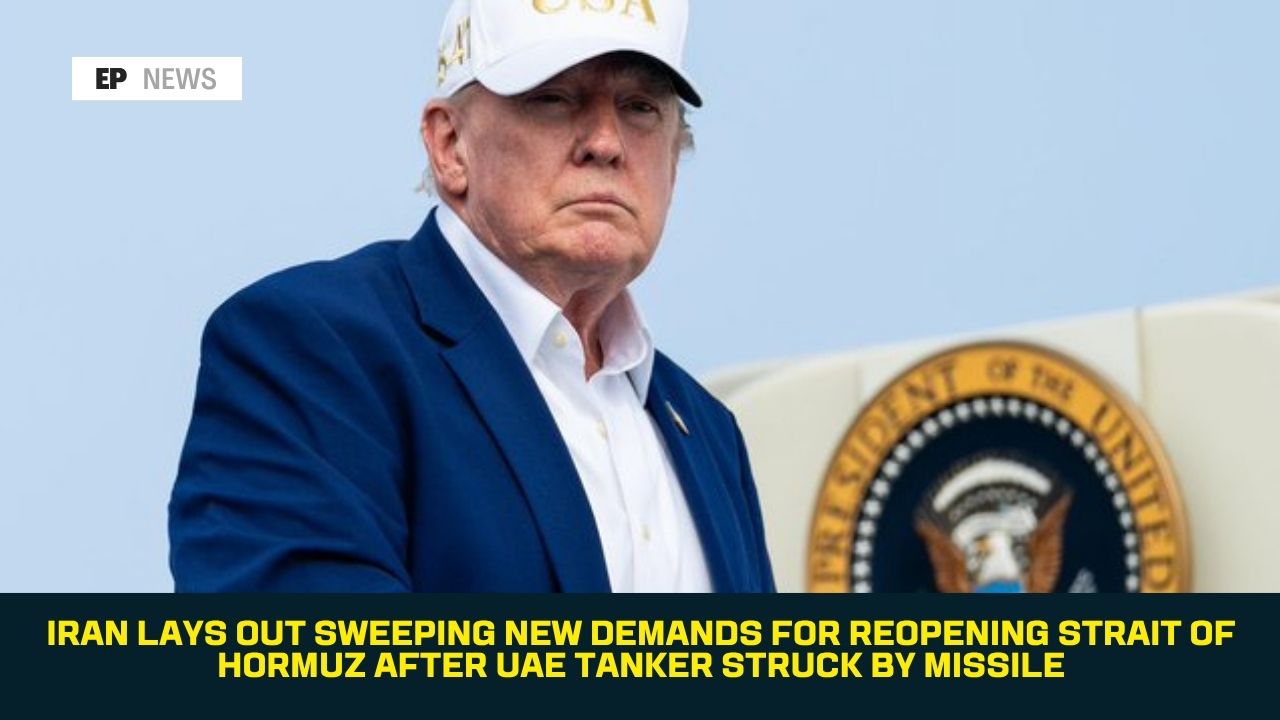
Iran Lays Out Sweeping New Demands for Reopening Strait of Hormuz After UAE Tanker Struck by Missile
Iran’s Supreme National Security Council issued a new set of sweeping demands Saturday, August 8, for reopening the Strait of Hormuz — insisting the United States must lift its naval blockade, withdraw military forces from the region, and pay war reparations before the critical shipping waterway reopens. The announcement came hours after the United Arab Emirates said an oil tanker affiliated with its state oil company was struck by a missile while transiting the strait.
What Iran Is Demanding
Mohammad Bagher Zolghadr, secretary of Iran’s Supreme National Security Council, said Saturday that reopening the strait would require Washington to lift its naval blockade and sanctions, withdraw U.S. military forces from the region, pay war reparations, and release frozen Iranian assets, according to media reports relayed by CNBC. The council also called for an end to U.S. attacks on Iran’s regional allies and to threats against Iran itself. CNBC noted it had not independently verified these specific demands beyond the media reports describing them.
The Associated Press, in reporting carried by NBC News, characterized the statement as declaring that the Strait of Hormuz will not open until the United States “corrects its behavior” — new demands the AP said could shake up ongoing talks around a deal to manage the waterway and the traffic passing through it.
The Tanker Strike That Preceded the Announcement
Iran’s statement came shortly after the Abu Dhabi National Oil Company, known as ADNOC, said one of its vessels was targeted by a missile while transiting the Strait of Hormuz earlier that same day. ADNOC said in a statement that the incident “resulted in no injuries, and the situation has been brought under control,” according to CNBC.
The United Arab Emirates responded forcefully. In a post on X, the UAE said it “condemns in the strongest terms the targeting of an ADNOC-affiliated tanker while it was passing through the Strait of Hormuz.” According to CNN’s live coverage of the day’s developments, the UAE’s foreign ministry and the Gulf Cooperation Council explicitly blamed Iran for the attack.
A Separate, More Promising Track: The Iran-Oman Negotiations
Even as Iran’s demands toward Washington hardened, a parallel diplomatic track between Iran and Oman appeared to be making genuine progress. Iranian Foreign Minister Abbas Araghchi said Saturday that Iran and Oman — which both border the strait — were close to reaching an agreement on navigation, “specifically the determination of a transit route,” according to the Associated Press.
CNN’s coverage detailed the emerging framework: under the proposed Iran-Oman agreement, vessels would transit the strait via a temporary route until the two countries agreed on a new route to replace the historic “Traffic Separation Scheme” that ships used before the war began. Araghchi described establishing that new route as involving “extensive technical and legal complexities.”
Oman’s Ministry of Foreign Affairs described the negotiations as “positive and constructive” on Saturday, but cautioned that continued Iranian attacks on vessels — like the strike on the ADNOC tanker earlier that same day — threatened to undermine the progress being made, according to CNN.
Why a Deal With Oman Wouldn’t Fully Resolve the Crisis
It’s important to understand what an Iran-Oman agreement would and wouldn’t accomplish. CNN’s reporting was explicit on this point: a deal between Iran and Oman managing navigation through the strait does not mean the waterway will actually reopen, since Tehran has separately said it requires a number of guarantees specifically from the United States before it will allow vessels to transit freely — the demands laid out by the Supreme National Security Council. In effect, the Oman track addresses the technical and logistical mechanics of how ships could eventually move through the strait, while the U.S.-facing demands address the underlying political conditions Iran says must be met before that mechanism is actually activated.
Vice President JD Vance addressed the dual-track negotiations, according to CNN, saying Iran and Oman are working toward “a traffic scheme so that the ships that pass can pass through safely,” and that any deal would require a commitment from Iran not to fire at commercial vessels — a direct reference to the pattern of attacks, including Saturday’s strike on the ADNOC tanker, that have continued even as negotiations proceed.
The Scale of the Ongoing Disruption
Independent tracking data underscores just how severe the disruption to shipping through the strait has become. According to Strait of Hormuz Closed, a live tracking site monitoring transit data, the strait was effectively closed to commercial shipping as of August 9, with only 2 ships transiting on August 2 compared to a pre-crisis baseline of roughly 73 per day. The same tracker put Brent crude at $83.55 per barrel, with the site’s escalation and crisis-pressure indices both registering in their most severe bands.
The Strait of Hormuz carries close to a fifth of the world’s oil supply under normal conditions, making sustained disruption to transit a matter of significant concern for global energy markets well beyond the immediate region.
FAQ
What is Iran demanding before it will reopen the Strait of Hormuz? According to Iran’s Supreme National Security Council, the U.S. must lift its naval blockade and sanctions, withdraw military forces from the region, pay war reparations, release frozen Iranian assets, and end attacks on Iran’s regional allies.
What happened to the UAE tanker? An Abu Dhabi National Oil Company vessel was struck by a missile while transiting the Strait of Hormuz on August 8. ADNOC said no injuries resulted and the situation was brought under control; the UAE and the Gulf Cooperation Council blamed Iran for the attack.
Is Iran close to a deal with Oman on the strait? Iran’s foreign minister said the two countries were close to an agreement on a temporary transit route, though Oman cautioned that continued Iranian attacks on vessels threatened that progress.
Would an Iran-Oman deal reopen the strait? Not on its own. Iran has said reopening the strait to free passage still requires separate guarantees from the United States, meaning an Oman agreement would address navigation logistics without resolving the underlying political conditions Iran has attached to full reopening.
How much shipping is currently passing through the strait? According to independent tracking data, only about 2 ships transited on August 2, compared to a pre-crisis daily average of roughly 73 — indicating the strait remains effectively closed to normal commercial traffic.
Conclusion
Saturday’s developments capture the split-track nature of the ongoing Strait of Hormuz crisis: genuine, if fragile, technical progress in talks between Iran and Oman, running alongside a hardening set of political demands aimed squarely at Washington — all while attacks on commercial vessels, like Saturday’s strike on the ADNOC tanker, continue to occur in the strait itself. With shipping data showing the waterway still effectively closed to normal traffic, the gap between “a transit route is being negotiated” and “the strait is actually reopened” remains significant, and likely to stay that way until Iran’s demands toward the U.S. are addressed in some form.
Sources: CNBC, NBC News/Associated Press, CNN, The Intelligencer, Strait of Hormuz Closed live tracker (reporting dated August 8-9, 2026).