
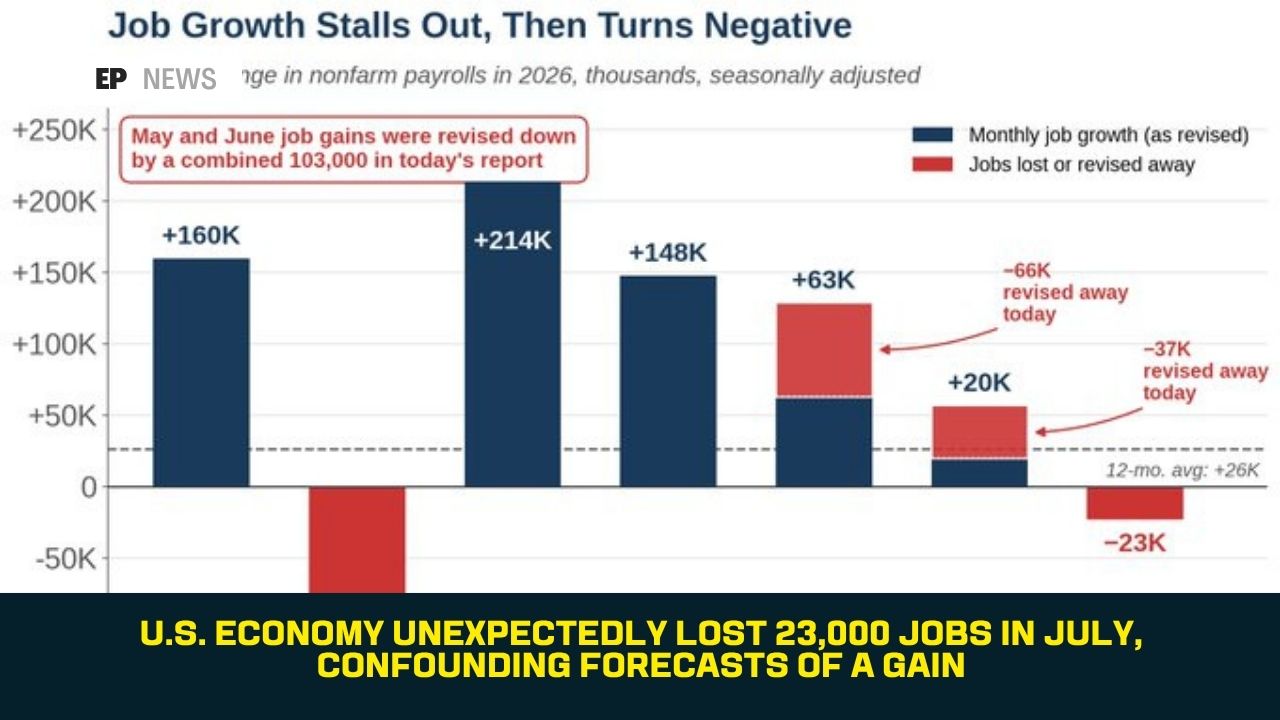
U.S. Economy Unexpectedly Lost 23,000 Jobs in July, Confounding Forecasts of a Gain
The U.S. economy shed 23,000 nonfarm payroll jobs in July, the Bureau of Labor Statistics reported Friday, August 7 — a sharp reversal from economists’ expectations of solid job gains and the first outright payroll decline in months, even as the unemployment rate ticked down in the same report.
What the Report Actually Showed
Total nonfarm payroll employment “changed little” in July, falling by a seasonally adjusted 23,000, according to the BLS’s official Employment Situation Summary. That compares to an average monthly gain of 34,000 over the prior 12 months, and stands in sharp contrast to what forecasters had been expecting: economists surveyed by the Wall Street Journal had projected a gain of roughly 83,000 jobs, while a separate Barron’s consensus put the figure at 95,000, and Econoday’s survey of analysts anticipated 88,000. Every one of those forecasts missed in the same direction, by a wide margin.
The unemployment rate, meanwhile, moved in the opposite direction from what the headline payroll number might suggest — falling to 4.1% in July, down from 4.2% in June, according to the BLS.
Why the Numbers Look Contradictory
The combination of falling payrolls and a falling unemployment rate isn’t as reassuring as it might initially appear, and multiple outlets were quick to unpack why. According to CNBC’s analysis, the drop in the unemployment rate was due largely to a further decline in the number of people either holding jobs or actively looking for work, rather than more people finding employment. The labor force participation rate fell to 61.4% in July, down from 61.5% the month before — a level the BLS noted hadn’t been seen in over five years, and one that reflects people leaving the labor force rather than a healthier job market.
CNBC’s own breakdown of the report described the headline payroll number as “misleading” in the opposite direction as well: the primary driver of the 23,000 decline was a loss of 53,000 government jobs, which economists said was largely attributable to seasonal factors that could ultimately be revised away in future updates. Private payrolls, by contrast, actually rose by 30,000 during the month — meaning the private-sector labor market showed modest growth even as the government component dragged the headline figure into negative territory.
Where the Losses and Gains Occurred
According to the BLS report, local government education led the declines, shedding 50,000 jobs, while retail trade lost 19,000 positions, concentrated mostly among warehouse clubs, supercenters, and other general merchandise retailers, which alone lost 21,000 jobs. Trading Economics had actually forecast healthcare to lead job growth in July alongside a rebound in leisure and hospitality — expectations that didn’t materialize in the way anticipated, based on the overall weak result.
Wages Barely Moved
Worker pay showed almost no growth in July. Average hourly earnings for all private-sector employees rose by just 2 cents to $37.62, according to Quartz’s reporting on the BLS data, bringing the 12-month wage growth rate down to 3.2% — the lowest pace since May 2021, according to CNBC, and below the 3.5% economists had forecast. The average workweek held steady at 34.3 hours.
Sizable Downward Revisions to Prior Months
Beyond July’s own weak showing, the report included substantial downward revisions to the two preceding months. May’s job gain was revised down by 66,000, from an originally reported 129,000 to just 63,000. June’s figure was revised down by 37,000, from 57,000 to just 20,000. Combined, those two revisions mean the U.S. economy added 103,000 fewer jobs over May and June than previously reported — compounding the sense that the labor market has been considerably weaker in recent months than earlier data suggested.
Other Notable Details in the Report
A few additional figures from the report stood out. The number of people on temporary layoff rose by 153,000 to 921,000 in July, according to Quartz. Long-term unemployment — defined as joblessness lasting 27 weeks or more — edged down slightly to 1.8 million, but still accounted for 25.5% of all unemployed people, according to the BLS’s detailed report. The BLS also noted that October 2025 data collection had been affected by a federal government shutdown, a reminder of ongoing disruptions to the data collection process over the past year.
What This Means for the Federal Reserve
The report lands at a particularly sensitive moment for Federal Reserve policy. CNBC noted that Fed policymakers have been split on where interest rates should head, with the labor market having been gradually improving from a weak 2025 while inflation has remained persistently above the central bank’s 2% target. In recent days, several Fed officials had spoken in favor of potentially raising rates as soon as September if inflation doesn’t ease — a debate that played out publicly at the Fed’s late-July meeting, where the Federal Open Market Committee voted 9-3 to hold its benchmark rate steady, with three regional bank presidents dissenting in favor of a hike.
Fed officials have historically placed more weight on the unemployment rate than on month-to-month payroll fluctuations, according to CNBC — meaning July’s declining unemployment rate could complicate the case for a near-term hike, even as the weak payroll and wage figures point toward a softening labor market that might argue against tightening policy further.
Vanguard economists, writing ahead of the report based on their own 401(k) contribution data, had already flagged concern about a softening labor market, projecting a July payroll gain of just 18,000 and warning of “the risk that this weakness will extend into autumn.” They specifically attributed declining labor force participation to lackluster hiring that has been “particularly challenging for younger workers,” and predicted that as sidelined workers eventually re-enter the labor force, the unemployment rate could actually face upward pressure in the months ahead as those returning workers outpace available job openings.
FAQ
How many jobs did the U.S. economy add or lose in July 2026? The economy lost 23,000 jobs, according to the Bureau of Labor Statistics — a sharp miss against economist forecasts that had ranged from roughly 80,000 to 95,000 in job gains.
Why did the unemployment rate fall if the economy lost jobs? The rate fell to 4.1% largely because labor force participation declined further, meaning fewer people were counted as either employed or actively looking for work — not because more people found jobs.
What drove the payroll decline specifically? A loss of 53,000 government jobs, primarily in local government education, was the main driver. Private-sector payrolls actually rose by 30,000 during the month.
Were prior months’ job figures revised? Yes, significantly. May’s gain was revised down from 129,000 to 63,000, and June’s was revised down from 57,000 to 20,000 — a combined 103,000 fewer jobs than previously reported.
How does this affect the Federal Reserve’s next interest rate decision? It creates a mixed signal. Some Fed officials have favored a possible rate hike in September if inflation doesn’t ease, but the weak payroll and wage data in this report could complicate that case, even as the falling unemployment rate offers a partially offsetting signal.
Conclusion
July’s jobs report delivered a genuine surprise, confounding forecasts across every major Wall Street estimate and revealing a labor market that looks considerably weaker beneath the headline numbers than the declining unemployment rate alone would suggest. Between the substantial downward revisions to May and June, near-stagnant wage growth, and a labor force participation rate at a five-year low, this report gives the Federal Reserve a genuinely complicated picture to weigh heading into its September meeting — one where neither a rate hike nor continued patience has an obviously clean case behind it.
Sources: U.S. Bureau of Labor Statistics, CNBC, Quartz, UPI, Trading Economics, Kiplinger (reporting dated August 7, 2026).