
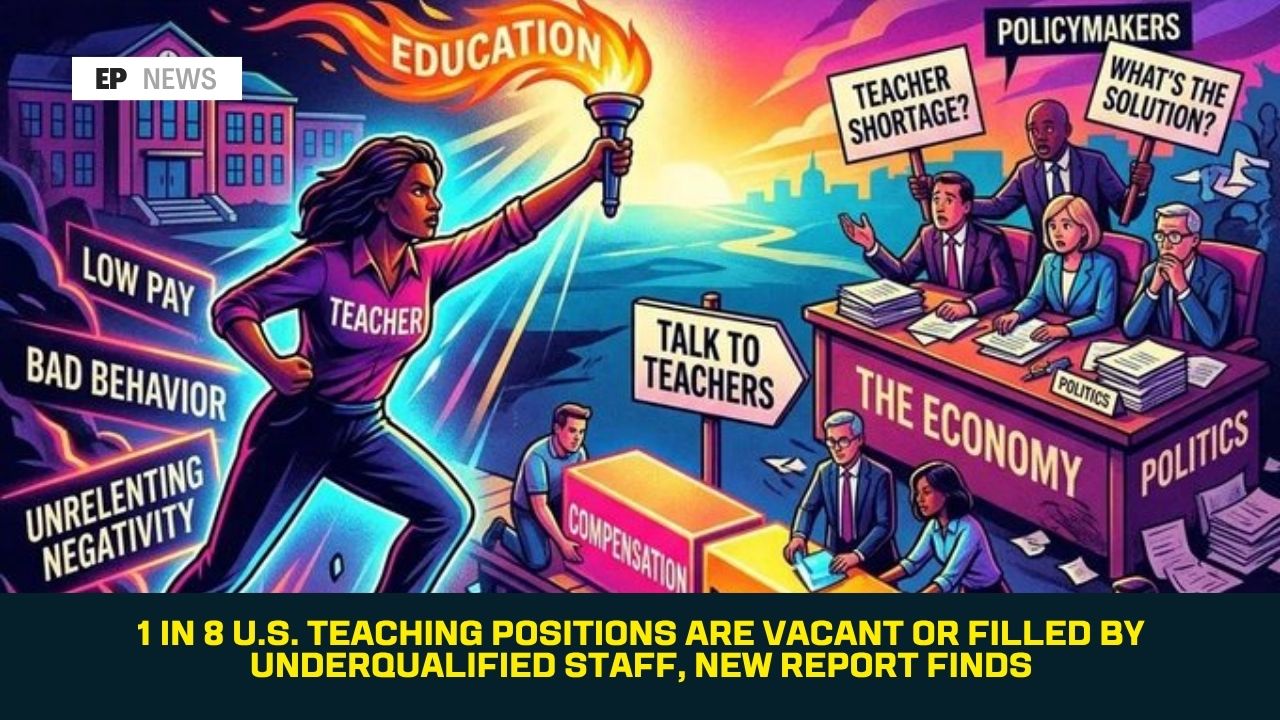
1 in 8 U.S. Teaching Positions Are Vacant or Filled by Underqualified Staff, New Report Finds
As the 2026-27 school year begins across the country, a new analysis from the Learning Policy Institute finds that at least 425,412 teaching positions nationwide are either sitting vacant or being filled by teachers who aren’t fully certified for their assignments — roughly one in eight of all teaching positions in the United States.
What the New Data Shows
According to the Learning Policy Institute’s most recent 2026 scan, all 50 states plus the District of Columbia reported employing an estimated 387,843 teachers who were not fully certified for their current teaching assignments. Separately, 29 states plus D.C. published vacancy data showing 37,569 unfilled teaching positions. Combined, those two figures — uncertified teachers plus outright vacancies — total at least 425,412 positions affected, representing roughly one in eight teaching jobs nationally.
The Institute was careful to note that this figure likely understates the true scope of the problem, since some states didn’t report the relevant data at all, and other states’ figures reflected only a subset of schools or teaching positions rather than the full picture statewide.
Where the Shortages Are Worst
The shortage isn’t evenly distributed across subjects or regions. According to reporting from Edustaff based on federal data submitted by states for the 2024-25 school year, every single state and the District of Columbia reported shortages in multiple subject areas. The most commonly cited shortage areas were special education, science, and mathematics — fields that have faced persistent staffing gaps for decades. The largest overall concentrations of shortage positions, measured by vacancies, temporary certifications, and out-of-field assignments combined, were in special education, elementary education, language arts, and career and technical education.
A separate tracking effort, the US Teacher Shortage project, estimated for the 2025-26 school year that there are at least 56,000 vacant positions and 350,000 underqualified positions nationwide, while also noting stagnation in enrollment for teacher certification programs across most states — a warning sign that the pipeline feeding new teachers into the profession isn’t growing to meet ongoing demand.
Rural districts face particular challenges, according to Edustaff’s analysis, citing smaller local tax bases, geographic isolation from teacher preparation programs, and fewer local recruitment options as factors that contribute to higher vacancy rates and greater reliance on out-of-field teaching in those communities.
Why the Shortage Persists: Two Compounding Problems
Education researchers point to two interlocking causes behind the ongoing shortage. The first is a weakened pipeline of new teachers entering the profession. According to the Learning Policy Institute, interest in teaching among college students has been declining since the turn of the century and has fallen, over the past decade, to its lowest level in 50 years. Nationally, enrollment in teacher preparation programs dropped sharply by about 100,000 candidates between 2012-13 and 2014-15 and has remained relatively stable — meaning depressed — since then.
The second, larger driver is attrition among teachers already in the profession. The Learning Policy Institute found that attrition accounts for roughly 90% of annual new teacher demand nationally, and that nearly three in four teachers (74%) who left teaching or moved schools did so voluntarily, for reasons unrelated to retirement. Among those who left the profession, commonly cited reasons included pursuing other careers, seeking higher salaries, and general dissatisfaction with teaching as a career.
A Veteran Administrator’s Perspective on How Much Has Changed
A Washington Post opinion piece published this week, written through The Hechinger Report, offered a striking before-and-after comparison from one former Chicago assistant principal’s experience. In the late 1990s, posting a job opening for a physics teacher might draw 20 applications, while an opening for an English teacher could draw 150. Today, according to the same piece, administrators often consider themselves fortunate to receive even one or two qualified candidates for an opening — illustrating just how dramatically the applicant pool has shrunk over roughly a quarter-century.
Some Signs of Local Progress
Not every state’s trend line is worsening. Florida, historically one of the states with the most severe teacher shortages, has shown meaningful improvement in recent years. According to Teachers of Tomorrow’s analysis, the Florida Department of Education reported a 17.7% reduction in teacher vacancies for the 2025-26 school year compared to the prior year, representing an almost 30% decrease over two years — down from more than 7,000 vacancies in 2023 to about 3,000 by early 2025.
That improvement comes with an important caveat, however. The Florida Education Association has warned that many classrooms in the state still lack certified, permanent teachers, and has attributed part of the apparent decline not just to genuinely improved hiring, but also to budget cuts and staffing reductions that lean more heavily on uncertified educators to fill classroom roles — meaning some of the reported “improvement” may reflect a shift in how gaps are being filled rather than a full resolution of the underlying shortage.
Why This Matters Beyond Staffing Numbers
The practical consequences of unfilled or under-qualified teaching positions extend well beyond administrative spreadsheets. According to Edustaff, when districts can’t fill classrooms with fully prepared teachers, they frequently resort to larger class sizes, long-term substitute teachers, or outright course cancellations. High staff turnover also disrupts school communities and diverts resources away from direct instruction and student support services toward continual recruitment and training efforts.
What Researchers Say Needs to Happen
The Learning Policy Institute and other researchers have pointed to several priorities for addressing the shortage going forward, according to Edustaff’s summary of recommended policy directions: expanding affordable, high-quality pathways into teaching, including residency programs and “grow-your-own” initiatives designed to reduce financial barriers to entering the profession; strengthening mentoring and induction support systems so new teachers receive sustained guidance during their most vulnerable early years in the classroom; and improving compensation and working conditions to address the root causes driving experienced teachers to leave the profession voluntarily.
FAQ
How many teaching positions are currently affected by the shortage? At least 425,412 positions nationwide are either vacant or filled by teachers not fully certified for their assignments, according to the Learning Policy Institute’s 2026 analysis — roughly one in eight of all teaching positions in the country.
Which subjects face the most severe shortages? Special education, science, and mathematics are the most commonly cited shortage areas nationally, with special education, elementary education, language arts, and career and technical education showing the largest overall concentrations of shortage positions.
What’s driving the shortage? Two main factors: declining interest in teaching as a career among college students, which has fallen to a 50-year low, and high attrition among current teachers, which accounts for roughly 90% of annual new teacher demand.
Is the shortage getting better anywhere? Some states, like Florida, have reported reduced vacancy numbers in recent years, though advocacy groups caution that part of that improvement may reflect increased reliance on uncertified staff rather than a full resolution of underlying shortages.
How does this affect students directly? Unfilled or underqualified teaching positions can lead to larger class sizes, more reliance on long-term substitutes, and course cancellations, along with disruption to school communities from high staff turnover.
Conclusion
As millions of students head back to classrooms this month, the teacher shortage documented in this new report isn’t a temporary, pandemic-era anomaly — it’s the product of decades-long declines in interest in the profession, compounded by persistently high attrition among teachers already on the job. With enrollment in teacher preparation programs still stagnant and roughly one in eight positions nationally affected, researchers say meaningful improvement will likely require sustained investment in both recruitment pipelines and the working conditions that determine whether teachers stay in the classroom once they get there.
Sources: Learning Policy Institute, Edustaff, The Washington Post/The Hechinger Report, Teachers of Tomorrow, US Teacher Shortage project (reporting dated July-August 2026).