
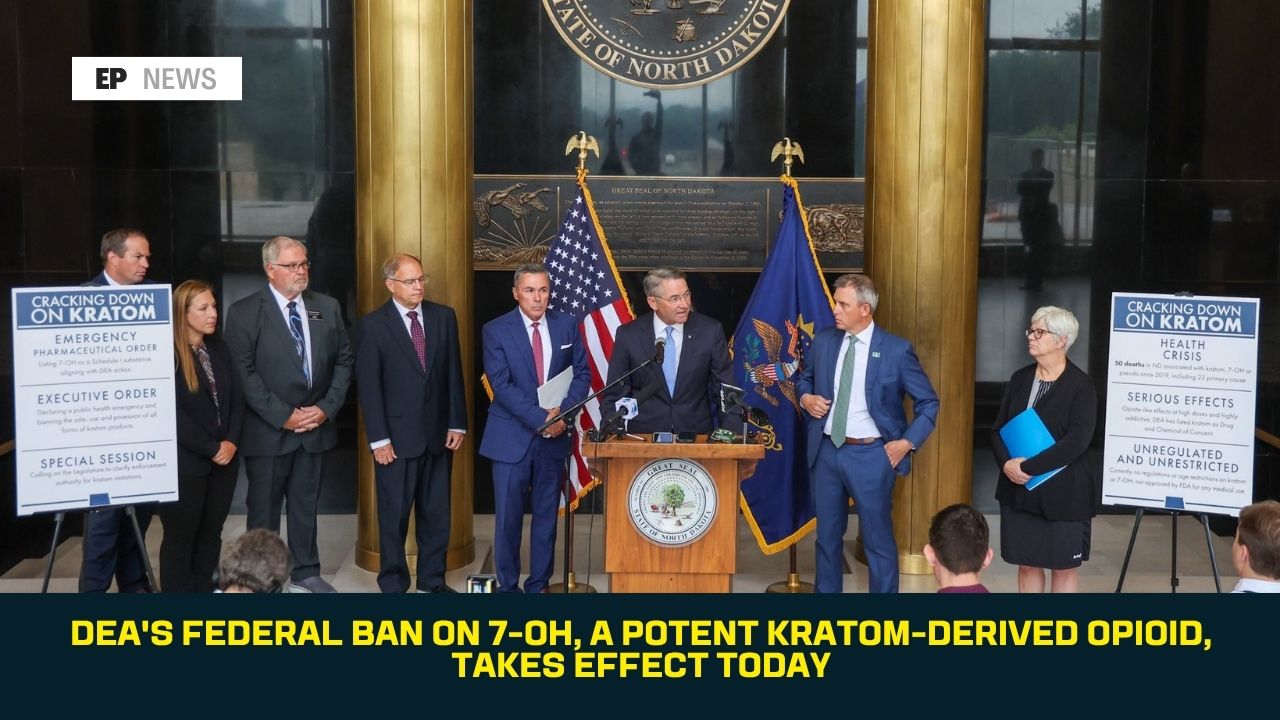
DEA’s Federal Ban on 7-OH, a Potent Kratom-Derived Opioid, Takes Effect Today
A federal ban on concentrated forms of 7-hydroxymitragynine, commonly known as “7-OH” — a synthetic compound derived from the kratom plant that doctors say can be five to 15 times more potent than morphine — takes effect Wednesday, August 5, 2026, classifying it as a Schedule I controlled substance alongside heroin and LSD.
What’s Actually Being Banned
The Drug Enforcement Administration filed two separate notices of intent on July 1, 2026, both published in the Federal Register on July 6. The first targets 7-OH itself: any product containing a concentration of 7-hydroxymitragynine above 0.05% by dry weight in botanical materials, or above either 0.05% by weight/volume or 1 milligram in processed extracts, concentrates, edibles, and pills, will now fall under Schedule I control, according to Congress.gov’s Congressional Research Service summary.
The second notice applies the same Schedule I classification to three related synthetic compounds: mitragynine pseudoindoxyl (MP), dihydro-7-hydroxymitragynine (MGM-15), and a fluorinated variant known as MGM-16. Unlike the 7-OH scheduling, the ban on these three related substances applies without a minimum threshold — any amount is now controlled, according to Congress.gov.
Notably, the DEA specifically justified including MGM-16 even though it hasn’t yet found evidence of the compound being sold to consumers, stating that scheduling MGM-15 without MGM-16 “would create a regulatory loophole that manufacturers are already poised to exploit,” according to the same CRS report.
Why the DEA Is Acting Now
The scheduling decision follows growing alarm from doctors and poison control centers about a sharp rise in severe cases tied to 7-OH products. Dr. John Downs, director of the Virginia Poison Center at Virginia Commonwealth University, described the substance’s potency starkly in comments to WDBJ: “We’re talking about something that I’ve seen anywhere between maybe 5 and 15 times more potent than morphine.”
The federal government’s own health assessment backs up that concern. According to Legis1’s reporting, the National Institute on Drug Abuse has said 7-OH can cause opioid-like respiratory depression — the same mechanism that makes opioid overdoses potentially fatal — that can be reversed with naloxone, unlike mitragynine or raw kratom leaves, which have not shown the same effect. The Department of Health and Human Services separately told the DEA it had no objection to the temporary scheduling and found that synthetic 7-OH and its related compounds have no accepted medical use and a high potential for abuse.
Data cited in the DEA’s own Federal Register filing found that of documented case reports involving 7-hydroxymitragynine toxicity through 2019, 55 were fatal and 30 were non-fatal, spanning both male and female patients with a median age of 36.
How 7-OH Differs From Traditional Kratom
Kratom itself — the plant from which 7-OH is derived — remains legal at the federal level and is not covered by this scheduling action. The distinction matters: 7-hydroxymitragynine occurs naturally in kratom leaves only in negligible amounts, according to Nutritional Outlook. The products targeted by this ban involve synthetically concentrated or chemically altered versions of the compound, often marketed in high-potency supplements, extracts, and beverages that bear little resemblance, in terms of potency, to traditional kratom leaf products.
That distinction has made public health assessment more complicated, since 7-hydroxymitragynine is also a known metabolite the body produces when processing ordinary mitragynine — meaning it can be difficult to distinguish exposure to concentrated 7-OH products from the body’s own natural processing of regular kratom, according to the DEA’s Federal Register filing.
The Path to This Point
The scheduling action wasn’t sudden. The FDA formally recommended Schedule I classification for concentrated 7-OH products to the DEA back on July 29, 2025, according to Restoration Recovery’s tracking of the regulatory process. The FDA had also separately warned consumers against 7-OH products in 2025 and sent warning letters to seven companies for illegally marketing them, according to Holland & Knight’s health policy summary.
Congress has also been engaged on the issue. Rep. Gus Bilirakis, R-Fla., introduced the END 7-OH Act, H.R. 8000, on March 19, 2026, which was referred to the House Committees on Energy and Commerce and Judiciary, according to Legis1 — though that legislation remains separate from, and slower-moving than, the DEA’s emergency scheduling action taking effect today.
State governments had already begun acting independently while the federal process played out. Several states, including Tennessee as of July 1, 2026, had already banned 7-OH products under their own kratom statutes ahead of today’s federal action, according to Restoration Recovery.
What This Means Practically
Because the DEA used its emergency, or “temporary,” scheduling authority under 21 U.S.C. 811(h), the agency was able to bypass the standard public comment process typically required for permanent scheduling decisions, according to Legis1. The temporary order takes effect on the date it’s published in the Federal Register and remains in effect for two years, with a possible one-year extension if the DEA pursues permanent scheduling in the meantime, according to Congress.gov.
Once in effect, the scheduling imposes the full range of regulatory controls and administrative, civil, and criminal sanctions that apply to Schedule I substances on anyone who manufactures, distributes, imports, exports, or possesses 7-OH products above the specified threshold, according to the DEA’s own Federal Register notice.
It’s worth noting what the current regulatory action does not resolve: HHS’s more recent involvement, according to Pain News Network, has specifically focused on whether the DEA’s chosen 0.05% threshold is appropriate — not on the broader question of whether 7-OH should ultimately be permanently scheduled, or on the general safety of kratom-derived products more broadly. Those larger questions remain open for future rulemaking.
FAQ
When does the 7-OH ban take effect? August 5, 2026 — the date the DEA’s temporary scheduling order was set to be published in the Federal Register.
Is regular kratom now illegal too? No. This scheduling action targets concentrated, synthetic, or chemically modified forms of 7-hydroxymitragynine and three related compounds. Traditional kratom leaf, where 7-OH occurs only in negligible natural amounts, remains federally legal.
Why is 7-OH considered dangerous? Medical experts say it can be five to 15 times more potent than morphine and can cause opioid-like respiratory depression, the mechanism responsible for opioid overdose deaths. It also carries risks of dependence and withdrawal.
How long will this scheduling order last? The temporary order is set to remain in effect for two years, with a possible one-year extension if the DEA pursues permanent Schedule I classification during that time.
Did states ban 7-OH before the federal government did? Yes. Several states, including Tennessee as of July 1, 2026, enacted their own bans on 7-OH products ahead of this federal action.
Conclusion
Today’s scheduling order marks the culmination of a process that began with an FDA recommendation more than a year ago and accelerated as poison control centers and emergency physicians reported a rising number of severe cases tied to concentrated 7-OH products. By using emergency scheduling authority, the DEA has moved faster than the standard rulemaking process would normally allow — but the underlying questions about permanent classification, appropriate potency thresholds, and the broader regulatory status of kratom itself remain open for further review in the months ahead.
Sources: Congress.gov Congressional Research Service, Nutritional Outlook, Federal Register, WDBJ7, Legis1, Pain News Network, Restoration Recovery, Holland & Knight (reporting dated July 1-August 5, 2026).