
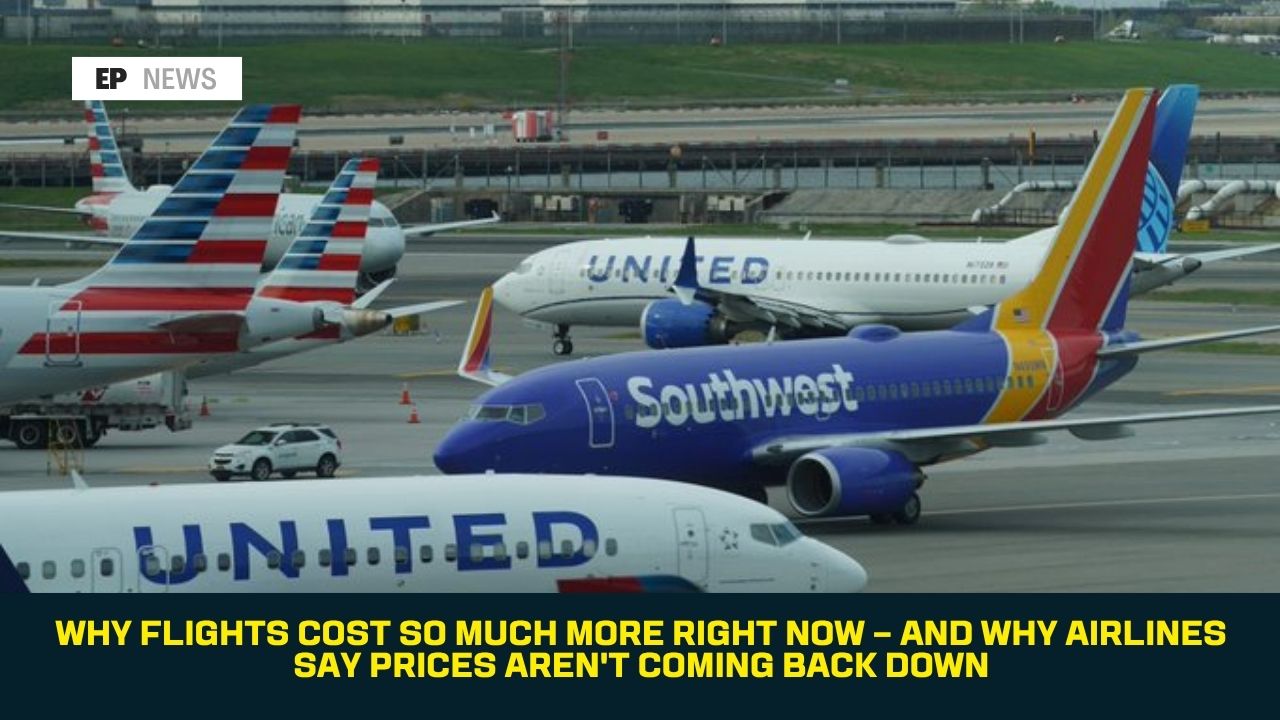
Why Flights Cost So Much More Right Now — and Why Airlines Say Prices Aren’t Coming Back Down
Airfares in the United States have climbed sharply this year, driven largely by a surge in jet fuel costs tied to the conflict in the Middle East — and airline executives say the higher prices are likely here to stay, even if fuel costs eventually ease.
How Much Prices Have Actually Risen
Airfares have increased by 8.2% since February, according to inflation data from the U.S. Department of Labor cited by Al Jazeera. The increase follows the initial U.S. and Israeli strikes on Iran and the retaliation that followed, which sent oil prices spiking globally and drove up airlines’ single largest operating expense.
The impact shows up clearly in individual carriers’ reported fares. According to CNBC, Southwest Airlines’ average one-way fare was $225.61 in the second quarter of 2026, up from $186.65 during the same period in 2025 — an increase of roughly 21%. CNBC also relayed one traveler’s account of paying $800 combined for two economy tickets between New York and Chicago on United Airlines, a route she said used to cost a couple hundred dollars total.
Why Fuel Costs Have Jumped So Much
The scale of the added expense at the largest carriers is substantial. United Airlines said it expects to pay approximately $6 billion more for fuel this year than it had projected at the start of 2026, according to CNBC. American Airlines forecast a similar $6 billion increase in fuel costs compared to last year — in both cases, a jump of more than 50% versus 2025 fuel spending.
Airlines have responded by pulling back on capacity rather than simply absorbing the cost. United announced in April that it would need to raise prices by as much as 20% amid the higher fuel costs, according to Al Jazeera, while American Airlines scaled back several routes for August and September as fuel expenses rose.
Not Every Carrier Survived
The pressure on the industry hasn’t been limited to higher prices — it’s also reshaped which airlines are still operating. Budget carrier Spirit Airlines ceased operations in May after roughly three decades in business, according to Al Jazeera’s reporting, one of the clearest examples of how the cost pressure has hit lower-margin carriers hardest.
The disappearance of ultra-low-cost competition has had ripple effects on pricing more broadly. According to travel industry analysis from thetraveler.org, on routes where budget carriers once significantly undercut legacy airlines, their downsizing or exit from the market has been followed by substantial price increases, since fewer discount options remain to keep prices in check.
Airlines Say Baggage Fees and Higher Prices Are the New Normal
Perhaps the clearest signal that airlines don’t expect a return to pre-2026 pricing came from Delta’s own leadership. During a recent earnings call, Delta’s CEO said higher checked baggage fees will likely be a permanent fixture going forward, serving as an ongoing revenue source for the airline rather than a temporary pandemic-era or fuel-crisis measure, according to travel industry reporting from TravelPulse and gmtoday.com.
That’s happening even as Delta posts strong results: the airline reported record first-quarter revenue of $14.2 billion, a 9% increase year-over-year, according to the same reporting — a sign that higher fares and fees haven’t meaningfully dented demand so far.
Why Airlines Aren’t Rushing to Lower Prices
Points Path founder and CEO Julian Kheel, whose company analyzes flight search and pricing data, offered a blunt explanation for why airlines have little incentive to cut fares even as costs remain elevated: with demand still running strong, airlines simply aren’t losing sleep over whether travelers will show up. Southwest Airlines CEO Bob Jordan echoed that sentiment in comments to CNBC’s “Squawk on the Street” in late July, saying that despite high fuel costs and high prices, the airline continues to see strong demand.
Points Path’s broader analysis, cited by both TravelPulse and gmtoday.com, found that domestic cash fares were up roughly 15% between June 1 and September 20 compared to the prior year, with points-based award fares up even more, around 18%. International cash fares rose about 12%, with international points fares up 14%.
Where Travelers Can Still Find Value
Despite the overall price increases, some pockets of relative affordability remain. According to Expedia’s 2026 Air Hacks Report, August has emerged as the most affordable month to fly overall, with flights running roughly 29% cheaper on average than December — a savings of about $120 per ticket — as business travel demand tapers off toward the end of summer. The same report found that Friday has become the cheapest day of the week to both book and depart, a shift attributed to reduced business travel at the end of the workweek.
Separately, fare-tracking service Dollar Flight Club identified Fort Lauderdale, Orlando, Chicago, Pittsburgh, and Dallas as the cheapest domestic destinations to fly to in 2026, with average fares as low as $94 to $108 depending on the route and travel dates.
FAQ
Why have airfares gone up so much in 2026? Primarily because of a sharp rise in jet fuel costs tied to the conflict between the U.S., Israel, and Iran, which caused oil prices to spike globally starting earlier this year. Airlines have passed much of that cost along through higher fares and fees.
How much more are airlines paying for fuel this year? United and American Airlines have each projected roughly $6 billion in additional fuel costs for 2026 compared to the prior year — an increase of more than 50% at each carrier.
Will airfares go back down once fuel prices stabilize? Airline executives have signaled that some price increases, including higher baggage fees, are likely permanent rather than temporary, even if fuel costs eventually ease.
Are there still ways to find cheaper flights? Yes. Industry data suggests August is currently one of the cheaper months to fly overall, and Fridays have become a lower-cost day to both book and depart, as business travel demand drops off toward the end of the week.
Did any airlines go out of business because of rising costs? Yes. Budget carrier Spirit Airlines ceased operations in May 2026 after roughly three decades in the industry, a casualty of the broader cost pressure facing lower-margin airlines.
Conclusion
This year’s airfare increases trace back to a clear cause — a sharp rise in fuel costs tied to Middle East conflict — but the response from airlines suggests the higher prices may outlast the crisis that triggered them. With strong travel demand giving carriers little incentive to lower fares even as some cost pressures potentially ease, and permanent fee increases like Delta’s baggage policy already being framed as the new normal, travelers hoping for a return to pre-2026 pricing may be waiting a while. In the meantime, timing choices like flying in August or booking for Friday departures remain some of the more reliable ways to find relative savings.
Sources: CNBC, Al Jazeera, TravelPulse, gmtoday.com, Expedia Air Hacks Report, Dollar Flight Club (reporting dated July-August 2026).