
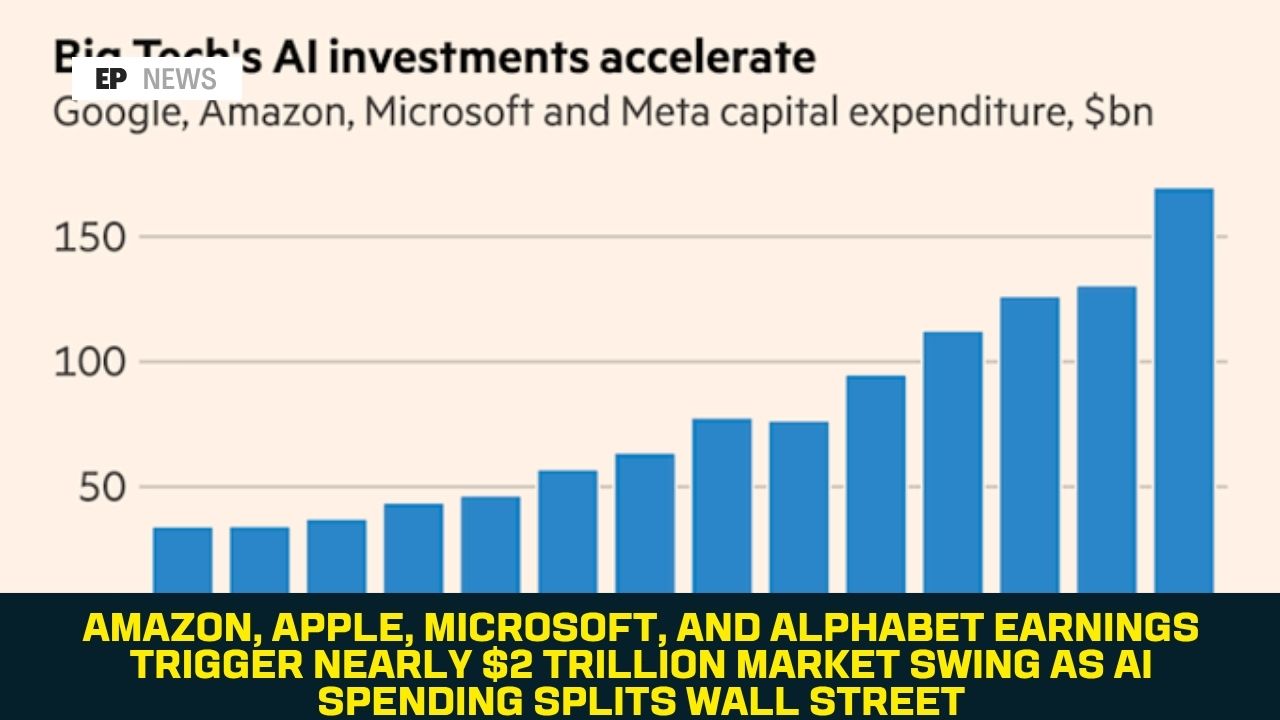
Amazon, Apple, Microsoft, and Alphabet Earnings Trigger Nearly $2 Trillion Market Swing as AI Spending Splits Wall Street
A wave of megacap technology earnings this week moved nearly $2 trillion in combined market value, as Amazon’s cloud business posted its fastest growth since 2021 while Apple’s stock tumbled on weak guidance tied to rising memory chip costs. Together, the results are sharpening a growing divide on Wall Street over which companies are actually turning years of massive AI spending into returns.
Amazon: “Booming” Cloud Growth
Amazon’s results, released Thursday, July 30, came in well ahead of expectations across the board. The company reported adjusted earnings per share of $1.97 versus a $1.82 estimate, on revenue of $200.61 billion against a $196.47 billion estimate.
The standout figure was Amazon Web Services, the company’s cloud computing division, which grew 37% year-over-year — well above Wall Street’s forecast of 31% growth and the unit’s fastest growth pace since 2021. CEO Andy Jassy described AWS as “booming” in the earnings release, pointing specifically to the company’s artificial intelligence and custom chip businesses, both of which have now exceeded a $25 billion annual revenue run rate.
Amazon’s advertising business also beat expectations, bringing in $19.81 billion against a $19.43 billion forecast. Jassy said the company now expects capital expenditures to hit $220 billion for the year, up from the $200 billion figure the company had held steady on since February, citing rising memory prices as a key driver of the increase. He indicated the elevated spending pace is likely to continue for some time.
Apple: Beat on Earnings, Miss on Guidance
Apple’s results, also released Thursday, told a more complicated story. The company posted adjusted earnings per share of $1.91 against a $1.89 estimate, with revenue of $109.42 billion beating the $108.65 billion consensus forecast.
But investors focused on what came next: Apple issued soft guidance for the current quarter, projecting revenue growth of just 9% to 11%, below analysts’ expectations of 12% growth. Apple shares fell more than 7% the following day.
CEO Tim Cook attributed the weaker outlook directly to memory chip costs, telling analysts the company has paid more for memory in each of the last three quarters and doesn’t see relief coming. Cook said that looking beyond September, pricing pressure on memory components is likely to continue increasing and could weigh further on the business, adding that the industry needs to expand its supplier base beyond the three companies that currently dominate memory production. He said some of the cost increase would be offset by existing inventory and savings elsewhere, but stopped short of predicting when the pressure would ease.
Looking further out, growth expectations for Apple have cooled significantly. According to FactSet data cited by CNBC, consensus estimates call for revenue growth of around 12% in the fiscal fourth quarter, dropping into the single digits for most of 2027 — a marked slowdown after Apple posted its first double-digit revenue growth quarter since 2021 in the prior period.
How the Rest of Big Tech Compared
Amazon and Apple’s results landed in the middle of a broader wave of megacap earnings that had already reshaped expectations for the AI spending race. The week prior, Alphabet reported Google Cloud growth of 82%, while Microsoft’s Azure cloud revenue rose 43% in its fiscal fourth quarter — both figures that raised the bar heading into Amazon’s own cloud numbers.
Across the six megacap companies that had reported earnings by the end of the week, roughly $2 trillion in combined market value moved in one direction or another, according to CNBC. Amazon, Microsoft, and Alphabet — the three largest cloud providers, often referred to as hyperscalers — all saw their market capitalizations surge on the back of strong cloud growth, adding hundreds of billions of dollars in value. Apple and Meta, by contrast, saw their valuations decline. On Friday specifically, Amazon shares surged while Apple shares fell sharply.
What’s Driving the Divide
The split in investor reaction points to a broader debate taking shape on Wall Street: whether the enormous sums of money technology companies have committed to AI infrastructure are starting to generate visible returns. All three major cloud providers used their earnings calls to affirm or raise their capital expenditure forecasts for the year, signaling that the spending spree on data centers, chips, and AI infrastructure isn’t slowing down. Investors appear to be rewarding companies where that spending is already translating into accelerating cloud revenue growth — Amazon, Microsoft, and Alphabet — while showing less patience for Apple, whose AI-related costs are currently showing up primarily as a supply-chain headwind rather than a growth driver.
FAQ
How did Amazon’s stock react to earnings? Amazon shares surged following the report, driven by AWS cloud revenue growth of 37% — faster than Wall Street expected and the unit’s best growth rate since 2021.
Why did Apple’s stock fall after a earnings beat? Despite beating both earnings and revenue estimates, Apple issued weaker-than-expected guidance for the current quarter, which it attributed to rising memory chip costs. Apple shares fell more than 7% as a result.
How much is Amazon planning to spend on AI this year? Amazon raised its 2026 capital expenditure forecast to $220 billion, up from the $200 billion figure it had maintained since February, citing rising memory prices.
How did Microsoft and Alphabet’s cloud businesses perform? Microsoft’s Azure cloud revenue grew 43% in its fiscal fourth quarter, while Alphabet’s Google Cloud grew 82% — both reported in the week before Amazon and Apple’s results.
How much market value moved because of this earnings season? Nearly $2 trillion in combined market value moved into or out of the six largest technology companies that had reported earnings by the end of the week, according to CNBC.
Conclusion
This earnings season has drawn a clearer line than usual between AI spending as an investment and AI spending as a cost. Amazon, Microsoft, and Alphabet are showing Wall Street that their massive infrastructure bets are translating into accelerating cloud revenue, while Apple’s earnings beat was overshadowed by supply-chain pressure it can’t yet fully offset. With capital expenditure forecasts still climbing across the industry, the next several quarters will be a key test of whether this spending gap between AI’s winners and its laggards continues to widen — or whether Apple and others catch up as memory supply eventually stabilizes.
Sources: CNBC (reporting dated July 30-31, 2026).