
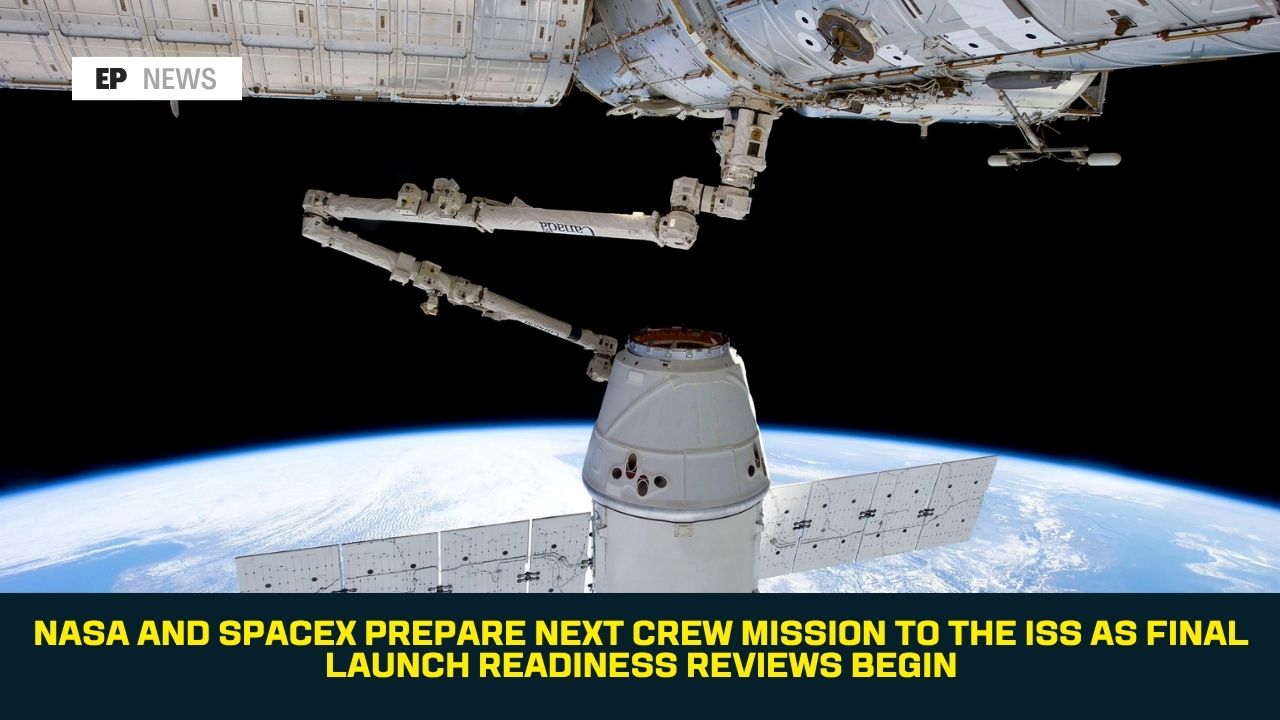
NASA and SpaceX Enter Final Preparations for Upcoming ISS Crew Mission
NASA and SpaceX are moving into the final stages of preparation for their next crewed mission to the International Space Station (ISS), with engineers conducting launch readiness reviews, spacecraft inspections, and weather assessments ahead of liftoff.
The mission represents another milestone in NASA’s Commercial Crew Program, which continues to rely on SpaceX’s Crew Dragon spacecraft to transport astronauts safely between Earth and the orbiting laboratory. According to NASA, the final technical reviews are focused on ensuring that both the Falcon 9 rocket and Crew Dragon spacecraft meet all safety and performance requirements before launch.
Final Launch Readiness Reviews Underway
Before every crewed launch, NASA and SpaceX complete a series of comprehensive reviews involving engineers, flight directors, mission managers, and safety specialists.
These reviews evaluate:
- Falcon 9 rocket systems
- Crew Dragon spacecraft readiness
- Weather conditions
- Flight software
- Communications systems
- Emergency procedures
- Launch pad equipment
Officials say each checkpoint must be successfully completed before astronauts receive final approval to launch.
What Is the Mission’s Main Objective?
The primary goal of the mission is to transport a new team of astronauts to the International Space Station while returning another crew to Earth after completing several months in orbit.
During their stay aboard the ISS, astronauts will conduct:
Scientific Research
Experiments in biology, medicine, physics, and materials science.
Technology Demonstrations
Testing new equipment designed for future Moon and Mars missions.
Station Maintenance
Routine inspections, repairs, and system upgrades aboard the space station.
International Cooperation
Working alongside astronauts from partner space agencies to support long-term scientific research.
Why the International Space Station Matters
Orbiting approximately 250 miles (400 kilometers) above Earth, the ISS serves as one of the world’s most advanced scientific laboratories.
Researchers use the station to study:
- Human health in microgravity
- Plant growth in space
- Advanced manufacturing
- Earth observation
- Climate monitoring
- Future deep-space exploration technologies
The research conducted aboard the ISS contributes to both scientific knowledge and technological innovation on Earth.
SpaceX’s Growing Role in Human Spaceflight
Since NASA certified Crew Dragon for operational missions, SpaceX has become a central part of America’s human spaceflight program.
The partnership has helped restore the United States’ ability to launch astronauts from American soil while reducing reliance on foreign launch systems.
SpaceX now regularly supports:
- ISS crew rotation missions
- Cargo resupply flights
- Private astronaut missions
- Technology demonstrations
The Commercial Crew Program has significantly expanded access to low-Earth orbit for both government and commercial missions.
Safety Remains the Top Priority
NASA officials emphasize that crew safety remains the most important factor before every launch.
Launch teams continuously monitor:
Weather
High winds, lightning, or thick cloud cover can delay liftoff.
Rocket Systems
Every major component of the Falcon 9 rocket undergoes repeated inspections.
Spacecraft Performance
Crew Dragon’s life-support systems, navigation software, and emergency escape capabilities are thoroughly tested.
Mission Operations
Flight controllers rehearse multiple contingency scenarios before launch day.
If any issue arises during final reviews, the launch can be postponed until engineers resolve the concern.
Scientific Importance of the Mission
The upcoming expedition will continue research benefiting people both in space and on Earth.
Areas of study include:
- Cancer and medical research
- Advanced materials
- Water purification technologies
- Robotics
- Artificial intelligence applications in space operations
- Long-duration human spaceflight
NASA says many technologies developed for the ISS have found practical applications in healthcare, communications, and engineering.
Economic Impact
The continued partnership between NASA and SpaceX also supports thousands of jobs across the U.S. aerospace industry.
The program benefits:
- Aerospace manufacturers
- Engineering firms
- Research universities
- Technology companies
- Launch operations teams
Commercial spaceflight has become an increasingly important contributor to America’s innovation economy.
What Happens Next?
Over the coming days, NASA and SpaceX will complete:
- Final Launch Readiness Review
- Mission management meeting
- Weather forecast assessments
- Astronaut quarantine procedures
- Countdown rehearsals
- Final fueling preparations
If all technical and weather requirements are satisfied, the mission will proceed according to the scheduled launch timeline. Any changes will be announced through official NASA channels.
Frequently Asked Questions (FAQ)
What is the purpose of this mission?
The mission will transport astronauts to the International Space Station while supporting scientific research, station maintenance, and international cooperation.
Who is launching the mission?
The mission is a joint effort between NASA and SpaceX under NASA’s Commercial Crew Program.
Why are launch readiness reviews important?
These reviews ensure that the rocket, spacecraft, crew, and weather conditions meet NASA’s strict safety standards before liftoff.
Could the launch be delayed?
Yes. NASA may postpone the launch if weather conditions or technical inspections indicate additional work is needed to ensure crew safety.
Conclusion
As NASA and SpaceX complete their final preparations for the next International Space Station mission, attention is once again turning to one of America’s most successful public-private partnerships in space exploration. With comprehensive safety reviews underway and astronauts preparing for launch, the mission highlights the continued importance of scientific research, technological innovation, and international collaboration in low-Earth orbit. If all readiness milestones are met, the upcoming flight will add another chapter to the growing legacy of U.S. human spaceflight and the Commercial Crew Program.