
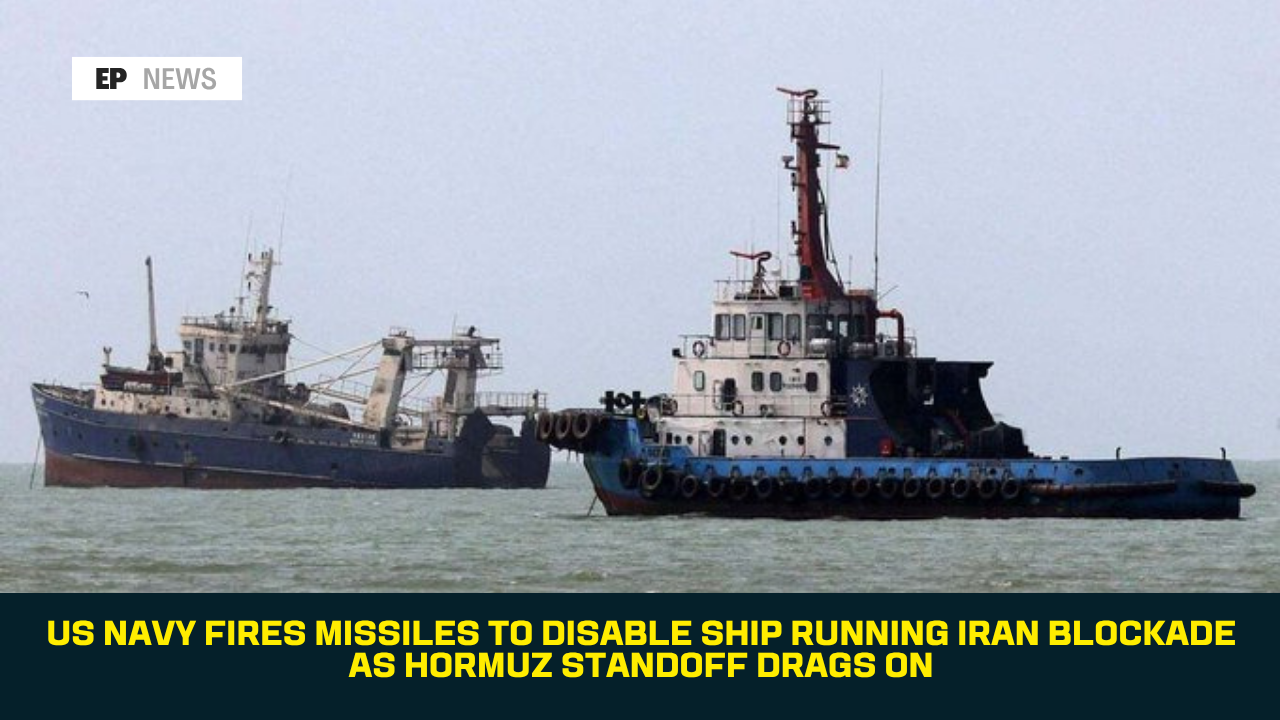
US Navy Fires Missiles to Disable Ship Running Iran Blockade as Hormuz Standoff Drags On
A U.S. Navy helicopter fired two Hellfire missiles into the engine room of a cargo ship early Tuesday, August 11, after its crew ignored repeated warnings while attempting to break Washington’s naval blockade of Iranian ports — the third vessel U.S. forces have disabled since reimposing the blockade in July, as talks over reopening the Strait of Hormuz remain stalled.
What Happened
U.S. Central Command said an MH-60 Navy helicopter fired the two missiles into the engine room of the Vela Nova, a Panamanian-flagged cargo vessel, after its civilian crew ignored repeated American warnings to stop. “The ship is no longer transiting to Iran in violation of the U.S. blockade, which remains in full effect,” CENTCOM said in its Tuesday statement, according to ABC News.
Maritime security firm Vanguard identified the vessel and said it was struck while traveling west through the Gulf of Oman, roughly 71 nautical miles from Pakistan, according to the Washington Examiner’s reporting on the Wall Street Journal’s account of the incident. The strike sparked a fire that was subsequently extinguished, and all 17 crew members aboard were accounted for, with no reports of casualties. The ship appeared to be attempting to transfer its crew to another civilian vessel following the strike, according to a U.S. official cited by the Journal.
The Broader Pattern of Enforcement
Tuesday’s strike wasn’t an isolated action. According to ABC News, it marked the third ship U.S. forces have disabled since the blockade’s restart in July, with two other vessels having been boarded and 55 more “redirected” during that same period. Fox News reported a slightly updated tally as of August 11: CENTCOM said it had redirected 55 commercial vessels attempting to run the blockade, disabled three non-compliant vessels, and boarded two, describing its forces in the region as “highly vigilant, lethal, and ready.”
According to the Washington Examiner, U.S. strikes on noncompliant vessels typically involve precise targeting of a ship’s engine room or rudder specifically to disable it without causing significant casualties — a description consistent with how Tuesday’s strike on the Vela Nova was carried out.
This isn’t the blockade’s first phase, either. During an earlier April-to-June enforcement period, CENTCOM said it redirected more than 140 vessels and disabled nine that didn’t comply, according to the Washington Examiner.
Why the Blockade Was Reinstated
The current blockade traces back to a broken ceasefire. Trump reinstated the naval blockade in July after Iran resumed attacks on ships transiting the Strait of Hormuz, reversing a prior agreement that had temporarily eased tensions, according to the Washington Examiner. That earlier truce stemmed from a memorandum of understanding signed by the U.S. and Iran in June, intended to launch renewed negotiations toward a lasting peace deal, along with resolving the future of sanctions on Iran and its nuclear program, according to Al Jazeera.
In the 26-day window between that June agreement and the blockade’s reinstatement, Tehran managed to ship more than 80 million barrels of oil — worth roughly $6 billion — to foreign buyers, according to the Washington Examiner, underscoring both how quickly Iran moved to capitalize on the lifted restrictions and why the blockade’s economic pressure is considered significant by U.S. officials.
Iran’s Position: No Reopening Without Concessions
Iranian officials have remained firm in their public messaging. Mohsen Rezaei, secretary of Iran’s Supreme National Security Council, said Tuesday, according to Al Jazeera’s translation of comments carried by Iran’s semi-official Tasnim news agency, that the Strait of Hormuz “will not be opened until the United States changes its behaviour and accepts Iran’s conditions.” In a post on X cited by ABC News, Rezaei added that reopening requires the U.S. to end the war and blockade, release Iran’s frozen assets, and resolve the broader regional conflict, including in Lebanon and Gaza. He specifically said any separate agreement Iran reaches with Oman on shipping routes would remain distinct from the question of the strait’s overall closure.
Mohammad Mokhber, an adviser to Iranian Supreme Leader Mojtaba Khamenei, invoked the 1979-81 Iran hostage crisis in an apparent warning directed at Trump on X Tuesday, according to Fox News — a historical reference underscoring how high tensions have climbed in the standoff’s current phase.
Parallel Diplomatic Track With Oman
Even as the U.S.-facing rhetoric hardens, a separate diplomatic channel between Iran and Oman continues showing signs of movement. Qatar’s Foreign Ministry spokesperson Majed al-Ansari said Tuesday that talks between Iran and Oman over the future of the Strait of Hormuz are at a “critical point,” according to ABC News, adding that Doha had received “positive statements from both capitals” in recent days.
Separately, Pakistani Defense Minister Khawaja Muhammad Asif told Bloomberg News that the U.S. and Iran were reportedly nearing a deal as of Tuesday, saying, “Things are shaping up again in favor of a peace arrangement or a deal,” according to the Jerusalem Post. That assessment stood in some tension with Iran’s own foreign minister, who separately said Tuesday that Tehran was not currently in direct talks with the U.S. specifically to end the war and reopen the strait — even as Washington maintained that a broader deal was near.
Trump’s Latest Demand
President Trump added a new complication to the negotiating picture Monday, calling for reparations from Iran covering “50 years” of damage, according to Al Jazeera — a demand that goes beyond the previously discussed framework. Iran had separately called for reconstruction funding to be included in any eventual deal, with the June memorandum of understanding having contained a preliminary plan for a $300 billion fund, according to Al Jazeera’s reporting.
Oil Market Reaction
Energy Secretary Chris Wright said Tuesday that oil continues to flow through the Strait of Hormuz despite Iran’s efforts to close the waterway, though at a reduced pace — roughly half of its normal rate of 20 million barrels per day, according to Fox News, citing a post from Wright on X. Oil prices ticked higher Monday amid the mixed signals from both sides, with Brent crude gaining just over 1% to $84.42 a barrel and U.S. West Texas Intermediate advancing to $78.83, according to CNBC’s markets coverage. Westpac noted in a client note cited by CNBC that “uncertainty remains high as we go into the sixth month of the Iran war.”
FAQ
What happened to the Vela Nova? A U.S. Navy helicopter fired two Hellfire missiles into its engine room after the crew ignored repeated warnings while attempting to break the U.S. blockade of Iranian ports. All 17 crew members were accounted for with no reported casualties.
Why does the U.S. have a naval blockade on Iranian ports? President Trump reinstated the blockade in July after Iran resumed attacks on ships in the Strait of Hormuz, following the collapse of a ceasefire that had been part of a June memorandum of understanding between the two countries.
How many ships has the U.S. disabled or redirected under the blockade? As of August 11, CENTCOM said it had redirected 55 vessels, disabled 3, and boarded 2 since the blockade’s July restart, in addition to a larger tally from an earlier April-to-June enforcement phase.
What does Iran say it wants before reopening the strait? An end to the war and blockade, the release of Iran’s frozen assets, resolution of broader regional conflicts including in Lebanon and Gaza, and compensation for damages.
Is a deal close? Accounts differ. Pakistan’s defense minister said a deal appeared to be shaping up as of Tuesday, while Iran’s foreign minister said Tehran was not currently in direct talks with the U.S. specifically on ending the war and reopening Hormuz.
Conclusion
Tuesday’s strike on the Vela Nova illustrates how the current standoff has settled into a pattern of sustained economic pressure paired with sporadic, targeted military enforcement — even as diplomatic channels, particularly the Iran-Oman talks on shipping routes, continue showing incremental signs of movement. With Trump’s new reparations demand adding a fresh complication and Iranian officials publicly reasserting that the strait stays closed until their full list of conditions is met, the gap between the optimistic and pessimistic accounts of how close a deal actually is remains wide, leaving the strait’s normal shipping capacity still running at roughly half its usual rate.
Sources: Al Jazeera, ABC News, CENTCOM, Fox News, Washington Examiner/Wall Street Journal, The Jerusalem Post, CNBC (reporting dated August 10-12, 2026).