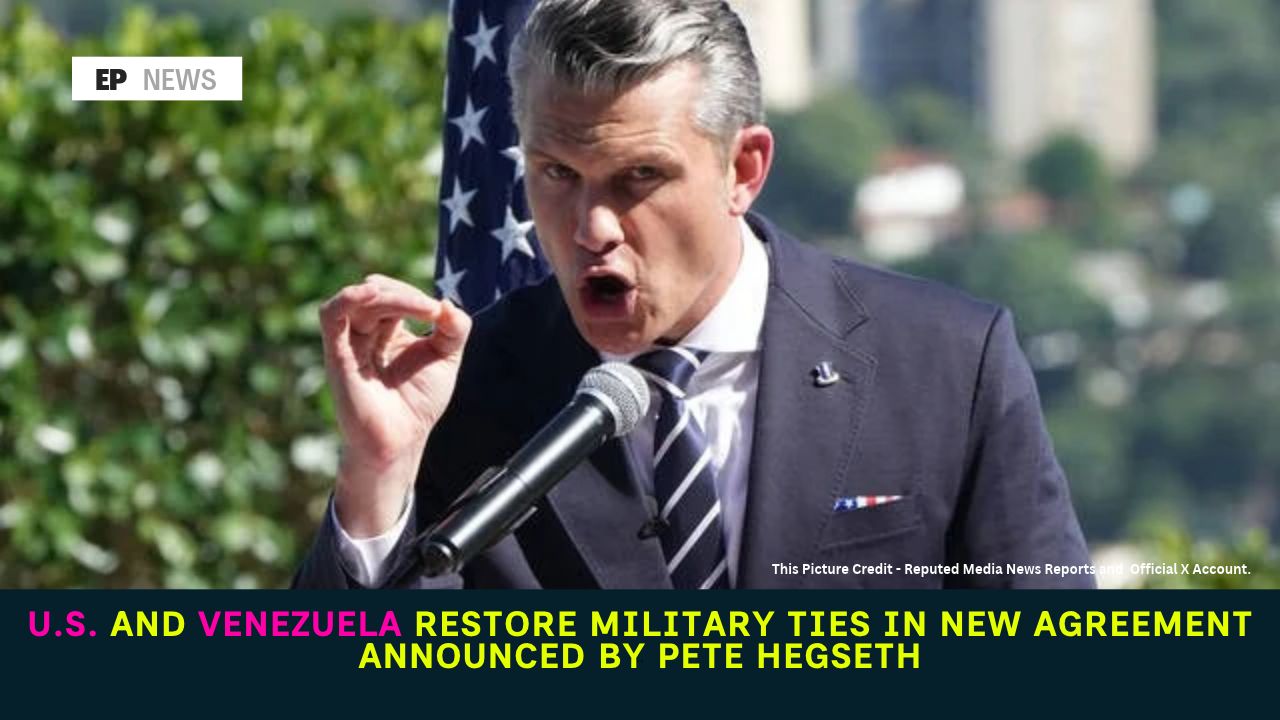
U.S. and Venezuela Restore Military Ties in New Agreement Announced by Pete Hegseth
November 19, 2026 | U.S News
The United States and Venezuela have announced a new agreement to restore military cooperation, marking a major change in relations between the two countries following the removal of former Venezuelan President Nicolás Maduro earlier this year.
U.S. Defense Secretary Pete Hegseth announced the agreement on November 18, 2026, during a visit to Caracas, where he met with Venezuela’s acting President Delcy Rodríguez at the presidential palace.
The proposed military partnership includes joint training, intelligence sharing and possible cooperation involving defense equipment and military capabilities. Both governments described the agreement as an opportunity to address common security threats, although they have not publicly provided a detailed implementation plan.
The announcement is significant because the United States and Venezuela had experienced years of political confrontation, sanctions and security tensions. In January 2026, U.S. forces captured Maduro during a military operation in Caracas, dramatically changing the country’s political situation.
Now, less than a year later, Washington is seeking closer security cooperation with the Venezuelan government led by Rodríguez.
The agreement also comes amid the Trump administration’s broader effort to increase American influence across Latin America, particularly in areas involving energy resources, organized crime and regional security.
What Is the New U.S.-Venezuela Military Agreement?
The new agreement is intended to reestablish military ties between Washington and Caracas.
Hegseth announced the arrangement while standing alongside Venezuelan officials during his visit to the country.
According to the Associated Press and Reuters, the agreement covers several areas of potential cooperation:
- Joint military training.
- Intelligence sharing.
- Defense equipment and capabilities.
- Cooperation against drug-trafficking networks.
- Possible modernization and professionalization of Venezuela’s armed forces.
Hegseth said the two countries would be training and partnering together while sharing intelligence and expanding defense capabilities.
Rodríguez also welcomed the agreement, saying cooperation could help the countries confront common threats and strengthen the training of Venezuelan military personnel.
However, neither government publicly released a comprehensive explanation of the agreement’s operational details.
The Pentagon did not immediately provide additional information about the scope of the partnership, the military units involved or the timeline for implementation.
That means the announcement should not be interpreted as confirmation that American troops will be permanently stationed in Venezuela or that a specific joint military operation has already been approved.
For now, the publicly confirmed development is the restoration of military cooperation through an agreement announced by the defense secretary.
Why Did Pete Hegseth Visit Venezuela?
Hegseth’s November 18 visit was his first trip to Venezuela since the January operation in which U.S. forces captured Maduro.
The visit represents an important diplomatic shift.
For years, the United States maintained a confrontational relationship with Maduro’s government. Washington accused senior Venezuelan officials of corruption and involvement in criminal networks, while imposing sanctions and supporting political pressure against the administration.
The January military operation fundamentally changed that relationship.
Following Maduro’s capture, Rodríguez assumed leadership and continued governing as Venezuela’s acting president.
The Trump administration has since increased diplomatic engagement with Caracas.
Hegseth’s visit followed earlier trips by other senior American officials, including Secretary of State Marco Rubio, Energy Secretary Chris Wright and CIA Director John Ratcliffe, according to the Associated Press.
The visits indicate that Washington is pursuing a broader relationship with the Venezuelan government rather than limiting its engagement to military matters.
The United States has also shown strong interest in Venezuela’s oil industry and critical mineral resources.
Hegseth’s trip therefore combined security discussions with the wider strategic interests of the Trump administration.
What Did Hegseth Say About Drug Trafficking?
One of the central reasons given for the new military partnership is the fight against drug-trafficking organizations.
Hegseth said Venezuela could work with the United States to recover territory from criminal networks and improve regional security.
During remarks at the U.S. Embassy in Caracas, he issued a strong warning to groups he described as narco-terrorists.
He said the new partnership would lead to a significant increase in joint action against drug-trafficking groups.
The Trump administration has made combating international drug trafficking a major part of its Latin America security policy.
American forces have conducted operations against suspected drug-smuggling boats in the Caribbean Sea and eastern Pacific Ocean.
According to AP reporting, at least 240 people had been killed in these operations since the campaign began in September 2025.
The administration has described the targets as drug-trafficking vessels and individuals connected to criminal organizations. However, AP reported that U.S. officials had released limited public evidence supporting claims about the vessels’ cargo or the overall impact of the operations on drug availability in the United States.
That distinction matters when evaluating the new agreement.
The announcement indicates that Washington wants Venezuela to become a security partner in regional anti-drug efforts. It does not independently establish that every person or organization targeted by U.S. operations is involved in drug trafficking.
The effectiveness of the new cooperation will depend on intelligence quality, legal safeguards, operational coordination and measurable results.
How Did Venezuela Respond to the Agreement?
Acting President Delcy Rodríguez welcomed Hegseth during the visit and expressed support for stronger military cooperation.
Rodríguez said the arrangement could help the two countries address common threats and improve the training, equipment and technology available to Venezuela’s armed forces.
Her comments suggest that Caracas sees the agreement as an opportunity to rebuild military capabilities and restore a working relationship with Washington.
Venezuela’s military has faced significant challenges following years of economic difficulties, political instability and international pressure.
The country has also experienced problems involving military equipment, maintenance and institutional capacity.
Improved access to training and technology could potentially help address some of these weaknesses.
However, the precise nature of any American assistance remains unclear.
There has been no publicly confirmed list of equipment transfers, training locations, financial commitments or specific military exercises connected to the new agreement.
The two governments will need to provide more information before observers can assess how much the partnership will change Venezuela’s military capabilities.
A Dramatic Shift After Nicolás Maduro’s Capture
The new military agreement is especially notable because of the events that preceded it.
On January 3, 2026, U.S. forces conducted a military operation in Caracas and captured then-President Nicolás Maduro.
Maduro was subsequently taken to the United States, where he remains in federal custody awaiting legal proceedings.
The Trump administration described the operation as a major success.
During his Caracas visit, Hegseth praised the American military operation and described it as an exceptionally sophisticated mission.
He also said Venezuela had changed from what Washington considered a major regional threat into a security partner.
The political situation inside Venezuela, however, remains complicated.
Rodríguez, who previously served as Maduro’s vice president, has continued leading the country.
The ruling political movement that held power under Maduro remains influential.
Opposition leader María Corina Machado has also returned to Venezuela after spending time in exile.
The future of Venezuela’s political system remains uncertain, and no date for the next presidential election had been announced in the AP report published around Hegseth’s visit.
This creates an important distinction: improved military cooperation with Washington does not automatically mean that Venezuela has completed a democratic political transition.
The Oil Connection: Why Venezuela Matters to Washington
Military cooperation is only one part of the expanding relationship between the two countries.
Venezuela possesses enormous oil reserves, making its energy industry strategically important for the United States.
The Trump administration has been working to expand American involvement in the country’s energy sector following Maduro’s removal.
According to Reuters, a separate agreement involving North American Blue Energy Partners (NABEP) provides long-term access to 17 Venezuelan oilfields containing approximately one-fifth of the country’s oil reserves.
The United States secured a 35% stake in NABEP’s parent company through the arrangement, along with a guaranteed share of production and first-refusal rights over the remaining output.
This is a separate energy arrangement, not the military cooperation agreement announced by Hegseth.
Alejandro Betancourt, the Venezuelan businessman who controls NABEP, attended events connected to Hegseth’s visit.
Reuters reported that Betancourt said the company planned to increase production to more than 250,000 barrels per day by the end of 2026.
That would represent an increase from the 224,000 barrels per day the company reported producing in mid-October.
The production target is a company projection, not a confirmed result.
The energy relationship is important because the Iran war has disrupted oil shipments through the Strait of Hormuz and increased pressure on global energy markets.
Hegseth argued that Venezuelan oil could reduce the Western Hemisphere’s exposure to disruptions around the Strait.
However, increasing Venezuelan production significantly would require investment, infrastructure improvements and sustained political stability.
The military agreement and the oil partnership therefore reflect different but connected aspects of Washington’s broader strategy in Venezuela.
What Is the Trump Administration’s ‘Donroe Doctrine’?
During his speech in Caracas, Hegseth used the phrase “Donroe Doctrine,” combining President Donald Trump’s name with the Monroe Doctrine.
The original Monroe Doctrine was announced in 1823 and established an American policy opposing further European colonization and interference in the Western Hemisphere.
Over time, the doctrine became associated with the United States asserting influence across Latin America.
Hegseth used the new phrase to describe the Trump administration’s approach to regional security and American influence.
He said Venezuela had moved from being a major regional threat to becoming a security partner working with the United States.
The language reflects the administration’s intention to take a more active role in Latin American affairs.
Supporters of this approach argue that closer regional cooperation could help combat drug trafficking, improve border security and protect strategic interests.
Critics may view the approach as an expansion of American intervention in the region, particularly given the January operation that removed Maduro.
The new military agreement is therefore not simply a defense arrangement. It is also a signal about how the Trump administration wants to shape relationships with governments across the Western Hemisphere.
Concerns About Venezuela’s Military and Human Rights Record
Despite the announcement, the partnership faces significant challenges.
The Venezuelan armed forces have been accused by international observers and human rights organizations of corruption and involvement in abuses.
The Washington Post cited analysts who questioned the military’s capacity to regain control over areas influenced by powerful criminal organizations.
Phil Gunson, a senior analyst with the International Crisis Group in Caracas, also raised concerns about the Venezuelan military’s institutional weaknesses and history.
These concerns create difficult questions for Washington.
The United States wants to work with Venezuelan forces to address security threats, but cooperation with military institutions accused of serious abuses may create political and human rights risks.
Any long-term partnership will need clear standards concerning accountability, civilian protection and the use of intelligence.
It will also require mechanisms to ensure that military assistance is used for legitimate security purposes.
The public announcement has not yet explained what safeguards or monitoring arrangements will govern the new cooperation.
What Does the Agreement Mean for U.S. Relations With Latin America?
The new arrangement could influence America’s relationships with other countries in the region.
The Trump administration has emphasized the Western Hemisphere as a major strategic priority.
Its policies include efforts to strengthen cooperation against drug trafficking, increase access to energy resources and improve military relationships with regional governments.
Hegseth’s visit to Venezuela was part of a broader Latin America trip that also included Colombia.
Reuters reported that he was expected to deliver a Lockheed Martin C-130 Hercules aircraft to Colombia and discuss security cooperation with the government in Bogotá.
The United States has also discussed possible military action against armed groups operating in Colombia, although such proposals have generated political and diplomatic concerns.
These developments indicate that Washington is pursuing a more active regional security policy.
For countries in Latin America, the approach could create opportunities for cooperation while also raising questions about national sovereignty and the extent of American military influence.
Venezuela’s agreement is likely to be closely watched by neighboring governments because of the country’s recent history with Washington.
What Happens Next?
The immediate challenge is turning the announcement into a functioning military partnership.
Several important questions remain unanswered:
- Which military units from both countries will participate?
- Where will joint training take place?
- What intelligence will the two governments share?
- Will Venezuela receive new American defense equipment?
- What legal and human rights safeguards will apply?
- How will the countries measure progress against drug-trafficking networks?
- Will the agreement lead to a broader long-term defense relationship?
The Pentagon and Venezuela’s government have not yet publicly answered all these questions.
Further meetings between military officials and government representatives will likely be necessary to establish the practical arrangements.
The agreement could eventually lead to more regular communication, training exercises and intelligence cooperation.
However, the scale and speed of implementation remain uncertain.
The relationship will also be affected by Venezuela’s political future, the oil sector and the Trump administration’s broader regional strategy.
Conclusion
The new U.S.-Venezuela military agreement marks a dramatic change in relations between Washington and Caracas.
After years of confrontation and the January 2026 operation that captured Nicolás Maduro, the two governments are now discussing joint training, intelligence sharing and expanded defense cooperation.
Defense Secretary Pete Hegseth described Venezuela as an emerging security partner, while acting President Delcy Rodríguez welcomed the opportunity to strengthen the country’s military capabilities.
The agreement is also connected to wider American interests involving drug trafficking, oil production and regional influence.
However, major details remain undisclosed. The public announcement does not confirm permanent U.S. troop deployments, a specific joint military operation or a completed democratic transition in Venezuela.
The next stage will depend on how the two governments implement the agreement and whether the promised cooperation produces measurable security improvements.
For now, the announcement represents one of the most significant developments in U.S.-Venezuela relations since the political upheaval earlier this year.
Frequently Asked Questions (FAQs)
1. Did the United States and Venezuela sign a military agreement in November 2026?
Yes. U.S. Defense Secretary Pete Hegseth announced on November 18 that the two countries had signed an agreement to restore military cooperation.
2. What does the U.S.-Venezuela military agreement include?
The announced areas include joint military training, intelligence sharing, defense equipment and broader military cooperation.
3. Who met Pete Hegseth in Venezuela?
Hegseth met Venezuela’s acting President Delcy Rodríguez in Caracas on November 18, 2026.
4. Why is the agreement important?
It represents a major shift in relations following years of confrontation and the January 2026 U.S. military operation that captured former Venezuelan President Nicolás Maduro.
5. Will U.S. troops be permanently stationed in Venezuela?
No permanent U.S. troop deployment was confirmed in the public announcement. The agreement’s operational details have not been fully disclosed.
6. Will the two countries work together against drug trafficking?
Hegseth said the partnership would expand joint action against drug-trafficking groups. The specific operations and arrangements have not yet been publicly explained.
7. Is the military agreement connected to Venezuela’s oil industry?
They are separate arrangements, but both reflect the Trump administration’s broader effort to expand its relationship and influence in Venezuela.
8. Who is Delcy Rodríguez?
Delcy Rodríguez is Venezuela’s acting president. She assumed leadership after Nicolás Maduro was captured by U.S. forces in January 2026.
9. What is the Donroe Doctrine?
It is a phrase used by Hegseth that combines Trump’s name with the Monroe Doctrine to describe the administration’s approach to American influence and security in the Western Hemisphere.
10. Has the Pentagon published all the details of the agreement?
No. The public announcement described broad areas of cooperation, but the Pentagon had not provided a complete operational explanation.
Sources and References
- Associated Press – U.S. and Venezuela sign a deal to reestablish military ties.
- Reuters – Hegseth announces new U.S.-Venezuela military partnership agreement.
- The Washington Post – Hegseth makes surprise appearance in Venezuela and renews military partnership.
- Reuters – Reporting on the separate Venezuelan oil agreement and production plans.
- U.S. Department of Defense – Official information on U.S. regional security policy.