
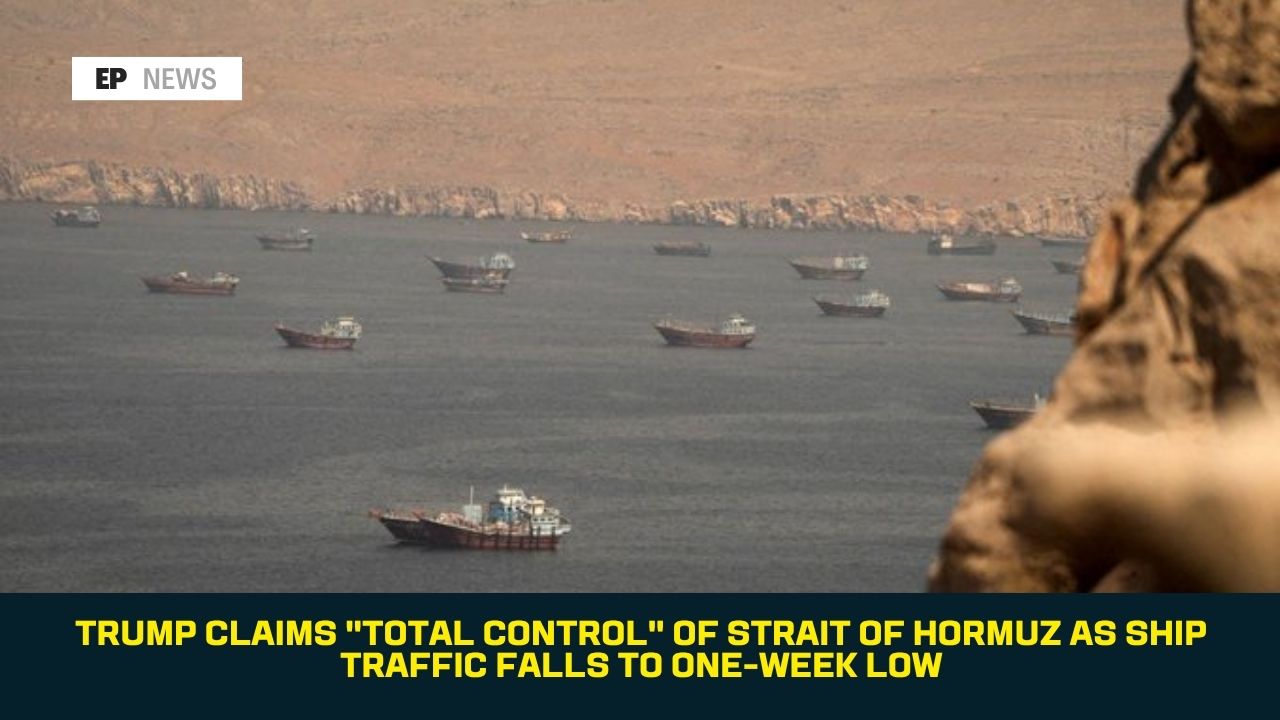
Trump Claims “Total Control” of Strait of Hormuz as Ship Traffic Falls to One-Week Low
President Trump declared Wednesday, August 12, that the United States maintains “total control” over the Strait of Hormuz, doubling down on a claim he first made to reporters a day earlier — even as actual shipping traffic through the waterway fell to a one-week low amid the ongoing U.S.-Israel war with Iran.
What Trump Said
Trump made his claim in a Truth Social post Wednesday, echoing comments he’d given reporters at Joint Base Andrews the night before. “The U.S.A. has total control over the Strait of Hormuz. I THINK WE WILL KEEP IT! Our Naval Blockade is being called, by everyone, ‘A WALL OF STEEL,’ and there is nothing Iran can do about it,” he wrote, according to Reuters.
His Tuesday night remarks to reporters were more expansive and combative in tone. “We have total control over the Hormuz Strait right now. They don’t have control. We have total control. We own it,” Trump said, according to Bloomberg. He paired the claim with a warning directed at Tehran: “At some point, maybe they’ll do something, and then they get blown away.” Trump also addressed his broader distrust of Iran directly: “I’m the last person to trust Iran. They’ve lied to me constantly.”
What Shipping Data Actually Shows
Trump’s declaration of “total control” stands in tension with real-time shipping data, which shows the strait remains far from operating normally. According to Al Jazeera, citing Reuters and trade analytics platform Kpler, just eight ships transited through the Strait of Hormuz on Tuesday — down from a previous ten-day average of about 12 ships, and dramatically below the pre-war rate of 130 to 140 daily transits.
The dispute over transit rights in the strait — a critical route for oil, gas, and fertilizer that normally carries around a fifth of global oil demand — is considered one of the primary triggers for the broader escalation in the U.S.-Iran conflict, according to Yahoo News. Shipping through the strait was largely undisturbed before the U.S. and Israel began attacking Iran on February 28.
Signs of Continued Evasion
Even amid the blockade, satellite tracking suggests some tankers are continuing to cross the strait covertly. According to gCaptain’s reporting via Bloomberg, satellite images showed vessels conducting cargo transfers outside of Hormuz, with some tankers crossing the waterway with their transponders deliberately switched off. Data from the European Union’s Sentinel 2 satellite showed 12 such transponder switches along more than 100 kilometers of coastline between Oman and the United Arab Emirates on Monday alone. Some ships have also since re-emerged in tracking platforms including Kpler and Vortexa after apparently crossing the strait during periods when their locations weren’t being publicly recorded. So-called “shuttle transits” — transfers conducted specifically to route around the blockade — continue to keep a key oil supply valve open despite the official closure, according to gCaptain.
A Collapsed Ceasefire and Hardening Positions
Wednesday’s exchange comes as both sides’ negotiating positions have hardened rather than converged. The U.S. and Iran signed a memorandum of understanding in June aimed at ending the conflict, but that agreement dissolved by mid-July as both sides resumed attacks, according to Al Jazeera.
Iran has continued pressing its own list of demands through intermediaries. According to Bloomberg, Iran’s Supreme National Security Council secretary Mohsen Rezaei said Tehran has conveyed additional demands to Washington, including that the U.S. end the war entirely and unfreeze Iran’s blocked assets — conditions consistent with the broader list of demands Iranian officials have articulated since the blockade’s reinstatement.
Recent Escalation Beyond the Blockade
The standoff has continued producing sporadic but serious incidents. This week’s developments include a U.S. Navy helicopter strike on a Panama-flagged cargo vessel Tuesday — the Vela Nova, which was disabled after ignoring warnings while attempting to break the blockade.
The conflict has also spread to a separate waterway. Yemen’s Houthi movement has opened what Al Jazeera described as a new front in the broader war, launching attacks on vessels in the Bab al-Mandab Strait. A Houthi attack on an Egyptian-owned ship Tuesday killed six people — the first confirmed deaths from an attack in that specific waterway during the current conflict, according to Al Jazeera.
A History of Shifting Claims
Trump’s assertion of control over the strait isn’t a new position, though its framing has evolved over the course of the conflict. According to Wikipedia’s tracking of the naval blockade, Trump said in March that “the war is very complete, pretty much,” claiming Iran’s military had been destroyed and the strait had reopened, while also expressing interest in the U.S. formally seizing control of the waterway from Iran. Later that same month, he called on NATO and China for help reopening the strait and protecting shipping — both of which declined — before saying the U.S. didn’t actually need the oil that passed through the strait and suggesting “maybe we shouldn’t even be there.” Iranian Foreign Minister Abbas Araghchi had separately said at the time that the strait remained open to all vessels except those belonging to the U.S., Israel, and their allies.
FAQ
What did Trump claim about the Strait of Hormuz? That the U.S. has “total control” over the waterway, describing the American naval blockade as a “wall of steel” that Iran cannot counter.
Does shipping data support that claim? Not fully. Just eight ships transited the strait Tuesday, far below the pre-war daily rate of 130 to 140 ships, though some tankers appear to be crossing covertly with transponders switched off.
Is fighting continuing elsewhere in the region? Yes. Yemen’s Houthi movement has opened a new front with attacks on vessels in the Bab al-Mandab Strait, including one that killed six people on an Egyptian-owned ship Tuesday — the first deaths from such an attack in that waterway during the conflict.
What happened to the U.S.-Iran ceasefire agreement? A memorandum of understanding signed in June aimed at ending the conflict dissolved by mid-July, with both sides resuming attacks.
What does Iran say it wants before the standoff ends? According to intermediary communications relayed to Washington, Iran has demanded the U.S. end the war entirely and unfreeze Iran’s blocked assets, among other conditions.
Conclusion
Trump’s repeated claims of “total control” over the Strait of Hormuz reflect confidence in the U.S. naval blockade’s effectiveness, but the underlying shipping data — traffic at a one-week low, tankers evading tracking systems, and a newly opened front of Houthi attacks in a separate strait — paints a picture of a still-volatile and only partially controlled situation. With both sides’ negotiating positions hardening rather than converging since June’s collapsed ceasefire, the gap between Trump’s public rhetoric and the waterway’s actual operational status remains significant heading into what is now the war’s sixth month.
Sources: Bloomberg, Al Jazeera, gCaptain, Reuters, Yahoo News, U.S. News & World Report, Wikipedia (reporting dated August 11-12, 2026).