
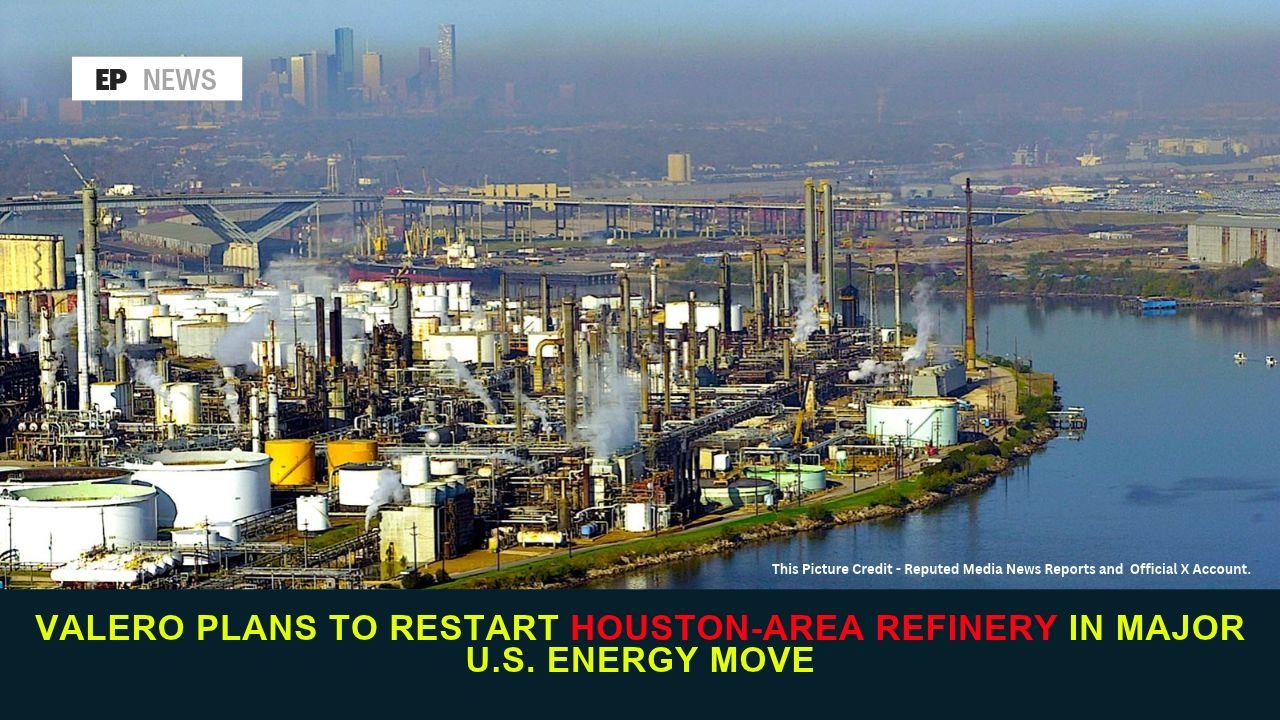
Valero Plans Major Houston Refinery Restart as U.S. Focuses on Domestic Fuel Production
November 19, 2026 | U.S News
A major development in the American energy industry is taking shape after Valero Energy agreed to purchase a shuttered refinery near Houston, Texas, and announced plans to restart part of the facility.
The proposed project could restore approximately 165,000 barrels per day of refining capacity by the end of 2027.
The acquisition and planned restart represent an important development for the U.S. refining industry, particularly as energy supply concerns and elevated fuel prices remain important economic issues.
According to Reuters, Valero agreed to purchase the facility from LyondellBasell for $320.5 million.
However, the purchase price is only one part of the overall investment.
Industry analysts estimate that restarting the refinery could require another $600 million to $700 million, potentially bringing the total project cost close to $1 billion.
The project comes as the Trump administration promotes greater domestic energy production and seeks to strengthen the country’s fuel supply.
Nevertheless, the refinery is not expected to provide immediate relief to American drivers. Its planned restart is still more than a year away.
Why the Houston Refinery Restart Matters
Refineries play a central role in the American energy system.
Crude oil cannot be used directly as gasoline or diesel in ordinary vehicles.
It must first be processed into different petroleum products.
Refineries convert crude oil into gasoline, diesel, jet fuel and other materials used throughout the economy.
The availability of refining capacity is therefore important for ensuring that crude oil can be converted into usable fuel.
The proposed Houston-area restart could add approximately 165,000 barrels per day of refining capacity.
Reuters reported that this would represent roughly 1% of total U.S. refining capacity.
Although the increase may appear relatively small compared with the overall American energy industry, it is significant because the United States has experienced refinery closures in recent years.
Restoring an existing industrial facility can provide additional capacity without requiring an entirely new refinery to be constructed.
What Is the Total Cost of the Project?
Valero’s purchase agreement is valued at $320.5 million.
However, restarting a refinery that has been shut down requires substantial additional spending.
Equipment must be inspected, maintained and potentially replaced.
Industrial systems need to be tested before operations can safely resume.
The facility must also meet applicable environmental and operational requirements.
Analysts cited by Reuters estimate that recommissioning could cost between $600 million and $700 million.
This brings the estimated total investment to approximately $1 billion.
The final amount may depend on the condition of the existing equipment, construction requirements and regulatory approvals.
Valero will also need to consider the economics of operating the facility over the long term.
Will the Project Reduce Gasoline Prices in America?
One of the biggest questions for American consumers is whether the refinery restart could lower gasoline prices.
The answer is that the project is unlikely to provide immediate relief.
The planned additional refining capacity is not expected to become available until the end of 2027.
That means drivers should not expect an immediate reduction in gasoline prices because of this announcement.
Gasoline prices depend on several factors, including:
- Global crude oil prices.
- Refinery operating capacity.
- Domestic fuel demand.
- Transportation and distribution costs.
- Seasonal fuel requirements.
- Government regulations.
- International supply disruptions.
Additional refining capacity could help strengthen domestic fuel production over time.
However, it cannot independently determine the price consumers pay at gasoline stations.
Challenges Facing the Restart
The project also faces several operational challenges.
Restarting an industrial refinery is a complicated process.
The company must ensure that processing equipment, pipelines, storage facilities and safety systems are functioning correctly.
Environmental requirements also need to be considered.
Refineries operate under regulations designed to control emissions, manage industrial waste and protect surrounding communities.
Any significant changes to the facility may require additional review.
The company must also evaluate whether future refining margins will justify the investment.
Analysts have suggested that the acquisition could generate approximately $150 million in annual free cash flow under normal operating conditions.
That projection is not a guarantee.
Actual financial performance will depend on market conditions, operating expenses, crude oil prices and fuel demand.
What This Means for Texas and the U.S. Economy
The Houston region is one of the most important energy and petrochemical centers in the United States.
Refineries and related industrial businesses support employment, transportation networks and supply chains.
A successful restart could create opportunities for construction contractors, industrial service providers and refinery workers.
It could also contribute to regional economic activity.
However, the final employment impact will depend on the facility’s operating requirements and staffing plans.
The broader U.S. energy industry will also be watching whether additional refining investments become economically attractive.
Frequently Asked Questions
1. Which company is purchasing the Houston-area refinery?
Valero Energy agreed to purchase the facility from LyondellBasell.
2. How much is the purchase agreement worth?
The reported purchase price is $320.5 million.
3. How much refining capacity could return?
Approximately 165,000 barrels per day.
4. When could the refinery restart?
The planned target is the end of 2027.
5. Will gasoline become cheaper immediately?
No. The project is not expected to add refining capacity immediately, and gasoline prices depend on several market factors.
Conclusion
Valero’s planned Houston-area refinery restart represents a significant investment in American energy infrastructure.
The potential restoration of 165,000 barrels per day of refining capacity could strengthen domestic fuel production and reverse part of the recent decline in U.S. refining capacity.
However, the project will require substantial investment, operational preparation and regulatory compliance.
For American consumers, the most important point is timing: the additional capacity is not expected to arrive immediately.
The project’s long-term success will depend on whether Valero can complete the restart economically and operate the facility profitably in a changing energy market.
Source: Reuters- November 19, 2026