
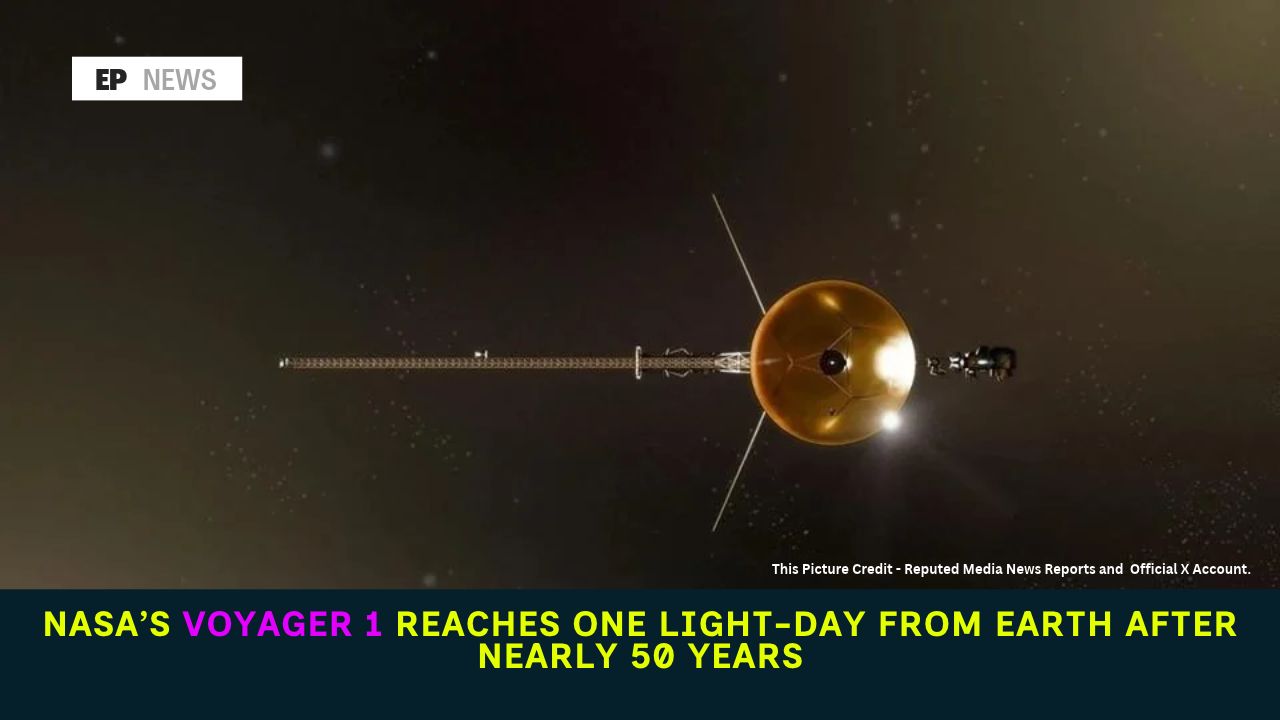
NASA’s Voyager 1 Reaches One Light-Day From Earth After Nearly 50 Years
Reporting Date: November 19, 2026
Category: U.S. News | NASA | Space & Technology
NASA’s Voyager 1 spacecraft has reached a remarkable milestone in the history of space exploration. Nearly 50 years after leaving Earth, the spacecraft has traveled approximately 16.1 billion miles (25.9 billion kilometers), becoming the first human-made object to reach a distance of one light-day from our planet.
The milestone was reached on November 18, 2026, according to NASA’s trajectory calculations. A light-day represents the distance light travels in 24 hours. At this extraordinary distance, a radio signal sent from Earth takes approximately one full day to reach Voyager 1, and a response takes another day to return.
However, the historic achievement comes alongside a technical challenge. NASA reported that Voyager 1 stopped transmitting science and engineering data on November 14. Ground controllers were still detecting its carrier signal, suggesting that important communication equipment remained operational, but the spacecraft was not returning its usual scientific information.
NASA engineers are investigating the problem. The agency said it expected to confirm the one-light-day milestone through the spacecraft’s signal and trajectory calculations on November 19.
The development highlights both the extraordinary endurance of the Voyager mission and the difficulties of operating a spacecraft billions of miles away.
Voyager 1 Reaches a Historic Distance From Earth
NASA’s Voyager 1 crossed the one-light-day distance on November 18, 2026, at approximately 2:16 a.m. Pacific Standard Time, according to the agency’s mission calculations.
At that point, the spacecraft was approximately 16.094 billion miles, or 25.902 billion kilometers, from Earth.
No other human-made object has traveled this far from our planet.
The milestone is significant because it gives scientists and the public a practical way to understand just how distant Voyager 1 has become. Even though radio signals travel at the speed of light, communication now requires an extraordinary amount of time.
A command transmitted from Earth takes about 24 hours to reach the spacecraft. A response sent back takes another 24 hours to arrive.
In other words, a simple exchange between mission controllers and Voyager 1 can require approximately two days.
NASA has emphasized that one light-day is a measurement of distance, not time. It is calculated using the distance light travels in a vacuum over 24 hours.
The milestone does not mean Voyager 1 has reached the edge of the universe. It means the spacecraft has traveled farther from Earth than any other human-made object.
What Does One Light-Day Actually Mean?
The term light-day may sound like a measurement of time, but it describes an enormous distance.
Light travels at approximately 186,000 miles per second, or around 299,000 kilometers per second.
Over 24 hours, that distance adds up to approximately:
- 16.09 billion miles
- 25.9 billion kilometers
- One light-day
For comparison, sunlight takes approximately eight minutes to travel from the Sun to Earth. Voyager 1 is now so distant that light needs an entire day to cover the distance between Earth and the spacecraft.
This also explains why NASA cannot operate Voyager 1 in the same way engineers control a nearby satellite.
When mission controllers send a command, they cannot immediately see the result. They must wait for the signal to travel through space, reach the spacecraft and, if a response is transmitted, return to Earth.
The delay makes troubleshooting extremely difficult, especially when a spacecraft experiences an unexpected technical problem.
NASA’s milestone is therefore not just about distance. It demonstrates how long a spacecraft built with technology from the 1970s has continued operating in an increasingly remote environment.
Voyager 1 Has Been Traveling Since 1977
Voyager 1 was launched by NASA on September 5, 1977. Its original mission focused on studying the outer planets of our solar system.
The spacecraft conducted historic observations of Jupiter and Saturn, helping scientists understand their atmospheres, moons, rings and surrounding environments.
Its journey also provided important discoveries about the outer solar system that could not have been achieved through Earth-based observations alone.
Voyager 1’s twin spacecraft, Voyager 2, launched earlier, on August 20, 1977.
Both spacecraft were designed to take advantage of planetary alignments that allowed them to visit multiple outer planets during their missions.
Voyager 2 later became the first and, so far, only spacecraft to visit Uranus and Neptune.
Although the original planetary missions were completed decades ago, both spacecraft continued traveling outward and conducting scientific observations.
Their extended missions have provided scientists with valuable information about the region beyond the Sun’s immediate influence.
Voyager 1 Entered Interstellar Space in 2012
One of Voyager 1’s most important achievements occurred in August 2012, when it crossed the heliopause and entered interstellar space.
The heliopause is the boundary where the solar wind’s influence meets the surrounding interstellar environment.
The solar wind is a continuous flow of charged particles released by the Sun. Together with the Sun’s magnetic field, it creates a vast protective region known as the heliosphere.
Voyager 1 became the first spacecraft to enter interstellar space, providing scientists with direct measurements from a region beyond the heliosphere.
Voyager 2 crossed the same boundary in November 2018.
These achievements gave researchers a rare opportunity to study the environment outside the Sun’s protective bubble.
The spacecraft continue to collect information about particles, magnetic fields and plasma waves in interstellar space, although their available instruments and power are increasingly limited.
Voyager 1’s one-light-day milestone represents another chapter in this remarkable scientific journey.
NASA Reports a Technical Problem With Voyager 1
While the distance achievement is a historic moment, NASA has also been dealing with a communication and data problem involving Voyager 1.
According to a NASA update published on November 18, the mission team discovered on November 14 that the spacecraft had stopped returning science and engineering data.
A Deep Space Network antenna in Canberra, Australia, detected Voyager 1’s carrier signal. A carrier signal is the basic radio signal used to carry information from the spacecraft to Earth.
However, the antenna received the signal without the expected data.
This distinction is important.
NASA explained that the presence of the carrier signal indicates that Voyager 1’s attitude and articulation control system is continuing to point the spacecraft toward Earth. Its antenna and radio-transmission equipment also appear to be functioning.
The missing data may instead involve the onboard computer responsible for collecting information from the spacecraft’s systems and scientific instruments and preparing it for transmission.
NASA has not announced a confirmed final cause for the problem.
Engineers are investigating the issue and considering possible next steps.
The agency has also been examining whether the current problem is connected to a brief communications interruption in October, when Voyager 1 temporarily lost contact with Earth for approximately 48 hours before communications resumed.
Why Fixing Voyager 1 Is So Difficult
Repairing a spacecraft located more than 16 billion miles away is not like fixing a satellite in Earth’s orbit.
NASA engineers cannot send a technician to inspect Voyager 1 or replace a damaged component.
Every troubleshooting operation must be performed remotely through radio communications.
The enormous distance creates a major delay. A signal takes about 24 hours to travel from Earth to the spacecraft, and another 24 hours for a response to return.
This means that engineers may have to wait approximately two days to understand the result of a command.
The spacecraft also uses technology developed in the 1970s. Its onboard computers have extremely limited processing capacity compared with modern computers.
Engineers must therefore work carefully when sending commands or changing operating procedures.
A small technical issue can require weeks or longer to diagnose because of the communication delay and the complexity of the spacecraft’s systems.
NASA noted that Voyager 1 experienced a similar situation in 2023, when the ground team received a carrier signal but no usable data. That earlier issue was traced to an onboard computer, and the experience gained from resolving it is helping engineers investigate the latest problem.
However, NASA has not confirmed that the current issue has the same cause.
How NASA Is Confirming the One-Light-Day Milestone
The technical problem has created an unusual situation for the mission team.
Although Voyager 1 is not currently returning its usual science and engineering data, NASA can still calculate its position using years of trajectory measurements.
The spacecraft is traveling away from Earth at a relatively consistent speed along a known path. Engineers can use these calculations to determine when it reaches a specific distance.
NASA said the carrier signal and trajectory calculations would allow the mission team to confirm the one-light-day milestone on November 19.
The agency had already calculated that the spacecraft crossed the distance on November 18.
This distinction matters: the milestone is based on the spacecraft’s known position and trajectory, not on whether every scientific instrument is currently transmitting data.
The communication issue does not change the spacecraft’s position or prevent it from continuing its outward journey.
Voyager 1 Is Carrying a Message From Earth
Voyager 1 is also famous for carrying the Golden Record, a specially prepared message intended to represent life and civilization on Earth.
The Golden Record was included aboard both Voyager spacecraft.
It contains sounds, music, images and greetings from different cultures and languages, selected to provide a representation of humanity and our planet.
The record was designed as a symbolic message that could potentially be discovered by an intelligent civilization in the distant future.
It includes natural sounds such as wind, thunder and animal calls, along with human greetings and selected musical recordings.
The Golden Record is not a communication system that NASA can use to contact other civilizations. It is a physical message carried by the spacecraft as it travels through space.
Nearly five decades after launch, the record remains one of the most recognizable symbols of humanity’s exploration beyond Earth.
Voyager 1’s one-light-day milestone gives the Golden Record an additional meaning: the spacecraft carrying this message is now so far away that even a signal traveling at the speed of light needs a full day to reach it.
NASA Invited People Around the World to Celebrate
NASA also organized a public celebration called “Shine Bright for Voyager’s Light-Day.”
The agency invited people around the world to create a symbolic wave of golden light after sunset on November 17.
Participants were encouraged to use flashlights, phones, tablets and illuminated buildings to represent a signal being sent toward Voyager 1.
NASA also provided a way to flash the spacecraft’s call sign, VGR, using Morse code.
The event was symbolic rather than a method of establishing direct communication with the spacecraft. Its purpose was to help people connect with a historic achievement in space exploration.
The campaign highlighted how Voyager 1 represents the work of thousands of scientists, engineers and other mission specialists across generations.
What Happens to Voyager 1 Next?
Voyager 1 will continue traveling farther from Earth as long as its remaining systems and power supply allow.
However, its ability to operate is becoming increasingly limited.
The spacecraft uses radioisotope thermoelectric generators, which produce electricity from the heat released by the natural decay of radioactive material.
The available electrical power gradually decreases over time.
NASA has been switching off selected instruments and spacecraft systems to conserve energy and extend the mission.
These decisions involve difficult trade-offs. Engineers must decide which equipment can be shut down while preserving the spacecraft’s most important scientific and communication capabilities.
The current data problem adds another challenge, but NASA has not announced that the mission is ending.
The agency has repeatedly demonstrated its commitment to keeping both Voyager spacecraft operational for as long as technically possible.
Even if Voyager 1 eventually stops communicating with Earth, it will continue traveling through interstellar space.
Its journey will not end simply because its ability to transmit information becomes unavailable.
Why the Voyager Mission Still Matters to Science
Voyager 1 and Voyager 2 have provided scientific information that would otherwise be extremely difficult to obtain.
Their measurements beyond the heliosphere help scientists understand the interaction between the Sun and the interstellar environment.
Researchers can study cosmic rays, magnetic fields, charged particles and plasma waves using data collected by the probes.
These observations also help scientists understand how the Sun’s influence extends into space and how the solar system interacts with the wider galaxy.
The mission has also demonstrated the value of long-term scientific investment.
Voyager 1 was launched decades before smartphones, modern internet services and many of today’s computing technologies existed.
Yet the spacecraft continues to operate at a distance that makes ordinary communication and troubleshooting extraordinarily difficult.
Its achievements show how engineering designed for a specific scientific purpose can remain valuable far beyond the original mission timeline.
Conclusion: Voyager 1 Continues Its Historic Journey
NASA’s Voyager 1 has reached one of the most extraordinary milestones in space exploration by traveling one light-day from Earth.
At approximately 16.1 billion miles away, it is now so distant that light itself requires a full day to reach it.
The achievement reflects nearly 50 years of engineering, scientific research and mission operations.
However, the spacecraft is also facing a new technical challenge after NASA detected a carrier signal without the expected science and engineering data.
Mission engineers are investigating the issue, and the agency has used trajectory calculations to establish the timing of the historic distance milestone.
Voyager 1’s journey is far from an ordinary space mission. It is a continuing reminder of humanity’s ability to explore beyond the limits of our immediate surroundings.
As the spacecraft moves deeper into interstellar space, it carries with it a message from Earth and a scientific legacy that will remain important for generations.
Frequently Asked Questions (FAQs)
1. How far away is Voyager 1 from Earth in November 2026?
Voyager 1 reached approximately 16.094 billion miles (25.902 billion kilometers) from Earth on November 18, 2026, according to NASA’s trajectory calculations.
2. What is one light-day?
One light-day is the distance light travels in 24 hours. It is approximately 16.09 billion miles or 25.9 billion kilometers.
3. When was Voyager 1 launched?
NASA launched Voyager 1 on September 5, 1977. Its original mission included studying Jupiter and Saturn.
4. Is Voyager 1 still in space?
Yes. Voyager 1 continues traveling through interstellar space beyond the heliosphere, the region influenced by the Sun’s solar wind and magnetic field.
5. Why has Voyager 1 stopped sending science data?
NASA reported that the spacecraft stopped returning science and engineering data on November 14, 2026, although its carrier signal was still detected. Engineers are investigating the cause, which had not been confirmed as of November 19.
6. Can NASA still communicate with Voyager 1?
NASA detected the spacecraft’s carrier signal, indicating that important communication equipment remained operational. However, the spacecraft was not returning its usual science and engineering data in the November 18 update.
7. How long does a message take to reach Voyager 1?
A radio signal traveling at the speed of light takes approximately 24 hours to reach Voyager 1. A response takes another 24 hours to return to Earth.
8. What is the Golden Record on Voyager 1?
The Golden Record is a specially prepared collection of sounds, music, images and greetings from Earth. It was included aboard both Voyager spacecraft as a symbolic message representing humanity.
9. Is Voyager 1 the farthest human-made object from Earth?
Yes. Voyager 1 remains the farthest human-made object from Earth and became the first to reach a distance of one light-day.
10. Will Voyager 1 continue operating forever?
No. Its power supply gradually decreases, and its systems will eventually stop functioning. NASA is conserving energy to keep the spacecraft operating and returning scientific information for as long as possible.
Note: This article reflects NASA information available on November 19, 2026. The one-light-day distance was calculated for November 18. NASA’s November 18 technical update said the mission team expected to confirm the milestone on November 19 while investigating the missing science and engineering data. Do not describe the data issue as a confirmed permanent failure.