
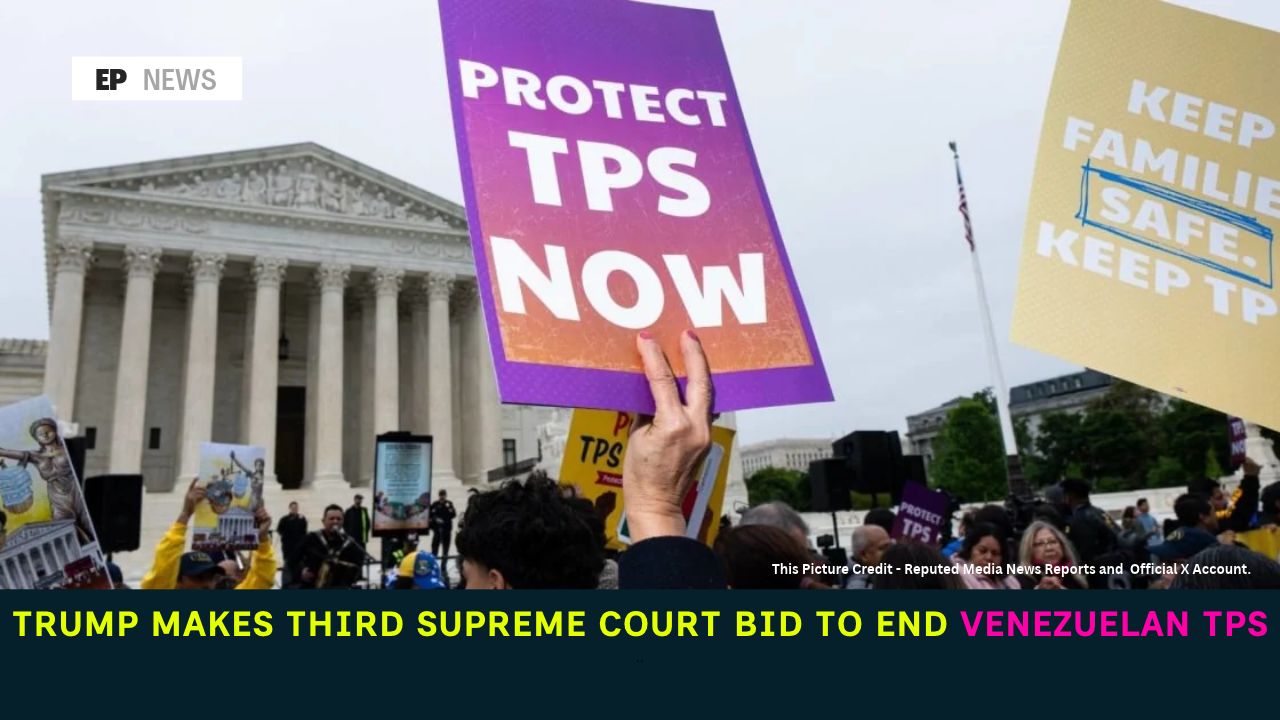
Trump Makes Third Supreme Court Bid to End Venezuelan TPS
Reporting Date: November 19, 2026
Category: U.S. News | Immigration | Supreme Court
The Trump administration has returned to the U.S. Supreme Court for the third time in its legal battle over immigration protections for Venezuelan nationals living in the United States. The latest emergency request asks the justices to prevent a federal court ruling from restoring Temporary Protected Status (TPS) for hundreds of thousands of Venezuelan migrants.
The legal dispute has reached a critical point because a temporary pause issued by the Ninth Circuit Court of Appeals is scheduled to expire on Friday, November 20. Unless another court order intervenes, a lower-court judgment setting aside the administration’s termination of Venezuela’s 2023 TPS designation could take effect.
The Department of Justice argues that restoring the protections would create immediate difficulties for immigration enforcement, including potentially requiring the release of approximately 1,800 Venezuelans currently held in immigration detention. Lawyers representing TPS holders and immigrant-rights organizations oppose the administration’s request and argue that the government should not be allowed to continue a policy that lower courts have found unlawful.
As of November 19, the Supreme Court had not announced a decision on the administration’s latest emergency application. The outcome could have significant consequences for Venezuelan families, immigration proceedings, employment authorization and the federal government’s authority to terminate humanitarian protections.
Why the Trump Administration Has Returned to the Supreme Court
On November 18, the Justice Department submitted an emergency application asking the Supreme Court to block the effect of a federal district court judgment in the case National TPS Alliance v. Mullin.
The filing represents the administration’s third attempt to obtain emergency relief from the Supreme Court in this particular dispute. The government wants the justices to keep the termination of Venezuela’s 2023 TPS designation in place while the case continues through the federal appeals process.
According to the application, the government believes it has a strong legal argument that federal courts cannot review certain decisions made by the Department of Homeland Security secretary concerning the termination of a country’s TPS designation.
The administration also argues that allowing the lower-court judgment to take effect would cause immediate operational problems. Its filing says immigration authorities could be required to release around 1,800 Venezuelan nationals from detention and stop carrying out as many as 332 final removal orders covered by the dispute.
These figures are arguments presented by the federal government in its court filing. They should not be interpreted as a Supreme Court finding or an independently confirmed prediction of what will happen to every person affected.
The emergency application asks the Supreme Court to issue an immediate administrative stay while it considers the government’s request for a longer stay. The court has not yet issued a final ruling on the November 18 application.
What Is Temporary Protected Status?
Temporary Protected Status is a humanitarian immigration program established by Congress in 1990. It allows eligible nationals of certain countries to remain temporarily in the United States when conditions in their home countries make it unsafe or otherwise inappropriate for them to return.
The program can apply when a country is experiencing circumstances such as armed conflict, environmental disasters or extraordinary and temporary conditions that prevent safe return.
TPS is not the same as permanent residency, citizenship or an automatic path to a green card. It does not independently provide permanent immigration status. Instead, it offers temporary protection from deportation and, for eligible beneficiaries, permission to work in the United States while the relevant designation remains active.
Under the program, eligible beneficiaries generally cannot be removed from the United States or detained solely on the basis of their immigration status during the period in which the applicable TPS designation protects them. They may also qualify for employment authorization.
The Department of Homeland Security reviews country conditions and makes decisions about whether a designation should continue, be extended or be terminated under the law.
The central question in the Venezuelan case is not simply whether Venezuela continues to face difficult conditions. It also concerns the legal authority of the DHS secretary and the extent to which courts can review decisions involving the termination of TPS.
How Venezuelans Received TPS Protections
The United States first designated Venezuela for Temporary Protected Status in March 2021 during the administration of President Joe Biden.
At that time, the government cited extraordinary conditions that prevented many Venezuelan nationals from safely returning to their country. These included political repression, economic instability and serious humanitarian concerns.
In October 2023, the Biden administration expanded the protection by issuing a new TPS designation for Venezuela. The expansion made additional Venezuelan nationals eligible, subject to the program’s requirements.
The administration later announced an 18-month extension of the 2023 designation in January 2025. That decision was subsequently reversed by the incoming Trump administration.
According to the Associated Press, approximately 600,000 Venezuelans received TPS protections after the program was introduced and expanded.
The legal dispute currently before the courts focuses on the administration’s termination of the 2023 designation and related decisions. The government’s Supreme Court application also explains that the separate 2021 designation was terminated and is not itself being challenged in this particular case.
This distinction matters because the litigation is not a general ruling about every Venezuelan immigration category or every person who has lived in the United States under a different immigration status.
Why Lower Courts Ruled Against the Administration
The case began after the National TPS Alliance and individual Venezuelan beneficiaries challenged the federal government’s decisions to end the protections.
The plaintiffs argued that the administration’s actions violated federal administrative law. They questioned whether the government had followed the required procedures and properly evaluated the relevant circumstances before terminating the designation.
On September 5, 2025, a federal district court in California granted summary judgment to the plaintiffs and set aside the administration’s decisions.
The district court concluded that the termination decision was arbitrary and capricious under the Administrative Procedure Act. Among its concerns, the court found that the administration had not carried out meaningful consultation with relevant government agencies and had not adequately explained its decision.
The government appealed the ruling.
In January 2026, the Ninth Circuit Court of Appeals upheld the district court’s summary-judgment decision. However, the Supreme Court later intervened in the case and sent it back to the appeals court for further consideration in light of a separate Supreme Court decision involving the legal review of TPS termination decisions.
That earlier Supreme Court intervention is an important part of the current dispute. It means the lower-court ruling has not simply moved forward without interruption.
On November 3, 2026, the Ninth Circuit issued an order granting the government a 14-day administrative stay beginning November 6. The court also directed the parties to provide expedited supplemental briefing.
That temporary order created the November 20 deadline now driving the latest emergency application.
What the Government Says Could Happen if TPS Returns
The Justice Department argues that allowing the district court judgment to take effect would require the federal government to reverse some immigration enforcement actions taken during the period when the Venezuelan designation was terminated.
Its November 18 filing identifies several possible consequences.
First, the government says it could be required to release approximately 1,800 Venezuelan nationals currently in immigration detention if they are covered by the restored TPS protections and cannot legally be detained on the basis of their immigration status alone.
Second, the administration argues that it could be prevented from carrying out up to 332 final removal orders involving people covered by the relevant designation.
Third, the government says it would have to address employment authorization for eligible beneficiaries. Work authorization documents that became invalid after the termination could become relevant again if the protections are restored.
The administration describes these consequences as severe and immediate. It also argues that changing immigration and employment records while the legal dispute continues could create administrative confusion.
These are the government’s arguments in support of its emergency request. The Supreme Court has not yet accepted them as established facts or ruled that the administration is entitled to the requested relief.
What Venezuelan Migrants and Their Lawyers Are Arguing
The plaintiffs and immigrant-rights advocates have taken the opposite position.
They argue that the government should not be allowed to continue enforcing a termination decision that a federal district court found unlawful. They also contend that the lower courts should be permitted to complete their review instead of having the Supreme Court repeatedly intervene through emergency applications.
Emi MacLean, an attorney for the National TPS Alliance at the American Civil Liberties Union of Northern California, criticized the administration’s latest request in comments reported by the Associated Press.
The plaintiffs have also described the consequences experienced by Venezuelan TPS beneficiaries since the protections were terminated. Their claims include detention, deportation, separation from family members who are U.S. citizens and removal to countries where some individuals had no previous ties.
Those allegations form part of the plaintiffs’ position in the legal dispute. They should not be treated as a finding that every Venezuelan TPS holder experienced the same circumstances.
The case also involves a broader question about how humanitarian immigration protections are administered. Supporters of TPS argue that people should not be returned to countries where conditions remain unsafe. The administration maintains that TPS is temporary and that the law gives the DHS secretary substantial discretion over whether a country’s designation should continue.
The Supreme Court’s Earlier Decisions Matter
This is not the first time the Supreme Court has considered emergency requests connected to the Venezuelan TPS litigation.
The administration previously obtained Supreme Court intervention that paused lower-court orders while the case proceeded. In October 2026, the justices again acted in the case, vacating an earlier Ninth Circuit judgment and returning the dispute to the appeals court for further consideration.
The government now argues that a later Supreme Court decision, Mullin v. Doe, supports its position that courts cannot review nonconstitutional challenges to the secretary’s decision to terminate a country’s TPS designation.
That legal argument is central to the November 18 application.
However, the current emergency request is a separate procedural step. The Supreme Court must decide whether to grant the requested relief, and the broader legal dispute may continue even after an emergency application is resolved.
The court’s earlier decisions involving TPS for Haitians and Syrians are also relevant background. In June 2026, the Supreme Court allowed the Trump administration to proceed with separate actions ending protections for people from those countries. But those cases do not automatically determine the outcome of the Venezuelan litigation.
What Could Happen After November 20?
The immediate question is whether the Supreme Court or the Ninth Circuit will issue another order before the temporary administrative stay expires.
There are several possible outcomes.
1. The Supreme Court grants the administration’s request.
If the justices issue the requested stay, the lower-court judgment would remain blocked while the legal proceedings continue. The administration would retain its current position on the affected TPS designation during that period.
2. The Supreme Court declines to intervene.
If the Supreme Court does not grant the requested emergency relief and no other order extends the pause, the lower-court judgment could take effect as the existing temporary stay expires. That could lead to renewed TPS protections for eligible beneficiaries under the relevant 2023 designation, subject to the precise terms of the court orders and applicable immigration requirements.
3. The appeals court issues another order.
The Ninth Circuit could take further action on the case, including addressing the legal arguments raised after the Supreme Court’s October remand. Any new order could affect the timing and practical consequences of the dispute.
The exact outcome will depend on the courts’ decisions. November 20 is an important procedural deadline, not a guarantee that every affected migrant will automatically receive a new immigration document or that all individual cases will be resolved on that date.
What This Means for Venezuelan Families and U.S. Employers
The dispute has consequences beyond the courtroom.
For Venezuelan families, the legal outcome could affect their ability to remain in the United States, avoid removal proceedings and maintain employment authorization if they qualify under the relevant TPS designation.
For employers, a change in the legal status of TPS protections could create questions about employment eligibility documents and verification procedures.
For immigration authorities, the dispute could require adjustments to detention, removal and work-authorization records.
However, people should not assume that every Venezuelan national living in the United States qualifies for TPS. Eligibility depends on the relevant designation, registration rules, residence and physical-presence requirements, and other legal conditions.
People who believe they may be affected should check official Department of Homeland Security and U.S. Citizenship and Immigration Services guidance and consult a qualified immigration attorney before making decisions about employment, travel or immigration status.
Conclusion: A Critical Legal Decision Is Approaching
The Trump administration’s third emergency appeal places Venezuelan TPS protections back before the U.S. Supreme Court at a particularly important moment.
The government argues that restoring the protections would disrupt immigration enforcement and create immediate administrative challenges. Venezuelan migrants and their advocates argue that the termination was unlawful and that the lower-court judgment should be allowed to take effect.
The November 20 deadline is now the immediate focus of the case. However, the wider legal dispute is likely to remain significant even after the next procedural decision.
As of November 19, 2026, the Supreme Court had not announced a decision on the latest application. The situation remains legally unresolved, and the practical impact on Venezuelan families will depend on what the courts decide next.
Frequently Asked Questions (FAQs)
1. Why did the Trump administration appeal to the Supreme Court again?
The administration filed an emergency application on November 18, 2026, asking the Supreme Court to block a lower-court judgment that could restore TPS protections for eligible Venezuelan migrants.
2. What is the November 20, 2026, deadline?
A temporary administrative stay issued by the Ninth Circuit on November 3 is scheduled to expire on November 20. If no further order intervenes, the lower-court judgment could take effect.
3. How many Venezuelans could be affected?
The Associated Press reported that approximately 600,000 Venezuelans received TPS protections after the program was introduced and expanded. The precise number of people currently living in the United States who remain affected by the litigation is unclear.
4. Could 1,800 Venezuelan migrants be released from detention?
The Justice Department says restoring the relevant TPS protections could require the government to release approximately 1,800 Venezuelans from immigration detention. This is the administration’s estimate presented in its court filing, not a Supreme Court order requiring those releases as of November 19.
5. Does TPS provide permanent U.S. residency?
No. Temporary Protected Status is a temporary humanitarian protection. It does not automatically provide permanent residency, U.S. citizenship or a green card.
6. Has the Supreme Court restored Venezuelan TPS?
No final decision on the administration’s November 18 emergency application had been announced as of November 19, 2026.
7. Where can Venezuelan migrants check official updates?
Affected individuals can monitor announcements from U.S. Citizenship and Immigration Services and the Department of Homeland Security. They should also consult a qualified immigration attorney for advice about their individual circumstances.
Note: This article reflects information available on November 19, 2026. The Supreme Court had not ruled on the administration’s latest emergency application at the time of reporting. The November 20 deadline and possible consequences should be updated if a new court order is issued.