
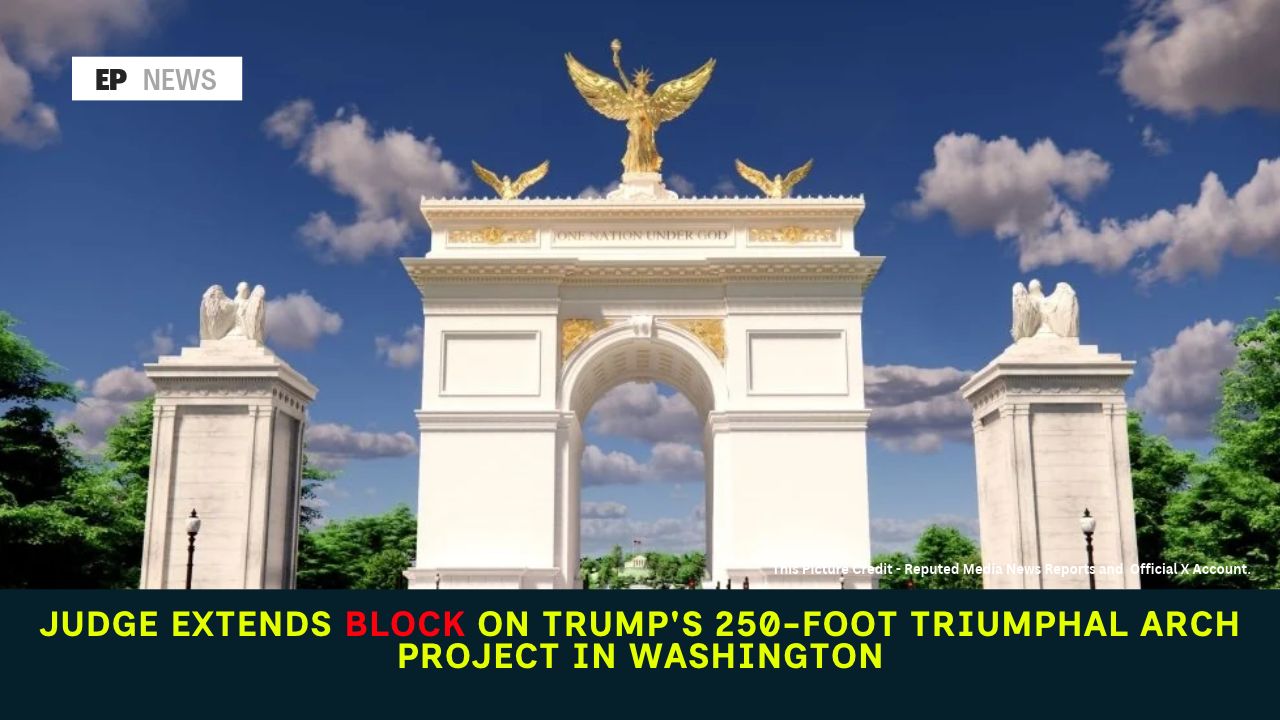
Judge Extends Block on Trump’s 250-Foot Triumphal Arch Project in Washington
November 19, 2026 | U.S News
A federal judge has extended a temporary order blocking construction of President Donald Trump’s proposed 250-foot triumphal arch near Arlington National Cemetery, giving the court more time to consider legal challenges against the controversial Washington monument project.
U.S. District Judge Tanya Chutkan issued the 14-day extension on Wednesday, November 18, keeping the construction project on hold until December 3, 2026, or until she issues a decision on the pending request for a longer-term preliminary injunction, whichever comes first.
The ruling is another legal setback for the Trump administration’s effort to build a monumental arch at Memorial Circle, near the Arlington Memorial Bridge and the Lincoln Memorial.
The administration has defended the project as a fitting monument intended to honor the United States and its veterans. Opponents, including Vietnam War veterans, historic preservation advocates, the District of Columbia and Virginia, argue that the construction lacks the necessary congressional authorization and could damage historically important public spaces.
The dispute has become a major legal and political controversy involving presidential authority, federal construction rules, historic preservation and the future appearance of the nation’s capital.
Why Did the Judge Extend the Construction Ban?
The temporary restraining order blocking construction was originally issued on November 5, 2026. It was due to expire on November 19.
The plaintiffs asked Judge Chutkan to extend the restriction while the court considered their request for a preliminary injunction that could keep the project suspended for a longer period.
On November 18, Chutkan agreed to extend the temporary order for another 14 days.
According to the Associated Press, the judge said circumstances in the litigation had not changed significantly since the earlier order. She decided that maintaining the existing situation was appropriate while the court considered the pending legal arguments.
The extension means the administration cannot begin construction-related work covered by the court’s order during this period.
However, the decision does not permanently cancel the proposed arch.
It is also not a final ruling that the entire project is illegal. The court is still considering the legal challenges and whether a longer-lasting injunction should be issued.
The White House criticized the extension. Spokesperson Davis Ingle described the ruling as an example of what the administration considers judicial interference with a project intended to unite the country.
The administration said it would continue defending the monument in court and remained confident it would ultimately prevail.
What Is Trump’s Proposed 250-Foot Triumphal Arch?
The proposed monument is planned for Memorial Circle, a traffic circle near the Arlington Memorial Bridge in Washington, D.C.
The location is especially important because it connects several nationally significant landmarks, including the Lincoln Memorial, Arlington Memorial Bridge and Arlington National Cemetery.
According to the federal court’s November 5 memorandum opinion, the proposed arch would stand approximately 250 feet tall.
That would make it more than twice the height of the Lincoln Memorial.
Reuters reported that the design shown in project renderings includes a large gold-colored winged female figure holding a flame, with gold eagles positioned around the structure.
The project has been referred to by different names, including the Independence Arch, the Great Triumphal Arch and the Military Triumphal Arch.
The design and its proposed location have become central issues in the controversy.
Supporters describe the structure as a major national monument that could become a recognizable feature of Washington.
Critics argue that its scale and placement could change the historic landscape around Arlington National Cemetery and disrupt important views between existing monuments.
The project is therefore not only a construction proposal. It has become a debate about how new monuments should fit into the carefully planned design of the U.S. capital.
Where Would the Arch Be Built?
The proposed construction site is Memorial Circle, located at the end of Arlington Memorial Bridge, near the entrance to Arlington National Cemetery.
The site is part of an important ceremonial and historic route connecting Washington’s monuments with the cemetery.
According to Judge Chutkan’s November 5 opinion, Memorial Circle has remained largely undeveloped green space for more than 85 years, preserving an unobstructed view toward Arlington National Cemetery.
The court described the area as part of a historic route extending from the Lincoln Memorial across the Potomac River and toward the cemetery gates.
The location has become a major concern for opponents of the project.
They argue that placing a 250-foot structure in this area could alter the historic relationship between the monuments and the cemetery.
The proposed construction could also affect traffic patterns around Memorial Circle.
The federal government’s environmental assessment projected that construction would require site preparation, excavation and foundation work before the main structure could be completed.
The assessment estimated that site preparation could take two to three months, foundation work another four to five months, and total construction approximately two to three years.
These are project estimates, not a confirmed construction schedule. The current court order prevents the administration from proceeding with the construction activities covered by the injunction.
Why Are Veterans and Historic Preservation Groups Opposing the Project?
The original lawsuit was filed by three Vietnam War veterans and an architectural historian.
They argue that the Trump administration does not have the necessary congressional authorization to build the proposed arch on federal land.
Their legal challenge focuses on federal laws governing construction on public land in Washington and the approval process for commemorative monuments.
The plaintiffs also argue that the project could harm historic views and the character of the area surrounding Arlington National Cemetery.
For the veterans involved, the location has personal and symbolic importance.
They have described their connection to Arlington as a place where they visit the graves of fellow service members and remember those who died during military service.
The architectural historian involved in the lawsuit has also raised concerns about the visual relationship between the Lincoln Memorial, Arlington Memorial Bridge and the cemetery.
The plaintiffs are seeking to prevent construction from proceeding without the legal approvals they believe are required.
Their arguments remain part of an ongoing lawsuit. The administration disputes their position.
Why Did Washington, D.C., and Virginia File a Lawsuit?
The legal dispute expanded when the District of Columbia and the Commonwealth of Virginia filed a separate lawsuit on October 31, 2026.
Both governments argued that construction could create practical and environmental problems for their jurisdictions.
Their concerns include:
- Increased traffic congestion near Memorial Circle.
- Road closures and changes to existing traffic routes.
- Additional pressure on emergency services.
- Potential environmental effects.
- Damage to the historic character of the area.
- Disruption to commuters and visitors.
The court consolidated the District of Columbia and Virginia case with the original lawsuit filed by the veterans and architectural historian.
This allowed the court to consider related legal challenges together.
The two governments also argued that federal agencies had not followed all applicable legal requirements before approving the project.
Their case includes claims under the Administrative Procedure Act and other federal laws.
The lawsuit does not mean that the court has already ruled against the administration on every issue. The legal claims remain subject to judicial review.
What Is the Trump Administration’s Defense?
The Trump administration argues that the project has legal authorization and that it can proceed through the relevant federal approval process.
Its position is that Congress authorized a monument at Memorial Circle more than a century ago alongside legislation concerning the Potomac River bridge.
The administration maintains that the existing authorization gives federal officials room to approve the proposed structure.
It has also argued that the arch would honor veterans and represent the country’s history and national identity.
Before the latest court extension, the project had received several important administrative approvals.
The Commission of Fine Arts had approved the design, the Federal Aviation Administration had issued a determination that the structure would not create a hazard to air navigation, and the National Capital Planning Commission had reviewed the project.
On November 5, the National Capital Planning Commission approved the arch proposal by an 8-4 vote.
The Department of the Interior also issued a final decision approving construction on November 5.
However, administrative approvals do not automatically resolve the separate legal question of whether the project has the required congressional authorization.
That issue remains central to the ongoing court proceedings.
What Laws Are at the Center of the Dispute?
The lawsuit raises questions about several federal laws governing construction and historic preservation in Washington.
One important provision is 40 U.S.C. Section 8106.
The law generally requires express congressional authorization before a building or structure can be erected on federal reservations, parks or public grounds in the District of Columbia.
The plaintiffs argue that the administration has not demonstrated the necessary authorization for the proposed arch.
Another important law is the Commemorative Works Act of 1986.
This legislation establishes procedures for creating monuments and commemorative structures on certain federal lands.
It is intended to protect the design and historic character of the nation’s capital and ensure that monuments are appropriately located and approved.
The lawsuit also raises questions under the National Environmental Policy Act and the National Historic Preservation Act.
These laws involve federal environmental review and the protection of historic properties.
The administration and the plaintiffs disagree about how these laws apply to the proposed monument.
The court will need to consider those arguments before deciding whether the project can legally move forward.
Why Is Arlington National Cemetery Important to This Case?
Arlington National Cemetery is one of the most significant military burial grounds in the United States.
It is the final resting place of thousands of American service members, veterans and national figures.
The proposed arch would be located near the cemetery, making the project’s visual and physical relationship with the site particularly sensitive.
Members of the Kennedy family filed a separate lawsuit on November 10, arguing that the proposed structure could obstruct views and cast shadows over gravesites, including those of family members buried at Arlington.
Their concerns add another dimension to the dispute.
For critics, the question is not simply whether a new monument should be built. It is whether a structure of this scale should be placed so close to an existing national memorial landscape.
The administration, however, argues that the arch would honor military service and national history.
The disagreement reflects different views about how the country should commemorate its history and preserve existing landmarks.
Could the Arch Still Be Built?
Yes. The court has not permanently cancelled the project.
The current order is temporary and is intended to preserve the situation while the judge reviews the legal arguments.
There are several possible outcomes.
The court could issue a longer-term injunction. If the judge grants the plaintiffs’ request, construction could remain blocked while the litigation continues.
The court could deny the request for a preliminary injunction. In that situation, the administration could have a path toward resuming the project, subject to the court’s orders and any other legal requirements.
The dispute could continue through appeals. Either side may seek review of important legal decisions, potentially extending the case.
A final decision will depend on the court’s assessment of congressional authorization, federal planning laws, environmental requirements and the arguments presented by both sides.
The December 3 date is therefore an important deadline for the current temporary order, not a guaranteed date for construction to restart.
What Happens Next in the Trump Arch Lawsuit?
The immediate next step is for Judge Chutkan to consider the pending request for a preliminary injunction.
The administration must continue complying with the temporary restraining order and ensure that relevant employees, contractors and other parties involved in the project are informed of the court’s restrictions.
The plaintiffs will continue arguing that construction should remain blocked until the legal questions are resolved.
The White House has indicated that it will keep defending the project.
The legal dispute could also become part of a wider political debate when Democrats take control of Congress in January 2027.
Several Democratic lawmakers have already indicated that they intend to oppose the project.
However, congressional opposition and the court case are separate matters. Any legislative action would have to follow the relevant procedures, while the federal judge will decide the legal issues currently before the court.
For now, the construction ban remains in effect.
Conclusion
The extension of the court order blocking President Donald Trump’s proposed 250-foot triumphal arch is an important development in the legal battle over the future of Memorial Circle in Washington.
Judge Tanya Chutkan has given the court until December 3, 2026, or until an earlier ruling on the pending injunction request, to consider whether construction should remain blocked for a longer period.
The administration argues that the monument has legal authorization and would honor American veterans. Opponents say the project lacks the necessary congressional approval and could damage an important historic landscape near Arlington National Cemetery.
The case has brought together veterans, preservation advocates, state and local governments and members of the Kennedy family.
Although the latest decision delays construction, it does not permanently cancel the project.
The next major development will be the court’s decision on whether to issue a longer-term injunction. Until then, the proposed arch remains on hold.
Frequently Asked Questions (FAQs)
1. Why did a federal judge block Trump’s triumphal arch?
A federal judge temporarily blocked construction after plaintiffs challenged whether the Trump administration had the necessary congressional authorization and had followed applicable federal laws.
2. When will the construction ban expire?
The temporary restraining order has been extended through December 3, 2026, unless the judge issues an earlier decision on the request for a preliminary injunction.
3. How tall will Trump’s proposed arch be?
The proposed structure is approximately 250 feet tall, making it more than twice the height of the Lincoln Memorial.
4. Where will the arch be built?
The proposed site is Memorial Circle near Arlington Memorial Bridge, between the Lincoln Memorial and Arlington National Cemetery.
5. Who is Judge Tanya Chutkan?
Tanya Chutkan is a U.S. District Judge for the District of Columbia. She is overseeing the consolidated federal cases challenging the arch project.
6. Why are veterans opposing the monument?
Three Vietnam War veterans and an architectural historian argue that the project lacks required congressional authorization and could harm the historic landscape around Arlington National Cemetery.
7. Has the Trump arch project been permanently cancelled?
No. The judge has extended a temporary construction ban. A final decision on the request for a longer-term injunction is still pending.
8. Does the Trump administration support the project?
Yes. The administration says the arch would honor veterans and argues that existing congressional authorization allows the project to proceed.
9. What is the next important date in the case?
December 3, 2026, is the current end date of the extended temporary restraining order, unless the court issues an earlier decision.
Sources and References
- Associated Press – Judge issues 14-day extension of order blocking Trump’s memorial arch in Washington.
- Reuters – Judge extends block on construction of Trump’s triumphal arch.
- U.S. District Court for the District of Columbia – Lemmon v. Trump and consolidated cases, November 5, 2026 memorandum opinion.
- National Capital Planning Commission – Review and approval of the proposed Memorial Circle arch.
- U.S. Department of the Interior – November 5, 2026 decision record concerning the Triumphal Arch at Memorial Circle.