
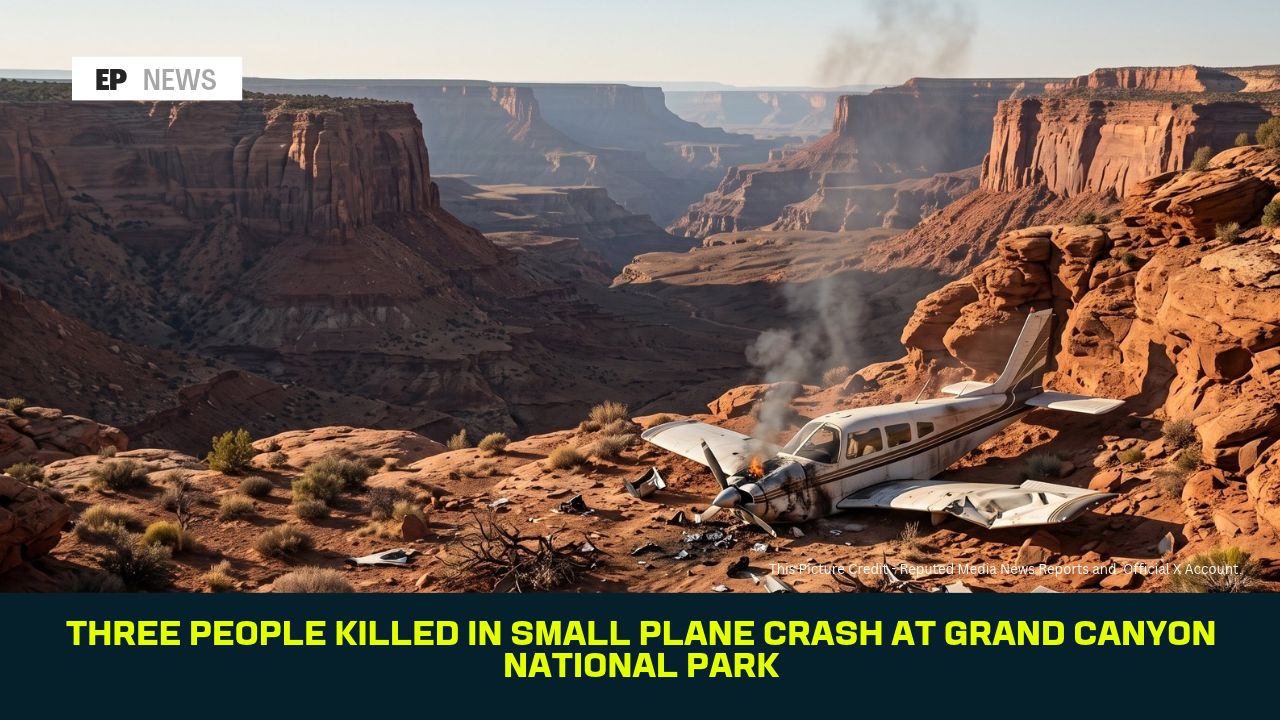
Three People Killed in Small Plane Crash at Grand Canyon National Park
November 17, 2026 | U.S News
Three people have died after a small aircraft crashed near the North Rim of Grand Canyon National Park in Arizona, triggering an overnight search operation and a federal aviation investigation.
The National Park Service (NPS) confirmed that search teams located the aircraft and its debris field at approximately 10:15 a.m. local time on Monday, November 16. Officials said there were no survivors.
The aircraft was identified as a Piper Comanche, a small single-engine airplane. It had three people aboard when it crashed in the Basin area near the North Rim.
The National Transportation Safety Board (NTSB) will lead the investigation, with support from the National Park Service. Authorities have not released the identities of the victims, and the cause of the crash remains unknown.
The accident has drawn attention to aviation safety in one of America’s most recognizable national parks, where rugged terrain and remote locations can make search-and-rescue operations challenging.
Here is what officials have confirmed about the crash, how the search operation unfolded and what investigators will examine next.
What Happened in the Grand Canyon Plane Crash?
The accident involved a Piper PA-24 Comanche aircraft that crashed in the North Rim area of Grand Canyon National Park on Sunday evening, November 15.
According to the Federal Aviation Administration (FAA), the aircraft crashed at approximately 7:15 p.m. local time.
The Grand Canyon Regional Communications Center received a report of a missing aircraft at approximately 11:30 p.m. Sunday. The airplane was reported to have three people aboard, and its last known location was near the Basin area of the North Rim.
After receiving the report, authorities organized an aerial search and coordinated with multiple emergency-response agencies.
The search continued into Monday morning. At approximately 10:15 a.m. on November 16, National Park Service personnel located the aircraft and a debris field.
The NPS confirmed that all three people aboard had died.
Authorities have not publicly identified the victims. The National Park Service said their names were being withheld out of respect for their families.
As of November 17, officials had not announced a confirmed explanation for what caused the aircraft to go down.
How Search Teams Located the Missing Aircraft
The search operation involved several agencies from Arizona and neighboring areas.
The Arizona Department of Public Safety conducted an aerial search during the early morning hours of November 16.
Search personnel used specialized equipment, including forward-looking infrared technology and night-vision systems, to help locate the missing aircraft.
These tools can assist search teams in identifying objects and possible signs of an aircraft accident, particularly when visibility is limited.
Several other agencies supported the operation, including:
- Arizona Department of Public Safety
- Coconino County Search and Rescue
- Kane County Search and Rescue
- Air Force Rescue Coordination Center
- National Park Service
The aircraft was eventually located in the Basin area near the North Rim.
The discovery ended the search for survivors, although further investigative work will now be necessary to determine the circumstances surrounding the accident.
The involvement of multiple agencies also highlights the importance of coordinated emergency response in remote areas.
What Type of Aircraft Was Involved?
The aircraft was identified as a Piper PA-24 Comanche.
The Piper Comanche is a single-engine general aviation aircraft designed for private and business flying. It is not a commercial passenger airliner.
The PA-24 family has been used by private pilots for decades and is known as a low-wing aircraft with retractable landing gear.
General aviation aircraft operate differently from large commercial passenger planes. They are often flown by private pilots and may travel between smaller airports or regional destinations.
The FAA’s preliminary accident information identifies the aircraft as a Piper PA24.
However, authorities have not yet released additional details about the aircraft’s registration, ownership, maintenance history or flight route.
Those details may become available as investigators collect records and examine the wreckage.
It is important not to assume that the aircraft experienced an engine failure, mechanical malfunction or pilot error. None of those explanations has been established by officials.
Why the Cause of the Crash Is Still Unknown
Aviation investigations require detailed examination before authorities can determine why an aircraft crashed.
The location of the wreckage alone does not establish what happened during the final moments of a flight.
Investigators generally examine several areas, including:
Aircraft condition: Investigators may inspect the engine, propeller, flight controls, landing gear and other components for evidence of mechanical problems or damage.
Flight information: Records may help establish the aircraft’s route, departure location, estimated flight path and communication with air traffic services.
Weather conditions: Investigators examine wind, visibility, cloud cover, precipitation and other atmospheric conditions that may have affected the flight.
Pilot information: Authorities may review pilot qualifications, flight experience, medical certification and other relevant records.
Accident site: The position of the aircraft, impact marks, debris distribution and surrounding terrain can help investigators reconstruct the accident.
These examinations take time.
Even when investigators identify visible damage, they must determine whether it occurred before impact, during the crash or as a result of the impact itself.
The NTSB will lead the investigation and provide further updates as information becomes available.
What the FAA Has Confirmed
The Federal Aviation Administration included the Grand Canyon accident in its aviation accident and incident statements dated November 16.
The agency reported that a Piper PA24 crashed on the North Rim of the Grand Canyon in Arizona at approximately 7:15 p.m. on November 15.
The FAA confirmed that three people were aboard.
The agency also stated that the NTSB would lead the investigation and provide further updates.
The FAA and NTSB have different but complementary responsibilities in aviation safety.
The FAA regulates civil aviation, establishes safety standards and oversees aircraft operations.
The NTSB independently investigates transportation accidents, including serious aviation incidents. Its role is to determine probable causes and make safety recommendations rather than assign criminal or civil liability.
The investigation may involve examination of the wreckage, aircraft documentation, pilot records and other relevant evidence.
The findings will help establish whether the crash involved mechanical, operational, environmental or other contributing factors.
Why the Grand Canyon North Rim Can Be Difficult for Search Operations
The Grand Canyon is one of the most distinctive landscapes in the United States.
Its steep cliffs, deep valleys, remote terrain and changing elevations can make emergency operations difficult.
The North Rim is generally less accessible than the South Rim and receives fewer visitors. Some areas are far from major roads and developed facilities.
When an aircraft goes missing in such an environment, search teams may need to coordinate aerial and ground operations.
The terrain can complicate efforts to locate wreckage, reach an accident site and safely recover evidence.
Nighttime conditions can make the challenge greater because visibility is reduced and aircraft debris may be difficult to distinguish from the surrounding landscape.
That is one reason the Arizona Department of Public Safety used infrared and night-vision technology during the early morning search.
The exact conditions at the crash location are still being examined. It would be premature to conclude that the terrain or weather caused the accident.
Was Bad Weather Responsible for the Grand Canyon Crash?
The cause of the accident has not been established.
Arizona’s Family reported that weather conditions around the Grand Canyon on Sunday night were not windy or rainy.
However, that observation does not establish what happened to the aircraft.
Aviation safety investigations consider more than whether rain or strong winds were present. Factors such as visibility, turbulence, cloud cover, aircraft performance, pilot decisions and mechanical conditions may also be relevant.
Investigators will need to examine the available evidence before reaching a conclusion.
At this stage, neither the FAA nor the National Park Service has announced a confirmed cause.
Any claim that the aircraft crashed because of bad weather, engine trouble or pilot error would be speculation.
What Happens Next in the NTSB Investigation?
The next phase will focus on documenting the accident site and collecting evidence.
The NTSB may examine the aircraft’s wreckage, review available flight information and interview people who may have relevant information about the flight.
Investigators may also review maintenance records, pilot credentials and weather information from the area.
A preliminary report may provide basic factual information about the accident. However, a preliminary report is not the same as a final determination of probable cause.
The complete investigation may take considerably longer.
The final NTSB report is expected to explain what investigators believe happened and identify any safety issues that may need attention.
If the investigation identifies a mechanical or operational safety concern, the findings may also help inform future aviation safety recommendations.
Until those findings are released, the cause of the Grand Canyon accident remains undetermined.
What This Accident Means for General Aviation Safety
The crash is a reminder of the risks associated with private and general aviation.
Thousands of private and recreational flights take place across the United States. These aircraft serve a wide range of purposes, including personal travel, business transportation, flight training and sightseeing.
Although general aviation is an important part of the country’s transportation system, it has different operational conditions from large commercial airlines.
Private aircraft may use smaller airports, fly over remote areas and operate with fewer onboard systems than larger passenger planes.
That makes pilot training, maintenance, preflight planning and weather assessment important parts of aviation safety.
However, one accident cannot establish a broader trend or prove that a particular aircraft model is unsafe.
The investigation into the Grand Canyon crash will be important for understanding the specific circumstances of this incident.
Its findings may also help aviation authorities identify any lessons that could improve safety for other pilots and passengers.
Grand Canyon National Park and Visitor Safety
The accident occurred near the North Rim of Grand Canyon National Park.
The North Rim is known for its scenic viewpoints, hiking opportunities and relatively quieter visitor experience compared with the South Rim.
The aircraft crash took place in the Basin area, according to the National Park Service.
The NPS announcement focused on the aircraft recovery and investigation. It did not announce a general park closure or a broad visitor evacuation in connection with the accident.
Visitors should continue to follow official National Park Service alerts for any changes to access, road conditions or restricted areas.
The accident should also not be confused with a commercial airline crash. The aircraft involved was a Piper Comanche, a general aviation airplane.
For families visiting the park, the most relevant information is that authorities are investigating the accident and have not yet released the victims’ identities.
Frequently Asked Questions
1. How many people died in the Grand Canyon plane crash?
Three people died after a Piper Comanche crashed near the North Rim of Grand Canyon National Park on November 15, 2026.
2. When was the missing aircraft found?
The National Park Service located the aircraft and debris field at approximately 10:15 a.m. local time on November 16.
3. Where did the plane crash?
The aircraft crashed in the Basin area near the North Rim of Grand Canyon National Park in Arizona.
4. What type of aircraft was involved?
The aircraft was identified as a Piper PA-24 Comanche, a single-engine general aviation airplane.
5. Has the FAA identified the cause of the crash?
No. The cause has not been confirmed. The National Transportation Safety Board will lead the investigation with support from the National Park Service.
6. Have the victims been identified?
No. The National Park Service said the names of the three people aboard were being withheld out of respect for their families.
7. Which agencies participated in the search?
The Arizona Department of Public Safety, Coconino County Search and Rescue, Kane County Search and Rescue, Air Force Rescue Coordination Center and National Park Service participated in the search operation.
8. Was bad weather responsible for the accident?
No official cause has been announced. Weather information may be reviewed as part of the investigation, but no confirmed explanation is currently available.
Final Thoughts
The deaths of three people in the Grand Canyon North Rim plane crash have brought a tragic end to an overnight search operation in Arizona.
The National Park Service located the missing Piper Comanche on November 16 and confirmed that no one aboard survived. Multiple agencies participated in the search, using aerial equipment and specialized technology to locate the wreckage in the remote area.
The investigation is now the responsibility of the National Transportation Safety Board, with support from the FAA and National Park Service.
For now, the identities of the victims remain private, and the cause of the crash is unknown.
The most important next step is a careful investigation that establishes what happened without relying on speculation. Further information should come from official updates and the NTSB’s findings.