
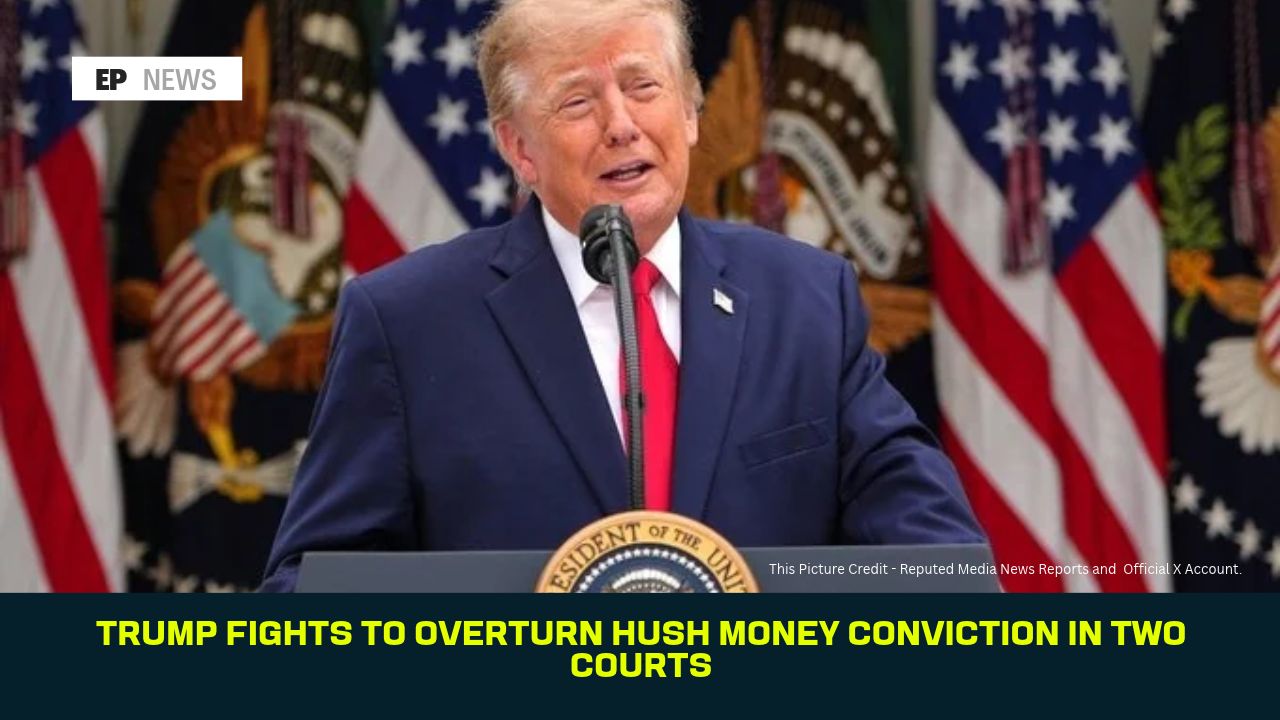
Trump Fights to Overturn Hush Money Conviction in Two Courts
November 17, 2026 | U.S News
President Donald Trump is continuing his legal fight to overturn his historic New York hush money conviction, pursuing separate appeals in state and federal courts. The latest development came Monday, November 16, when a three-judge panel of the 2nd U.S. Circuit Court of Appeals questioned Trump’s legal team about its attempt to move the criminal case from New York state court into the federal court system.
The hearing lasted more than an hour, with judges examining whether federal law actually allows the requested transfer and how such a move would work after a state jury has already returned a guilty verdict.
Trump’s lawyers want the case moved to federal court, where they believe they can seek dismissal based on presidential immunity arguments. However, the judges raised questions about the legal authority and practical process behind the request.
There was no immediate ruling following Monday’s hearing.
The development is significant because Trump is simultaneously pursuing a traditional appeal through New York’s state court system. Both legal efforts are aimed at overturning the May 2024 conviction, in which a jury found him guilty on 34 felony counts of falsifying business records connected to a $130,000 payment to adult film performer Stormy Daniels.
The case remains one of the most consequential criminal proceedings involving a former and sitting American president.
Federal Appeals Court Questions Trump’s Legal Strategy
The latest hearing took place before a three-judge panel of the 2nd U.S. Circuit Court of Appeals in New York.
Trump’s lawyer, Robert Giuffra Jr., asked the judges to intervene quickly and take control of the case before the New York state appeals process moves further.
His argument centers on whether the criminal prosecution can be transferred from state court to federal court under federal law.
Trump’s legal team believes that moving the case could allow him to challenge the conviction using arguments related to presidential immunity.
Giuffra also argued that waiting for the state appeals process to finish could take years before the matter reaches the U.S. Supreme Court.
The judges, however, expressed concerns about how the proposed transfer would actually work.
Judge John M. Walker Jr. questioned what would happen to the arguments and legal documents already submitted in the New York state appeals court.
Chief Judge Raymond J. Lohier Jr. also questioned whether Congress had authorized the procedural mechanism Trump’s lawyers were asking the court to adopt.
Federal law does not clearly describe every step of the process Trump is proposing.
The exchange suggests that the judges are examining not only the merits of Trump’s legal arguments but also whether the requested procedure is legally available at this stage of the case.
The appeals court did not announce a decision immediately after the hearing.
What Is Trump’s Hush Money Conviction About?
The criminal case originated from a payment made during the 2016 presidential election campaign.
Trump was accused of participating in a scheme to conceal a $130,000 payment made to Stormy Daniels, who had said she had a sexual encounter with him years earlier. Trump denied wrongdoing.
The payment was made by Trump’s former lawyer Michael Cohen shortly before the 2016 election.
Prosecutors argued that Trump later falsified business records to disguise reimbursements to Cohen, describing them as legal expenses rather than payments connected to the arrangement.
The prosecution said the records were falsified to conceal information from voters during the presidential campaign.
Trump’s defense disputed the prosecution’s interpretation and maintained that the case involved improper legal and political arguments.
In May 2024, a New York jury found Trump guilty on all 34 felony counts of falsifying business records.
The verdict made him the first former U.S. president convicted of a felony.
Trump has consistently denied wrongdoing and has continued challenging the conviction through the court system.
Why Trump Wants the Case Moved to Federal Court
One of the central issues in Trump’s latest legal strategy is presidential immunity.
In July 2024, the U.S. Supreme Court issued a major ruling concerning the immunity of presidents and former presidents from criminal prosecution for certain official acts.
The decision established that former presidents have absolute immunity for actions within their exclusive constitutional authority, at least presumptive immunity for other official acts, and no immunity for unofficial acts.
Trump’s legal team argues that some evidence used during the New York trial involved conduct connected to his presidency.
His lawyers have specifically challenged testimony and evidence involving Oval Office conversations, presidential work processes and social media activity.
They contend that the prosecution relied on evidence that should have received protection under the Supreme Court’s presidential immunity ruling.
Trump’s lawyers also dispute the prosecution’s characterization of the payment as an illegal campaign contribution under federal election law.
They argue that such allegations should be handled in federal court rather than through a state criminal prosecution.
The Manhattan District Attorney’s Office has opposed Trump’s effort to transfer the case.
The legal dispute is therefore not simply about whether the original conviction should be overturned. It also involves the boundaries of presidential immunity and the relationship between state criminal law and federal authority.
Federal Judge Previously Rejected Trump’s Transfer Request Three Times
Trump’s latest request follows several unsuccessful attempts to move the case into federal court.
Federal Judge Alvin K. Hellerstein rejected Trump’s request for a transfer on three occasions, including a ruling in August 2026.
In that decision, Hellerstein concluded that paying hush money and covering up an embarrassment were not presidential acts protected by immunity.
Trump’s legal team challenged the ruling and continued pursuing the transfer request through the federal appeals process.
The 2nd Circuit had previously sent the matter back for further consideration, asking the federal judge to examine important issues related to Trump’s immunity arguments.
That earlier action did not mean the appeals court had agreed with Trump. Instead, it required additional review of the legal questions involved.
Hellerstein’s August decision again rejected the transfer request.
The judge died last month at the age of 92, according to AP reporting.
Trump subsequently asked the appeals court to intervene, leading to the November 16 hearing.
The current panel must now consider whether the federal court has authority to take the case and whether Trump’s proposed route is legally justified.
Trump Is Also Appealing Through New York State Courts
The federal appeal is only one part of Trump’s legal strategy.
He is also pursuing a conventional appeal through the New York state court system.
On November 5, 2026, Trump’s lawyers presented arguments before the Appellate Division, a mid-level appeals court in New York.
That court has not yet issued a ruling.
The state appeal challenges the conviction through the ordinary appellate process, rather than relying exclusively on the request to move the case into federal court.
The two legal tracks are proceeding at the same time, creating a complicated situation involving state and federal judges.
The federal appeal focuses heavily on whether the case can be transferred and whether presidential immunity arguments should be considered in federal court.
The state appeal addresses the conviction itself through New York’s appellate system.
The Manhattan District Attorney’s Office has argued that the federal proceedings should not prevent the state appeals court from reaching its own decision.
Even if Trump succeeds in obtaining some form of federal intervention, the state appellate process may still remain relevant.
What Trump’s Lawyers Told the Appeals Court
During Monday’s hearing, Giuffra urged the judges to act quickly.
He argued that Trump could otherwise face a lengthy wait while state appellate courts consider the case.
The lawyer also suggested that the federal court could take the existing record and arguments, allowing the case to proceed through a federal district court before returning to the appeals court.
The judges questioned the legal foundation for that proposed process.
One concern was whether federal law clearly authorizes a post-verdict transfer in the way Trump’s lawyers described.
The judges also considered what would happen to the legal briefs and arguments already filed in the state court system.
The prosecution’s position was different.
Steven Wu, chief of appeals at the Manhattan District Attorney’s Office, urged the federal panel to leave the case in state court.
He argued that even if Trump were to obtain a favorable result in federal court, the New York state appeals court should remain free to issue its own ruling.
The competing arguments leave the appeals court with several procedural and legal questions to resolve.
No immediate decision was announced.
Why the Case Matters for Presidential Immunity
The case has broader implications beyond Trump’s personal legal situation.
The Supreme Court’s 2024 presidential immunity ruling changed how courts must evaluate criminal cases involving conduct by presidents.
The central distinction is between official presidential actions and private or unofficial conduct.
A president’s official responsibilities receive constitutional protection under the Supreme Court’s framework. However, that protection does not automatically cover private conduct simply because the person involved is president.
Trump’s legal team argues that some evidence introduced during the hush money trial involved official presidential activity.
Prosecutors have maintained that the underlying conduct involved private actions and business records rather than protected presidential responsibilities.
The courts must determine how the Supreme Court’s immunity ruling applies to the specific evidence and legal issues in Trump’s case.
The outcome could influence how future courts handle criminal prosecutions involving former presidents and conduct that crosses the boundary between private affairs and official government responsibilities.
However, Monday’s hearing did not resolve that larger constitutional question.
The immediate issue before the 2nd Circuit is whether it can intervene in the case and approve the requested transfer.
What Happens Next in Trump’s Legal Battle?
The next major development will depend on the 2nd Circuit’s decision.
The appeals court could issue a ruling on whether it has authority to intervene in Trump’s transfer request. It could also reject the request or take another procedural step before reaching a final decision.
Separately, the New York Appellate Division must decide Trump’s conventional appeal.
Neither court had issued a decision overturning the conviction as of November 17, 2026.
That means the original jury verdict remains in place.
Trump was sentenced in January 2025 to an unconditional discharge. This means he received no jail time, probation or financial penalty, but the conviction itself was not erased.
The legal process could continue for an extended period, depending on the decisions of the state and federal courts.
Trump’s legal team may also seek further review if it loses at the current appellate stage.
For now, the most important question is whether the federal appeals court will allow the case to move out of New York’s state court system.
Political Implications of the Ongoing Case
The legal proceedings are also politically significant because Trump is currently serving as president.
His effort to overturn the conviction has remained a major issue in discussions about presidential accountability, the justice system and the limits of executive power.
Supporters of Trump have argued that the prosecution was politically motivated and that the conviction should be overturned.
Critics have maintained that the case involved a jury verdict reached through the ordinary criminal justice process and should be reviewed under established legal standards.
The appeals process is especially important because it provides a formal route for challenging the conviction without relying on political arguments.
The courts must evaluate the legal questions independently, regardless of the political consequences of their decisions.
The case also highlights the unusual circumstances created when a sitting president continues to pursue appeals related to a criminal conviction obtained before returning to office.
The eventual outcome could have consequences for future debates about presidential immunity, state criminal prosecutions and the independence of the American justice system.
Frequently Asked Questions
1. Why is Donald Trump appealing his hush money conviction?
Trump is seeking to overturn his 2024 New York conviction on 34 felony counts of falsifying business records. His lawyers argue that the trial involved legal errors and evidence connected to presidential conduct that should receive immunity protection.
2. What happened during the November 16, 2026, hearing?
A three-judge panel of the 2nd U.S. Circuit Court of Appeals questioned Trump’s lawyer and a state prosecutor about whether the case could be transferred from New York state court to federal court. The judges did not announce an immediate decision.
3. Was Donald Trump convicted in the hush money case?
Yes. A New York jury found Trump guilty on all 34 felony counts in May 2024.
4. What was the $130,000 payment connected to?
The payment was made to Stormy Daniels shortly before the 2016 presidential election. Prosecutors argued that business records were later falsified to conceal the reimbursements associated with the payment.
5. Has the conviction been overturned?
No. As of November 17, 2026, the conviction remains in place while Trump’s state and federal appeals continue.
6. What is presidential immunity?
Presidential immunity is a constitutional protection that limits criminal prosecution for certain official presidential actions. The Supreme Court’s 2024 ruling distinguished protected official conduct from unofficial actions.
7. Did Trump receive a prison sentence?
No. In January 2025, Trump received an unconditional discharge. He did not receive jail time, probation or a financial penalty, but the conviction remained on the record.
8. Can the case still reach the U.S. Supreme Court?
Potentially, yes. Further appeals may be possible depending on the decisions of the lower courts and the legal issues involved. However, no future Supreme Court review is guaranteed.
Final Thoughts
Donald Trump’s effort to overturn his New York hush money conviction has entered another important stage, with federal appeals judges examining whether the case can be transferred out of the state court system.
The November 16 hearing revealed questions about the legal procedure proposed by Trump’s lawyers, while the separate New York state appeal remains unresolved.
For now, neither court has overturned the conviction, and the original jury verdict remains legally in place.
The next decisions from the federal appeals court and New York’s Appellate Division will determine how Trump’s legal challenge proceeds.
Beyond the individual case, the dispute raises important questions about presidential immunity, the authority of state courts and the limits of federal intervention in state criminal prosecutions.
The situation remains ongoing, and further developments should be reported only after the courts issue formal decisions.