
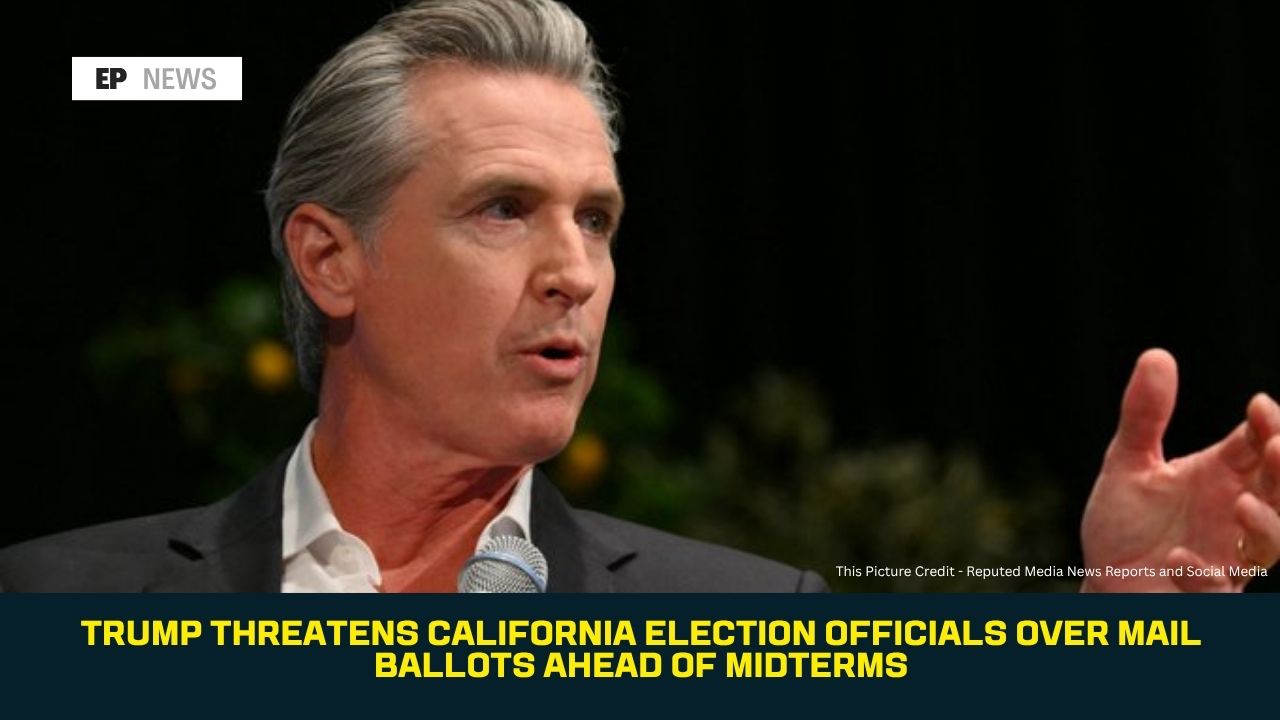
Trump Threatens California Election Officials Over Mail Ballots Ahead of Midterms
Publication Date: October 17, 2026
Category: U.S. Politics / Elections
Location: California and Washington, D.C.
President Donald Trump has threatened California election officials with imprisonment as the federal government intensifies its efforts to investigate suspected noncitizen voting ahead of the November 3, 2026, midterm elections.
The dispute escalated on Friday, October 16, after the U.S. Department of Justice warned Los Angeles County and California election officials that they could face criminal liability if they knowingly facilitated the counting of mail ballots returned by people the administration believes may not be U.S. citizens.
According to Reuters, the federal government identified more than 20,000 people it considers likely noncitizens who had been sent mail ballots. The Justice Department has sued California to prevent the ballots from being counted, while state and county officials have challenged the federal government’s approach and questioned how the list was compiled.
Trump shared a letter from Acting Deputy Attorney General Trent McCotter on Truth Social and threatened lengthy prison sentences for officials involved in the dispute.
California officials have argued that the administration has not adequately explained the data used to identify the individuals and have raised concerns about access to protected voter information.
The confrontation comes less than three weeks before Election Day, placing election administration, voter eligibility and federal authority at the center of a politically sensitive dispute.
What Happened in the California Mail Ballot Dispute?
The latest development followed a series of exchanges between the Justice Department and California election officials over a list of people whom federal authorities suspect may not be U.S. citizens.
According to Reuters, the Justice Department had given California officials 48 hours earlier in the week to review the list and respond to the government’s concerns. On Thursday, the department filed a lawsuit seeking to block California from counting the disputed ballots.
On Friday, Acting Deputy Attorney General Trent McCotter sent another letter warning that officials could face legal consequences if they knowingly helped facilitate voting by noncitizens in a federal election.
Trump then shared the letter on Truth Social and threatened imprisonment for officials involved.
The dispute involves several public officials, including California Secretary of State Shirley Weber, Los Angeles County Registrar-Recorder Dean Logan and county counsel representatives. The Justice Department’s letter was also directed to Los Angeles County Assistant Counsel Peter Bollinger.
The federal government says it used internal immigration records and data matching to identify the individuals. County officials, however, have questioned the methodology and said the administration had not sufficiently explained how the list was produced.
These disagreements are important because an allegation that someone may be ineligible to vote is not the same as a verified finding that the person is a noncitizen or has illegally cast a ballot.
The lawsuit and the dispute over the underlying data will determine how the matter proceeds. The available reporting does not establish that all the individuals identified by federal authorities are ineligible voters or that they have committed voting-related crimes.
Why Is the Justice Department Challenging California?
The Justice Department says its actions are intended to enforce federal election law and prevent noncitizens from voting in federal elections.
Federal law generally prohibits noncitizens from voting in federal elections, and knowingly facilitating unlawful voting can also carry legal consequences. The department has argued that California officials should take steps to address the ballots identified through the federal review.
California officials have taken a different position. They have questioned the reliability and transparency of the information provided by the federal government and have objected to what they describe as attempts to obtain protected voter data and alter state voter rolls.
The disagreement raises questions about the responsibilities of state election administrators and the federal government’s authority to investigate possible violations of election law.
States and local governments perform much of the practical work involved in administering elections, including maintaining voter records, distributing ballots and counting votes. Federal authorities, meanwhile, have responsibilities for enforcing federal election laws.
When the two levels of government disagree about eligibility records or election procedures, the dispute can become a legal question requiring judicial review.
In this case, the Justice Department has chosen to pursue the matter through the courts. The outcome will depend on the legal arguments, the evidence presented and the court’s assessment of the relevant laws.
What Does the Dispute Mean for Mail-In Voting?
Mail-in voting allows eligible voters to receive, complete and return ballots without voting in person at a polling location. It is used by voters for a variety of reasons, including convenience, disability, work schedules and distance from polling places.
The California dispute does not establish that mail-in voting as a whole is unlawful or that ballots returned by eligible voters should be rejected.
Instead, the immediate controversy concerns a specific list of individuals whom the federal government believes may be noncitizens and the question of how election officials should respond to those allegations.
Election officials must distinguish between legitimate eligibility checks and errors that could affect eligible voters. A data-matching system can identify records that deserve further examination, but a possible match is not necessarily conclusive proof of citizenship status.
For example, government databases may contain outdated information, incomplete records or differences in names and other identifying details. Naturalized U.S. citizens may also be incorrectly flagged by systems designed to identify noncitizens.
Reuters reported that previous citizenship-verification systems have mistakenly flagged some naturalized citizens. That history helps explain why election administrators may seek documentation and a transparent explanation before making decisions that could affect ballots.
The broader issue is how authorities can investigate suspected violations without incorrectly excluding eligible voters from the electoral process.
Are Noncitizens Allowed to Vote in Federal Elections?
In general, non-U.S. citizens are prohibited from voting in federal elections. Federal law makes it unlawful for a noncitizen to vote in a federal election, subject to specific statutory exceptions that are not relevant to ordinary federal voting eligibility.
Some local jurisdictions permit certain noncitizens to participate in particular local elections under local law. Those arrangements do not authorize noncitizens to vote in federal elections.
The distinction matters because discussions about election eligibility sometimes combine federal, state and local rules that are not identical.
It is also important to distinguish among three different situations:
- A person appears on a list of suspected noncitizens.
- A person is verified as ineligible to vote in a particular election.
- A person is proven to have illegally cast a ballot.
These are not interchangeable conclusions. A person appearing on an investigative list has not necessarily committed an offense, and an eligibility concern does not by itself prove that an illegal vote was cast.
The federal government says it used internal immigration records and data matching in preparing its list. California officials have questioned the methodology and the explanation provided for the data.
The court proceedings will help determine how the dispute is handled legally. Until the underlying claims are established, it would be inaccurate to describe every person on the list as a confirmed noncitizen voter.
Why the Timing Before the November Midterms Matters
The confrontation comes shortly before the November 3 midterm elections, when voters will decide races that will shape the balance of power in Congress.
Midterm elections can influence the president’s ability to advance legislation, confirm nominees and pursue policy priorities. As a result, disputes involving voting rules and election administration often receive heightened national attention during the weeks leading up to Election Day.
The California case also comes amid broader efforts by the Trump administration to examine voter registration records in multiple states.
According to Reuters, the administration has encouraged federal agencies to review state voter rolls obtained by the Department of Homeland Security. The government says such efforts are intended to identify potential election-law violations.
Critics argue that broad data reviews and threats against election officials could undermine public confidence if the methods are not transparent or if eligible voters are incorrectly flagged.
The immediate issue in California is narrower: whether the federal government can establish that the disputed ballots and records justify the action it is seeking in court.
Because the election is approaching, the timing of any judicial ruling could affect how election officials handle the ballots in question. The precise operational impact will depend on court orders and the decisions of the relevant election authorities.
What Has California Said About the Federal Claims?
California Secretary of State Shirley Weber has previously criticized the Justice Department’s attempts to obtain protected voter data and alter state voter rolls. Her office referred Reuters to an earlier statement expressing concern that the federal actions could cause confusion and reduce public trust in elections.
Los Angeles County officials have also challenged the government’s request.
County Counsel Dawyn R. Harrison said on Thursday that the county could not comply with the Justice Department’s demands because the administration had not explained how the list of suspected noncitizens was created.
The Justice Department’s subsequent letter said the list had been produced using internal immigration records and data matching.
The disagreement therefore concerns both the underlying allegations and the process used to identify the individuals.
For election administrators, acting on inaccurate records can create risks for eligible voters. For federal authorities, failing to investigate credible evidence of unlawful voting could undermine enforcement of election laws.
The competing responsibilities make it essential to establish the accuracy of the records, the legal basis for the requested action and the appropriate procedures for resolving disputed cases.
The available reporting does not establish that California officials have knowingly facilitated illegal voting. The Justice Department has issued warnings and filed a lawsuit, but the allegations must be evaluated through the applicable legal process.
Could California Officials Face Criminal Charges?
Federal law provides penalties for certain forms of unlawful voting and for knowingly assisting or facilitating prohibited conduct. However, a public warning from the Justice Department is not the same as a criminal conviction.
Whether an individual official could face criminal liability would depend on the relevant law, the person’s actions, the evidence of knowledge and intent, and the other legal requirements of a particular offense.
An official’s disagreement with a federal agency, by itself, does not establish a crime.
The Justice Department’s warning specifically concerns the possibility that officials could be liable if they knowingly facilitate unlawful voting. The administration has not established through the reporting cited here that the California officials named in the dispute have committed such an offense.
The lawsuit over the ballots and any potential criminal investigation are also distinct legal processes. A civil case seeking to change how ballots are handled does not automatically establish criminal wrongdoing.
The next steps will depend on the courts and on whether federal authorities present additional evidence or pursue further legal action.
What Could Happen Next in the Lawsuit?
The Justice Department’s lawsuit seeks to prevent California from counting the ballots at issue. The court will have to assess the government’s claims and the legal basis for the relief it is requesting.
Several questions may be central to the proceedings:
The accuracy of the federal list: The court may need to examine how the individuals were identified and whether the information reliably establishes their eligibility status.
The legal authority for the requested action: The parties may disagree about the extent to which federal authorities can direct or restrict state election procedures under the circumstances.
The treatment of disputed ballots: The court may have to consider what procedures are appropriate when voter eligibility is challenged shortly before an election.
The effect on eligible voters: Any remedy must be considered in light of the legal requirements for voting and the potential consequences of errors in identifying ineligible individuals.
The timing is particularly significant because election administrators must prepare for Election Day while litigation is ongoing.
Until a court issues a decision or relevant officials announce a change, it is premature to state that all disputed ballots will be rejected, that they will all be counted or that the case has been resolved.
How Voters Can Protect Their Right to Vote
Eligible California voters should rely on official election authorities for information about registration, ballot status and voting procedures.
People who receive an unexpected notice concerning their eligibility should contact their county election office and ask what documentation or steps may be required. They should avoid assuming that a news report or an unverified online list determines their own legal status.
Voters can also check official state and county election resources for deadlines and instructions concerning mail ballots.
It is important not to confuse the dispute over the federal government’s list with a general instruction that California voters should stop using mail-in ballots. The legal proceedings concern specific allegations and the handling of ballots linked to individuals identified by federal authorities.
The safest approach is to follow official election guidance and seek clarification directly from the responsible election office if there is uncertainty about an individual ballot.
Frequently Asked Questions
Why did Trump threaten California election officials with imprisonment?
Trump shared a Justice Department letter warning that officials could face criminal liability if they knowingly facilitated unlawful voting by noncitizens in federal elections. He then threatened imprisonment in a post on Truth Social. The warning does not establish that the officials have been convicted of a crime.
How many mail ballots are involved in the dispute?
Reuters reported that the administration identified more than 20,000 people it believes are likely noncitizens and who had been sent mail ballots. The report does not establish that every individual on the list is ineligible or that all of them illegally voted.
Is California being sued by the Justice Department?
Yes. Reuters reported that the Justice Department filed a lawsuit on Thursday, October 15, seeking to block the state from counting the disputed ballots.
Can noncitizens vote in U.S. federal elections?
Generally, no. Federal law prohibits noncitizens from voting in federal elections, subject to specific statutory exceptions. Some local jurisdictions have separate rules for certain local elections, but those rules do not authorize noncitizen voting in federal elections.
Has California admitted that noncitizens illegally voted?
The reporting cited here does not establish such an admission. California officials have questioned the federal government’s list and the methodology used to compile it.
Does this dispute mean mail-in voting is being canceled in California?
No statewide cancellation is established by the reporting cited here. The lawsuit concerns ballots linked to individuals the federal government suspects may be noncitizens. Voters should consult official California election authorities for current instructions.
When are the 2026 U.S. midterm elections?
Election Day is scheduled for Tuesday, November 3, 2026.
Conclusion
The dispute between the Trump administration and California election officials has intensified just weeks before the 2026 midterm elections. The Justice Department is seeking to block the counting of mail ballots associated with people it believes may be noncitizens, while state and county officials have challenged the federal government’s data and requests.
Trump’s threat of imprisonment has added a political dimension to an already contentious legal dispute. But the allegations should not be confused with proven wrongdoing: the available reporting does not establish that every person identified by federal authorities is ineligible or that the officials involved knowingly facilitated illegal voting.
The case raises important questions about election-law enforcement, the accuracy of voter data, the division of authority between state and federal governments, and the protection of eligible voters.
The next major development will likely come through the court proceedings or further statements from the Justice Department and California officials. Until then, the outcome remains uncertain, and voters should rely on official election authorities for accurate guidance about their own ballots.
Sources: Reuters, October 17, 2026; California Secretary of State statements referenced in Reuters reporting.
This article summarizes reported allegations and legal developments. It does not assert that the disputed voters or named officials have been found guilty of wrongdoing.