
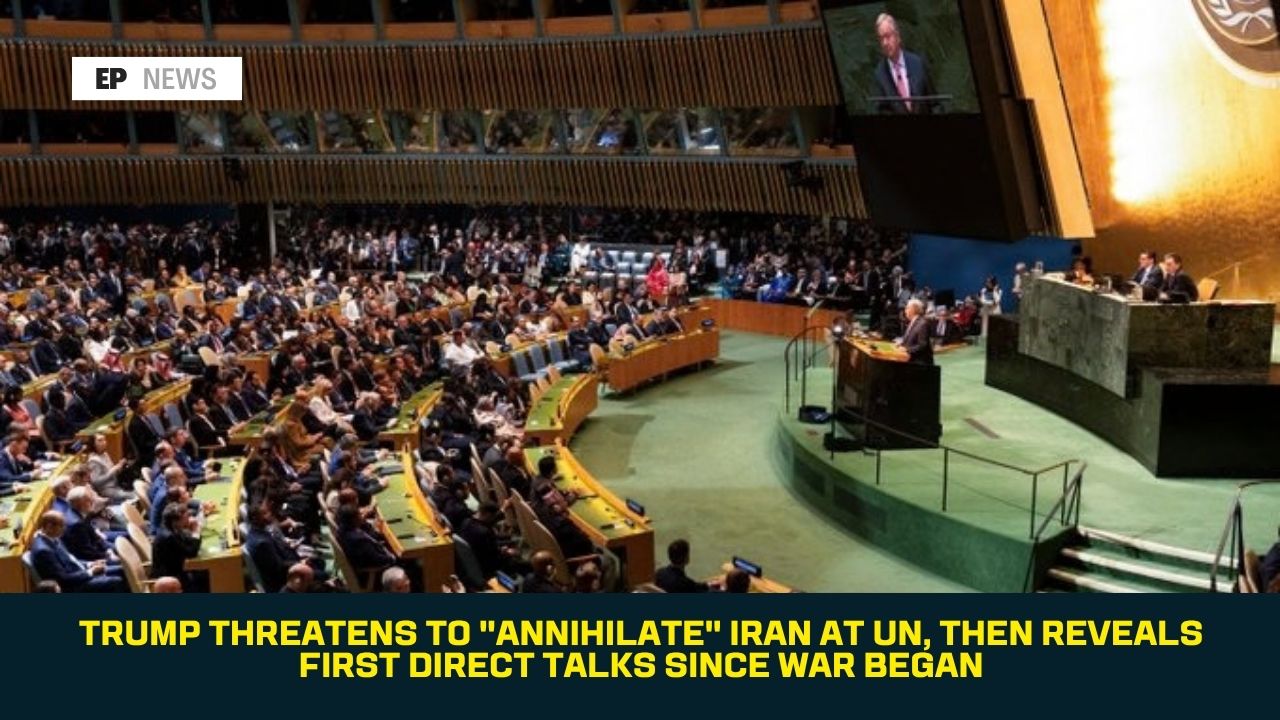
Trump Threatens to “Annihilate” Iran at UN, Then Reveals First Direct Talks Since War Began
President Trump threatened at the United Nations General Assembly on Tuesday, September 22, to “annihilate” Iran if a deal isn’t reached — then revealed hours later that American and Iranian officials had held three hours of direct talks in New York, marking the first confirmed face-to-face contact between the two sides since the war began in February.
What Trump Said at the UN
Speaking from the UN headquarters podium, Trump framed the war in stark, binary terms. “I have a big decision to make — will a deal be made with Iran that lets them rebuild and create a far greater country than it ever was before, maybe one of the greatest in the Middle East or even the world?” Trump said, according to the Kyiv Post. “Or do I annihilate the Islamic Republic and do it quickly, never giving them a chance to kill and destroy people and countries again?”
Trump used much of his address to defend his original decision to launch the war, arguing the conflict had preempted a nuclear threat from Iran, according to Time News. He also called on Tehran to fully reopen the Strait of Hormuz and return to the negotiating table to reach a comprehensive settlement, according to Euronews.
The Talks That Followed
Just hours after that ultimatum, Trump told reporters that American and Iranian officials had held direct talks on the sidelines of the summit. “They had a very good meeting, a very productive meeting,” Trump said, speaking during a meeting with Ukrainian President Volodymyr Zelensky, according to the Kyiv Post. “They have another one scheduled in the very near future.” Trump later told Gulf leaders gathered at the UN that there was “a lot of momentum” toward reaching an agreement with Tehran.
According to the Kyiv Post, Iranian Foreign Minister Abbas Araghchi met with Trump envoy Steve Witkoff and presidential adviser Jared Kushner on the sidelines of the General Assembly — a potential reopening of diplomatic channels after negotiations stalled earlier in the year. Trump’s own special envoy, Witkoff, described the exchange as “lengthy talks” conducted “through mediators,” according to CNN’s live UN coverage.
Trump subsequently offered a somewhat more precise account of who actually participated, according to Time News, clarifying that Witkoff and Kushner met with intermediaries rather than Iranian officials directly — describing the participants as “mediators of Iran, merely mediators.” That clarification leaves some ambiguity about whether this represented truly direct U.S.-Iran engagement or a more indirect channel facilitated through third-party intermediaries.
Rubio’s Comments on Direct Engagement
Secretary of State Marco Rubio addressed the administration’s broader posture toward direct talks in an NBC interview the same day, according to Newsy Today. “This is a president who, the most of the time, is ready to meet with anybody, because he feels that dialogue with people is important if you want to solve problems,” Rubio said, adding that the administration remains prepared to engage directly with Iranian President Masoud Pezeshkian.
Why the Timing Matters
This marks the first confirmed direct contact between Washington and Tehran since the war began February 28, 2026, according to Euronews — a war that has now run nearly seven months and moved through multiple phases of blockade, ceasefire negotiations, collapsed agreements, and renewed strikes. The talks come at what Euronews described as “a tumultuous moment” both for the world and for Trump’s presidency, with the president using his UN address to defend his conduct of the war even as he simultaneously pursued the diplomatic opening that followed it.
The Broader Economic Backdrop
The renewed diplomatic contact comes amid continued pressure on global oil markets. According to Newsy Today, oil prices have climbed due to the U.S.-led petroleum embargo on Iran, Houthi disruptions in the Red Sea, and a temporary closure by Saudi Arabia of a major regional oil facility — a combination of pressures that has kept energy markets on edge throughout the conflict’s later months, consistent with the record fuel prices reported earlier this month.
Other Developments From Trump’s UN Schedule
Tuesday’s Iran developments were part of a packed diplomatic schedule for Trump at the UN General Assembly. According to Euronews, Trump also held talks with new UK Prime Minister Andy Burnham, covering migration, the Iran conflict, and the Russia-Ukraine war, and met separately with Japanese Prime Minister Sanae Takaichi and Ukrainian President Zelensky. He was also scheduled to hold a more informal meeting with Venezuela’s acting President Delcy Rodríguez and with leaders from Gulf Cooperation Council nations.
Separately, Trump confirmed the U.S. will immediately begin developing a larger military presence in Greenland, including “building two very major military bases,” under a security pact with Denmark that leaves Greenland as Danish territory, according to Euronews — a deal that followed Trump’s earlier repeated threats to take the territory by force if necessary.
FAQ
Did the U.S. and Iran actually meet directly? Trump’s own account varied slightly: he initially described a direct meeting between officials, then clarified that his envoys Steve Witkoff and Jared Kushner met with Iranian intermediaries rather than Iranian officials themselves.
When was the last time the U.S. and Iran had any direct contact? Not since the war began on February 28, 2026, making this the first confirmed contact of any kind between the two sides in roughly seven months.
What did Trump threaten at the UN? He said he faced a choice between reaching a deal that would let Iran “rebuild and create a far greater country” or moving to “annihilate the Islamic Republic” quickly if no deal is reached.
Is another meeting planned? Yes. Trump said another meeting between the two sides is “scheduled in the very near future,” though no specific date was given.
What is Trump demanding from Iran as part of any deal? Full reopening of the Strait of Hormuz and a return to the negotiating table to reach a comprehensive settlement.
Conclusion
Tuesday’s whiplash between threatened annihilation and confirmed direct talks captures the genuinely unpredictable character this seven-month war has taken on, with Trump simultaneously escalating his public rhetoric and pursuing the most significant diplomatic opening since the conflict began. With another meeting already described as imminent and Trump telling Gulf leaders there’s “a lot of momentum” toward an agreement, the coming days will show whether this UN sideline contact represents a genuine turning point toward ending the war — or another instance in a conflict that has repeatedly produced diplomatic openings that ultimately collapsed.
Sources: Kyiv Post, Euronews (via Yahoo News Singapore, Yahoo News Canada), CNN, Time News, Newsy Today (reporting dated September 22-23, 2026).