
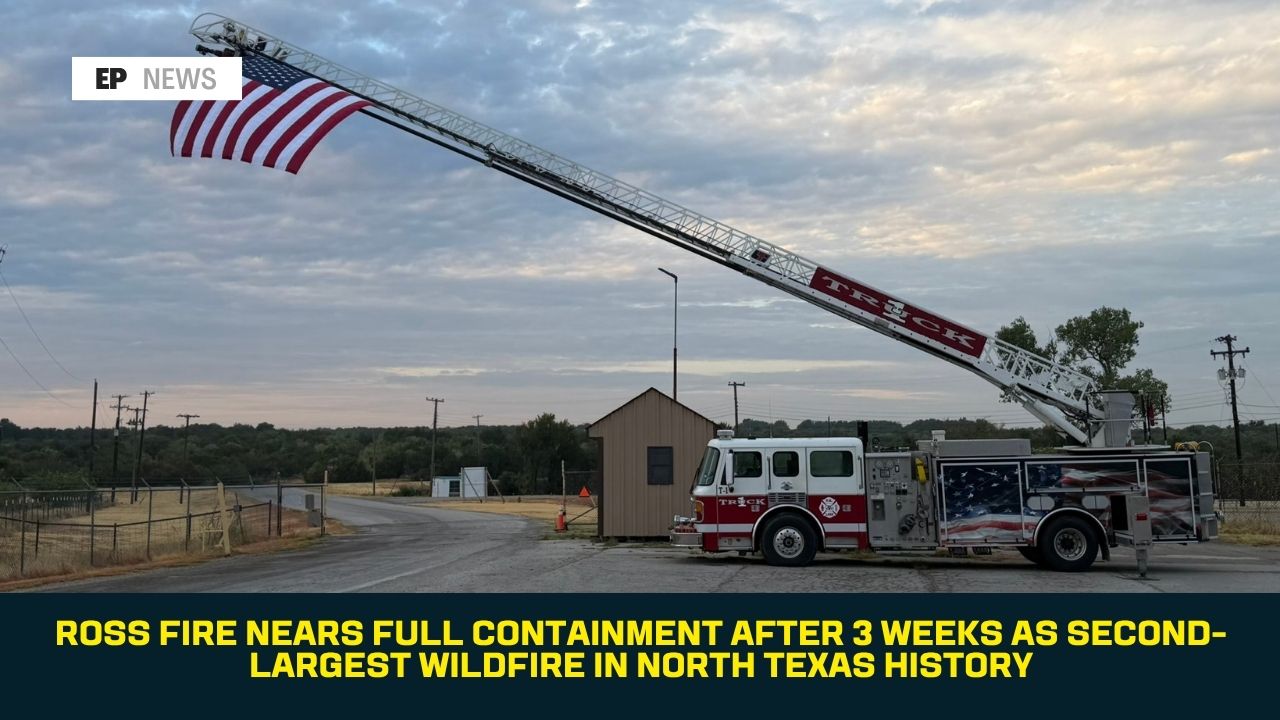
Ross Fire Nears Full Containment After 3 Weeks as Second-Largest Wildfire in North Texas History
Three weeks after igniting west of Fort Worth, the Ross Fire is now 93% contained, according to the Texas A&M Forest Service, after burning at least 90,400 acres and destroying more than 150 structures across Palo Pinto and Jack counties — making it the second-largest wildfire in North Texas history.
How the Fire Has Progressed
The Ross Fire began near the community of Ross in Palo Pinto County just before 1:30 p.m. on Monday, August 24, initially estimated at just 25 acres, according to the Palo Pinto County Emergency Service District. It grew explosively from there: within an hour of first responders arriving, Palo Pinto County Emergency Services District 1 Fire Chief Danny Watkins said the blaze had already escalated to a five-alarm fire. By that same evening, the fire had reached 15,000 acres as winds pushed the flames north into neighboring Jack County, according to KERA News.
The fire’s growth continued at a startling pace over the following days: it doubled from 25,000 to 50,000 acres in roughly three hours overnight, according to AccuWeather, before eventually reaching its current footprint of more than 90,000 acres. As of the most recent update from the Texas A&M Forest Service, cited by CBS Texas, containment stood at 93% as of Tuesday, September 15 — a significant improvement from the 12% containment level reported in the fire’s early, most volatile days.
The Damage So Far
According to CBS Texas, the fire has destroyed at least 157 structures, damaged 140 more, and helped save 453 additional structures across the affected area. The National Weather Service has confirmed the Ross Fire as the second-largest wildfire in North Texas’ recorded history, trailing only the 2011 Possum Kingdom Complex Fire, according to KERA News.
Among the properties affected was Worth Ranch, a Boy Scout camp in Palo Pinto operated by the Longhorn Council of Scouting America. According to the Dallas Morning News, many buildings at the camp suffered catastrophic damage, though no scouts, campers, or guests were present at the property when the fire moved through — the camp’s ranger, Pat Adams, was safely evacuated beforehand.
Evacuations and Community Impact
The fire prompted both mandatory and recommended evacuations across the two-county area during its most active phase. Fox 4 Dallas-Fort Worth reported that mandatory evacuations were issued for southern Jack County near Barton’s Chapel, with residents instructed to evacuate immediately via Highway 281, while residents north of Fortune Bend Road in Palo Pinto County were strongly advised to leave. An evacuation center was established at the Twin Lakes Activity Center in Jacksboro to support displaced residents.
Those mandatory evacuation orders in Jack County were lifted the day after they were issued, on August 25, as conditions improved, according to CBS Texas — though Jack County Emergency Management has continued warning returning residents to remain vigilant given that the fire was still active in neighboring Palo Pinto County at the time.
Local schools were also affected during the fire’s peak. Jacksboro ISD delayed its start by two hours on one occasion, and other area school districts adjusted schedules as smoke and evacuation concerns disrupted normal operations. By August 31, according to CBS Texas, all school districts in the area had resumed normal operations.
Why the Fire Grew So Quickly
Extreme weather conditions drove much of the fire’s explosive early growth. North Texas was experiencing above-average heat and dry conditions at the time, compounded by consecutive days of triple-digit temperatures, according to KERA News, with Fort Worth having been in moderate drought since August 11 according to National Oceanic and Atmospheric Administration data. High winds blowing steadily in a northeasterly direction, combined with that ongoing drought and heat, allowed the flames to spread rapidly across the sparsely populated ranchland separating the two counties.
The fire’s cause remains undetermined. Officials have said the blaze began as a grass fire near U.S. Highway 180 and Ross Watson Road, but investigators have not identified what specifically sparked it.
Air Quality and Broader Regional Effects
Smoke from the fire significantly affected air quality across the Dallas-Fort Worth metroplex during its most active weeks. The Texas Commission on Environmental Quality issued an air quality alert for North Texas, warning that conditions could become unhealthy for sensitive groups, including children, older adults, and people with asthma or other lung conditions, according to the Dallas Morning News. Heavy smoke was visible as far away as Saginaw and parts of Fort Worth itself, according to WFAA.
The Ross Fire was also just one of numerous wildfires burning across Texas during this stretch. According to KERA News, the state had 12 active fires as of mid-September, and just the week before, 156 separate wildfires had burned a combined 94,000 acres statewide, with fire risk running highest across West, Central, and East Texas.
Current Status
Palo Pinto Mountains State Park has remained open to visitors throughout the fire, though park officials have continued advising visitors with respiratory concerns to check air quality conditions before visiting, given ongoing smoke from the still-active blaze. With containment now at 93%, fire crews continue working to fully secure the fire’s perimeter, though full containment had not yet been declared as of the most recent update.
FAQ
How big is the Ross Fire? More than 90,400 acres as of the most recent update, with 93% containment reported as of September 15, 2026.
How many structures were destroyed? At least 157 structures destroyed, with 140 more damaged and 453 saved, according to the Texas A&M Forest Service.
When did the fire start? Monday, August 24, 2026, near the community of Ross in Palo Pinto County, initially estimated at just 25 acres before rapidly expanding.
Has a cause been determined? No. The fire’s specific cause remains under investigation.
How does this compare to other North Texas wildfires historically? The National Weather Service has confirmed it as the second-largest wildfire in North Texas’ recorded history, behind only the 2011 Possum Kingdom Complex Fire.
Conclusion
Three weeks after a 25-acre grass fire exploded into what’s now the second-largest wildfire in North Texas history, the Ross Fire’s 93% containment marks a significant turning point for the Palo Pinto and Jack County communities that bore the brunt of its destruction. With schools back to normal operations and most evacuation orders long since lifted, the region’s focus is likely shifting toward recovery and rebuilding — even as fire crews continue working to fully secure the remaining perimeter and Texas as a whole continues monitoring a dozen other active wildfires amid ongoing drought conditions statewide.
Sources: CBS Texas, Dallas Morning News, Fox 4 Dallas-Fort Worth, WFAA, KERA News, NBC 5 Dallas-Fort Worth, AccuWeather, Dallas Express, Fox Weather (reporting dated August 24-September 16, 2026).