
Mortgage Rates Remain Elevated on September 3, 2026
Mortgage rates remain a major concern for Americans considering buying a home, refinancing an existing loan or simply trying to understand where the U.S. housing market is heading.
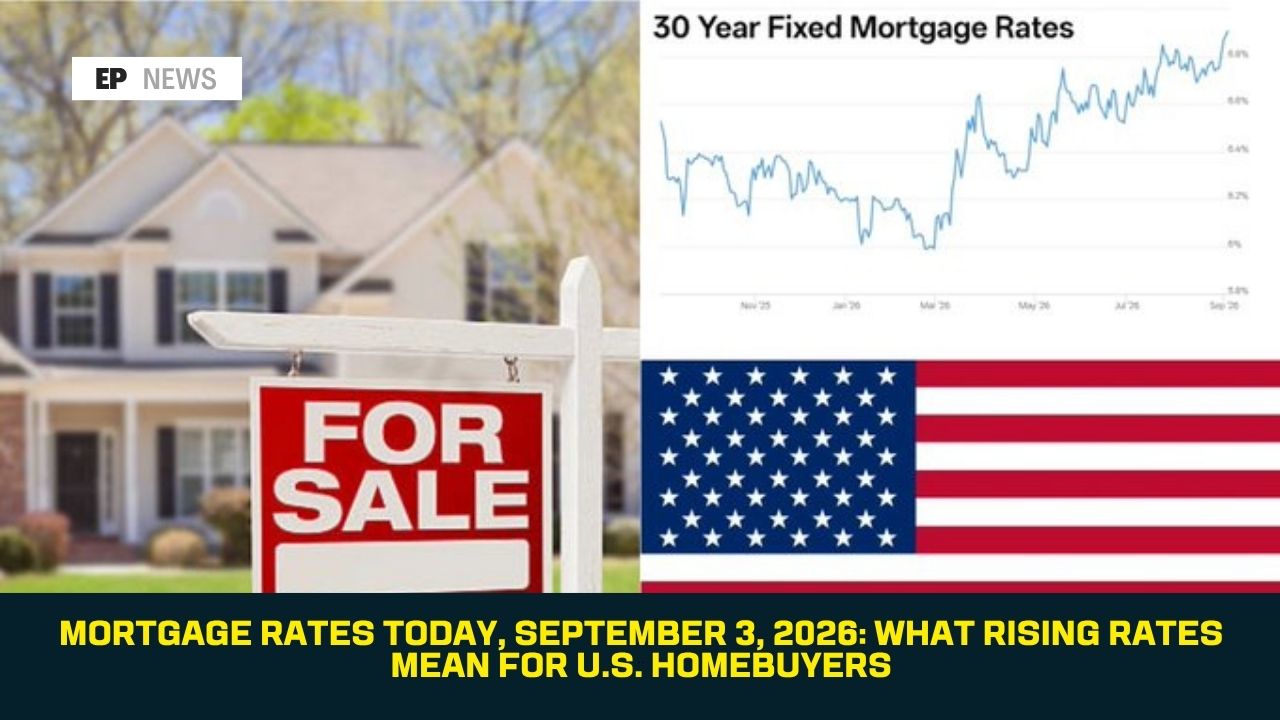
On Thursday, September 3, 2026, mortgage-rate data showed that borrowing costs remained significantly higher than many homebuyers would prefer. According to rate information published by NerdWallet using Zillow data, the average 30-year fixed mortgage APR was around 6.74%, while rates for shorter-term and adjustable mortgages were also elevated.
Different lenders and rate providers can report different figures because mortgage offers vary based on borrower qualifications, loan type, discount points and other factors. Zillow’s mortgage-rate information, for example, showed a 30-year fixed rate of approximately 6.875% on September 3.
The important message for consumers is clear: mortgage borrowing remains expensive compared with the lower-rate environment many Americans experienced earlier in the decade.
For potential buyers, even a relatively small increase in mortgage rates can significantly change a monthly payment and the total amount paid over the life of a loan.
Today’s Mortgage Rates: Why the Numbers Can Differ
One of the most confusing things about mortgage shopping is that consumers may see several different rates reported on the same day.
For example, one mortgage-data provider may report an average rate near 6.74%, while another lender may advertise a rate closer to 6.875%.
That does not necessarily mean one source is wrong.
Mortgage rates can vary depending on several factors, including:
- Credit score
- Down payment amount
- Loan size
- Property location
- Loan type
- Whether the borrower pays discount points
- Closing costs
- Debt-to-income ratio
- Whether the loan is for a primary residence, vacation home or investment property
This is why the rate advertised online should not automatically be treated as the rate every borrower will receive.
A borrower with excellent credit and a large down payment may qualify for a better offer than someone with a lower credit score or a smaller down payment.
For Americans shopping for a mortgage, the most useful number is often not simply the headline interest rate. Consumers should also examine the APR, lender fees, closing costs and total borrowing cost.
The 30-Year Fixed Mortgage Rate Is Higher Than It Was a Week Ago
NerdWallet’s September 3 mortgage update indicated that the average 30-year fixed mortgage rate had moved higher compared with one week earlier. The 30-year rate was also above its level from a year earlier, highlighting how quickly borrowing conditions can change.
A difference of a few basis points may not sound dramatic.
However, a basis point equals 0.01 percentage point, and changes can add up quickly when a borrower is financing hundreds of thousands of dollars.
For example, a homebuyer borrowing $400,000 will feel the impact of higher rates much more than someone borrowing $150,000.
The higher the loan amount, the more sensitive the monthly payment becomes to changes in mortgage rates.
That is why many buyers are now paying close attention to daily and weekly mortgage movements.
Why Are Mortgage Rates Rising?
Mortgage rates do not move based solely on decisions made by the Federal Reserve.
This is an important point for consumers.
The Federal Reserve has enormous influence over the broader interest-rate environment, but 30-year mortgage rates are more closely connected to longer-term financial-market conditions, particularly Treasury yields and mortgage-backed securities.
Recent market developments have included pressure in global bond markets and concerns about inflation and long-term borrowing costs. Reuters has reported on the broader bond-market selloff and rising concerns about long-term interest rates.
Several factors can influence mortgage rates at the same time.
These include:
Inflation expectations
If investors believe inflation could remain elevated, longer-term borrowing costs may increase.
Treasury yields
Mortgage rates often move broadly in the same direction as longer-term Treasury yields, although they do not move in perfect lockstep.
Economic growth
A stronger economy can sometimes push interest rates higher because investors may expect inflationary pressures to remain stronger.
Federal Reserve expectations
Markets closely watch the Federal Reserve for clues about future monetary policy.
Global events
Geopolitical developments, energy prices and global financial-market volatility can all affect investor behavior and bond yields.
For homebuyers, the result is often frustrating: mortgage rates can move even when the Federal Reserve has not changed its benchmark interest rate.
What Does a Mortgage Rate Near 6.7% Mean for Homebuyers?
The impact depends largely on the size of the mortgage.
Consider a simplified example.
A buyer borrowing $400,000 at a higher interest rate could pay hundreds of dollars more each month than a borrower who obtained the same loan at a substantially lower rate.
Over 30 years, the difference can become enormous.
That is why affordability is not determined only by the price of a house.
A buyer must consider three major costs:
- The home’s purchase price
- The mortgage interest rate
- Property taxes and homeowners insurance
In many parts of the United States, insurance costs have also become an increasingly important part of the affordability calculation.
A buyer who focuses only on the home’s listing price may underestimate the true monthly cost of ownership.
Should Americans Buy a Home Now or Wait for Lower Mortgage Rates?
There is no single answer for every buyer.
The right decision depends on personal finances rather than simply trying to predict the next move in mortgage rates.
A buyer may consider moving forward if:
- They have stable income.
- They have sufficient emergency savings.
- Their monthly payment comfortably fits their budget.
- They plan to stay in the home for several years.
- They have found a property that meets their long-term needs.
Waiting may make more sense for buyers who:
- Are struggling to qualify for a mortgage.
- Would have very little money left after the down payment.
- Have high-interest consumer debt.
- Expect their income or financial situation to change soon.
- Would be financially stretched by the monthly payment.
Trying to perfectly time mortgage rates can be difficult.
Rates can move quickly based on inflation reports, employment data, Treasury-market movements and Federal Reserve expectations.
Instead of making a decision based entirely on forecasts, consumers should focus on whether the current payment is sustainable.
How Rising Mortgage Rates Affect First-Time Homebuyers
First-time buyers are often among the most sensitive to changes in mortgage rates.
Unlike existing homeowners who may have built significant equity, first-time buyers typically depend more heavily on financing.
Higher rates can reduce purchasing power.
For example, a buyer who could comfortably afford a certain monthly payment when rates were lower may need to reduce their target home price when rates rise.
This creates a difficult situation.
Home prices may remain high in many markets, while mortgage payments become more expensive.
Reuters has previously reported that elevated mortgage rates have weighed on housing activity and affordability in the United States.
For first-time buyers, several strategies may help:
- Compare multiple lenders.
- Improve credit before applying.
- Consider different loan programs.
- Evaluate state and local homebuyer assistance programs.
- Increase the down payment if financially reasonable.
- Consider a less expensive property.
- Avoid stretching the budget to the absolute maximum approved by a lender.
Being approved for a large mortgage does not necessarily mean that mortgage is comfortable for a household budget.
What About Homeowners Who Already Have Low Mortgage Rates?
Millions of American homeowners obtained mortgages when interest rates were much lower than current levels.
For those homeowners, moving can create a financial challenge.
Selling a home with a low-rate mortgage and purchasing another property with a mortgage near 6% or 7% could dramatically increase monthly housing costs.
This phenomenon is often described as a mortgage lock-in effect.
Homeowners may choose to remain in their current homes because replacing their existing mortgage would be significantly more expensive.
That can reduce the number of homes available for sale and contribute to a tighter housing market in some areas.
However, personal circumstances can still make moving necessary.
Job changes, family needs, retirement and relocation decisions do not always wait for ideal interest rates.
Is Refinancing Worth It at Current Mortgage Rates?
For homeowners with very low mortgage rates, refinancing at today’s rates may not make financial sense.
However, refinancing is not always about getting a lower interest rate.
Some homeowners refinance to:
- Change from an adjustable-rate mortgage to a fixed-rate loan.
- Remove a borrower after a major life change.
- Change the loan term.
- Access home equity.
- Consolidate certain debts.
Still, refinancing comes with costs.
Consumers should carefully compare:
- New interest rate
- APR
- Closing costs
- Loan term
- Monthly payment
- Total interest over the life of the loan
Zillow’s refinancing guidance emphasizes comparing multiple offers and considering whether refinancing costs outweigh potential savings.
A lower monthly payment is not always proof that a refinance is financially beneficial.
Extending a loan term can reduce the monthly payment while increasing the total amount of interest paid over time.
How to Get the Best Mortgage Rate in September 2026
Consumers cannot control financial markets, but they can improve their chances of receiving a competitive mortgage offer.
1. Check Your Credit Score
A stronger credit profile can help borrowers qualify for better terms.
Review credit reports for errors before applying for a mortgage.
2. Compare Multiple Lenders
Do not automatically accept the first offer.
Banks, credit unions and online lenders may provide different rates and fees.
3. Look Beyond the Interest Rate
Compare the APR and closing costs.
A lower interest rate with expensive fees may not always be the best deal.
4. Consider the Down Payment
A larger down payment may improve loan terms in some situations and can reduce the amount borrowed.
However, buyers should avoid draining all their savings just to make a larger down payment.
Maintaining an emergency fund remains important.
5. Understand Discount Points
Borrowers can sometimes pay upfront fees to reduce the interest rate.
Whether this makes sense depends on how long the homeowner expects to keep the mortgage.
6. Get Pre-Approved
A mortgage pre-approval can help buyers understand their realistic budget before shopping seriously.
Will Mortgage Rates Fall Later in 2026?
No one can predict mortgage rates with certainty.
The direction of rates will depend on several major developments, including inflation data, Treasury yields, Federal Reserve policy and the overall health of the U.S. economy.
Federal Reserve Governor Christopher Waller said on September 3 that he could support keeping interest rates unchanged if incoming inflation data continues to show cooling price pressures, while also leaving open the possibility of tighter policy if inflation accelerates.
For consumers, that means mortgage-rate expectations remain uncertain.
Even if inflation improves, mortgage rates may not immediately fall to the levels Americans saw several years ago.
Long-term Treasury yields and broader financial-market conditions will continue to play an important role.
Mortgage Rates Today: What U.S. Homebuyers Should Do Now
The current mortgage environment requires patience and preparation.
Instead of focusing entirely on daily headlines, homebuyers should build a strong financial position.
That means:
- Maintaining good credit.
- Paying down expensive debt.
- Building emergency savings.
- Comparing mortgage offers.
- Understanding the full monthly cost of homeownership.
- Avoiding a purchase price that stretches the household budget too far.
The difference between two mortgage offers can potentially save a borrower thousands of dollars over time.
Shopping carefully is one of the few factors consumers can directly control.
Frequently Asked Questions
What is the average mortgage rate today, September 3, 2026?
Mortgage rates vary by lender and borrower profile. NerdWallet’s Zillow-based data showed a 30-year fixed mortgage APR around 6.74% on September 3, 2026, while Zillow Home Loans displayed different rate offers, illustrating why borrowers should compare multiple lenders.
Why are mortgage rates so high?
Mortgage rates are influenced by inflation expectations, Treasury yields, financial-market conditions and broader economic developments.
Does the Federal Reserve directly set mortgage rates?
No. The Federal Reserve does not directly set 30-year mortgage rates, although its policies can influence the broader interest-rate environment.
Should I wait for mortgage rates to fall?
The answer depends on your personal finances, housing needs and ability to afford the current payment. Predicting future mortgage rates is difficult.
Can I refinance if mortgage rates fall later?
Potentially. Homeowners may refinance in the future if a lower rate and the costs of refinancing make financial sense.
Conclusion
Mortgage rates remain one of the biggest financial challenges facing U.S. homebuyers in September 2026.
With 30-year mortgage borrowing costs remaining in the upper-6% range depending on the data source and borrower profile, affordability continues to be a major concern for households across the country.
For Americans planning to buy a home, the most important question may not be whether rates will move slightly higher or lower tomorrow.
The bigger question is whether the total cost of homeownership fits comfortably within the household’s long-term financial plan.
Mortgage rates may change.
Financial markets may change.
But buyers who maintain strong credit, compare lenders carefully, protect their emergency savings and avoid overextending their budgets will generally be in a stronger position to make informed decisions—regardless of where rates move next.
Editorial Note: Mortgage rates change frequently and vary based on lender, credit profile, loan type, down payment and other factors. This article is for informational purposes and should not be considered personalized financial advice.
Source of Media: NerdWallet, Zillow, The Wall Street Journal, Reuters