
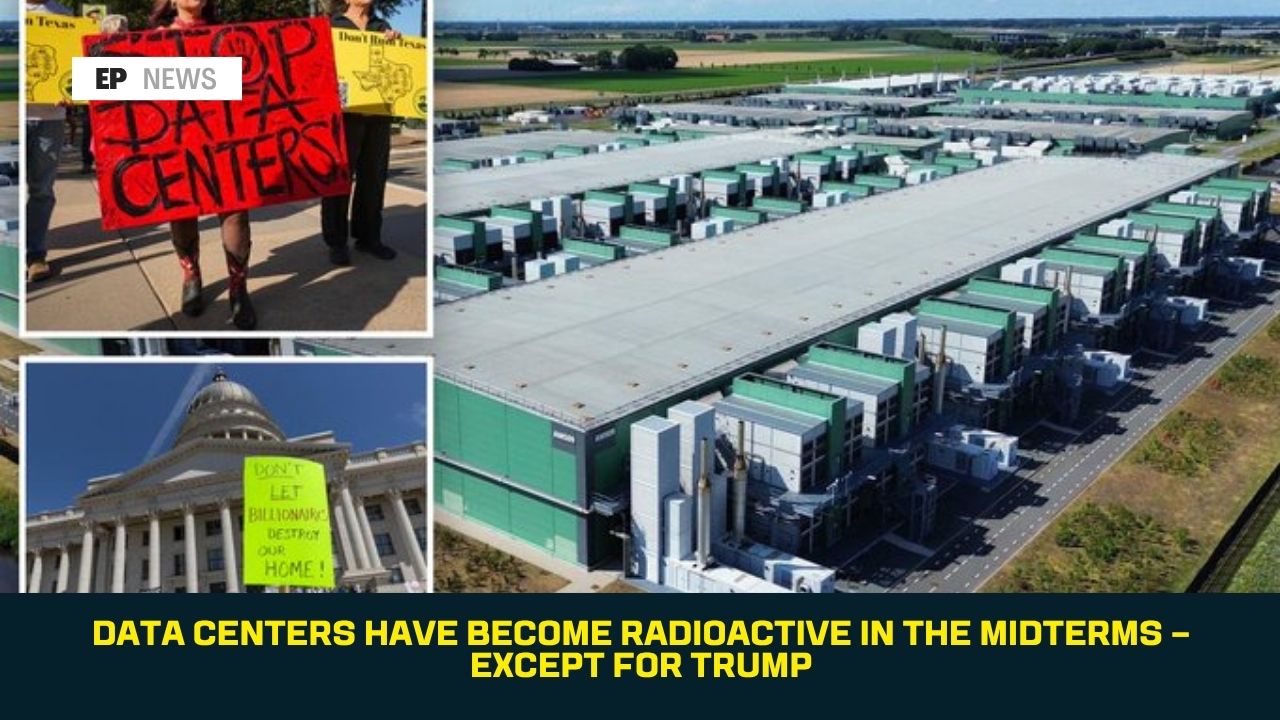
Data Centers Have Become Radioactive in the Midterms — Except for Trump
President Trump told a room full of cryptocurrency leaders at the White House this week that if he were a mayor or governor, he’d “absolutely want” a new AI data center in his community, citing the jobs and tax revenue it would bring. It’s the kind of statement that Republican and Democratic midterm candidates alike have been actively avoiding — and it illustrates a widening gap between Trump’s public enthusiasm for data centers and the political reality facing candidates who actually have to answer to voters living near them.
What Trump Said
“If I were the mayor of a town or the governor of a state, and I had a chance to get a big plant in, an AI plant or a data center,” Trump said, according to the Associated Press, “I would absolutely want it because the jobs are enormous and the money paid, the taxes paid, are just enormous.” Even the Senate Republicans’ own campaign arm has warned that anger over data centers — some of which dwarf football stadiums and use more energy than small cities — could cost the party a seat, according to the AP’s reporting, distributed across dozens of local outlets nationwide.
Why Voters Have Turned Against Data Centers
The core driver of the backlash is straightforward: electricity costs. Data centers require enormous amounts of power to run the servers behind AI models and cloud computing, and in many communities, that demand has coincided with electricity bills rising faster than overall U.S. inflation, according to a separate AP report on the issue. Ari Peskoe, who directs the Electricity Law Initiative at Harvard University, described the political dynamic bluntly to Fortune: “‘Fair share’ is a pretty squishy term, and so it’s something that the industry likes to say because ‘fair’ can mean different things to different people” — a reference to the tech industry’s repeated pledges to cover its own energy costs, pledges that have so far done little to quiet public anger.
NPR’s reporting from Hanover County, Virginia — describing itself as ground zero for the backlash — captured the tenor of local opposition directly. Resident Jennifer Corpus described the “Grow tomatoes, not data centers” yard signs that have become common in the area, characterizing the frustration as deeply personal and emotional for residents watching massive server farms rise near their homes.
A Genuinely Bipartisan Backlash
What makes this dynamic politically unusual is that the opposition doesn’t break cleanly along party lines. According to NPR, Sen. Bernie Sanders, an independent who caucuses with Democrats, has proposed a nationwide moratorium on new data center construction, while Republican Sen. Josh Hawley of Missouri has separately pushed for more AI regulation, and Florida Gov. Ron DeSantis has urged greater caution around the technology and the companies building it.
Brendan Steinhauser, CEO of the Alliance for Secure AI, told NPR he expects the issue to remain significant well beyond this election cycle: “I do think this is going to be a big issue in our politics throughout this year and probably for the foreseeable future.”
That prediction has already played out in real elections. According to a separate AP report, electricity costs were a decisive issue in gubernatorial races in New Jersey and Virginia — a data center hotspot — and in Georgia, where Democrats ousted two Republican incumbents on the state’s utility regulatory commission specifically over the issue.
How the Issue Is Reshaping State-Level Races
The Hill’s reporting on individual gubernatorial races illustrates how directly the issue is now shaping campaign platforms. In Michigan’s governor’s race, Democratic Secretary of State Jocelyn Benson — whose husband is a top executive at a company pushing for a new data center — has called for regulations addressing water usage and energy costs tied to the projects, while Republican Tom Leonard has gone further, pushing for a temporary moratorium on new data center construction altogether.
In Georgia’s governor’s race, Republican Lt. Gov. Burt Jones, whose father’s company is developing data centers as part of a larger project in the state, has faced attack ads over the issue — even as he and several rivals from both parties have found rare common ground supporting legislation to end tax subsidies for data centers.
Georgia’s state legislature illustrates just how unresolved the underlying policy fight remains: lawmakers spent months debating ways to curb data centers’ impact this year but ultimately took no action before their session ended, according to a separate AP report from Atlanta — a failure activist Judy Mullis, who’s fighting a proposed data center near Newnan, Georgia, described sharply: “I think they failed us, that’s what I think… I think they had the opportunity to do the right thing, and they didn’t. I’m so tired of them prioritizing big money.”
Where the Numbers Stand
Public opinion data backs up the intensity of the backlash. Most registered voters oppose building a data center in their own area, according to a July Fox News poll cited by the AP. A June Quinnipiac poll found that roughly 4 in 10 voters said AI data centers were an important factor in deciding their vote in U.S. House elections — though the issue still trails other concerns like the broader cost of living as the leading factor shaping the November elections.
Jefferies analysts, in a report cited by a separate AP article, went further, describing data centers as emerging as “the villain” in the broader affordability debate and predicting that every candidate running for office this cycle will effectively be forced to take a clear position, whether pro or con, on data centers and AI.
How the White House Has Tried to Respond
Trump has acknowledged the tension between his enthusiasm for data centers and voters’ cost concerns, previously saying it’s “only fair” for tech companies to shoulder the associated electricity costs themselves. In recent months, he has secured a voluntary pledge from major tech companies aimed at shielding U.S. consumers from higher utility bills tied to data center construction, even as he simultaneously pushes to streamline the permitting process for companies and utilities to build new power plants to meet the added demand.
But that voluntary pledge has produced its own skepticism, given how loosely defined “fair share” remains as a commitment, and building new power generation capacity doesn’t happen quickly — leaving candidates in competitive races to navigate the gap between the administration’s long-term energy strategy and voters’ immediate frustration over rising bills.
FAQ
Why have data centers become such a contentious midterm issue? Primarily because of electricity costs — data centers require enormous amounts of power, and in many communities that demand has coincided with electricity bills rising faster than general inflation.
Does opposition to data centers split along party lines? No. Both progressive figures like Sen. Bernie Sanders and conservative figures like Sen. Josh Hawley and Gov. Ron DeSantis have raised concerns about data center expansion or AI regulation more broadly, reflecting a genuinely bipartisan backlash.
What has Trump done to address rising electricity costs tied to data centers? He has secured a voluntary pledge from major tech companies to help shield consumers from higher utility bills, while also pushing to streamline permitting for new power plant construction to meet rising demand.
Have any elections already been decided by this issue? Yes. Electricity costs were a key factor in recent gubernatorial races in New Jersey and Virginia, and in Georgia, where Democrats won two seats on the state’s utility regulatory commission specifically tied to the issue.
How much does the public actually oppose data centers? Most registered voters oppose having a data center built in their own area, according to a July Fox News poll, and about 4 in 10 voters cited AI data centers as an important factor in deciding their vote for U.S. House races, per a June Quinnipiac poll.
Conclusion
Trump’s continued public embrace of data centers stands in increasing contrast to the political reality facing candidates across the country, who are navigating an issue that’s proven capable of flipping races regardless of party affiliation. With state legislatures like Georgia’s failing to reach consensus on curbing the industry’s impact, and voluntary corporate pledges facing skepticism over their vague terms, this fight over who ultimately pays for the AI infrastructure boom appears likely to remain one of the more unpredictable wedge issues shaping the 2026 midterms through November.
Sources: Associated Press (via PBS News, WRAL, Washington Times, Anchorage Daily News, WTOP, and dozens of additional local affiliates), NPR, The Hill/AOL, Fortune, Barchart (reporting dated August 20, 2026, and earlier 2026 coverage).