
Courts Have Ruled Against ICE’s Mandatory Detention Policy in 90% of 11,600 Lawsuits, Analysis Finds
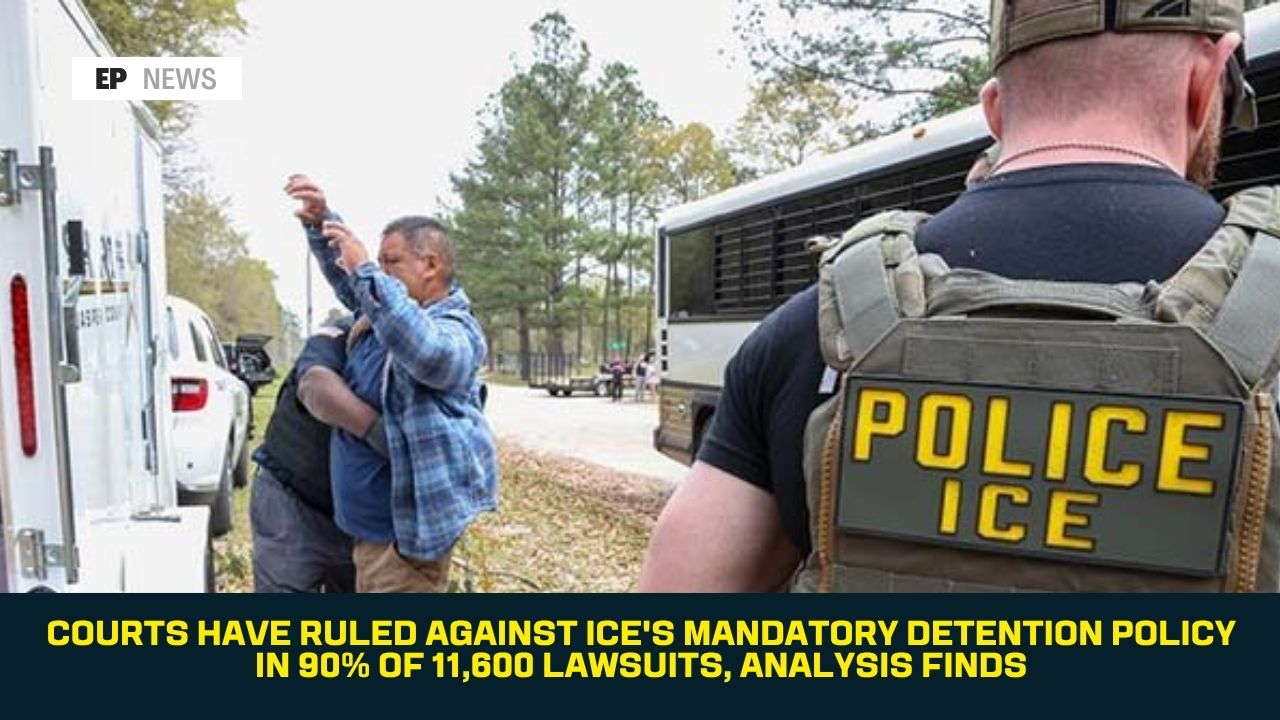
An analysis by Politico’s Kyle Cheney of roughly 11,600 lawsuits filed against the federal government by detained immigrants found that judges have ruled against Immigration and Customs Enforcement in approximately 90% of cases — a pattern that’s overwhelmed the federal court system even as the underlying detention policy has continued to be applied by the administration.
The Policy Behind the Lawsuits
The wave of litigation traces back to a specific internal memo. On July 8, 2025, Todd Lyons, then the outgoing acting head of ICE, issued guidance dramatically expanding who is eligible to be detained without a bond hearing, according to reporting cited on the legal analysis podcast Lawfare Daily. Previously, mandatory detention for the duration of removal proceedings had been applied primarily to people arrested at the border shortly after arriving, or those considered flight risks or public safety threats.
Under Lyons’s reinterpretation, the government now treats essentially anyone facing deportation as though they are a newly arriving immigrant — triggering the same legal provision that requires mandatory detention, regardless of how long that person has actually lived in the United States, according to Cheney’s analysis relayed on Lawfare Daily. The Associated Press reported that the directive, first reported by The Washington Post, made people ineligible for a bond hearing before an immigration judge; instead, they cannot be released unless the Department of Homeland Security itself makes an exception.
How Judges Have Responded
According to MS NOW’s summary of Politico’s database and analysis, the Trump administration prevailed in about 1,200 of the roughly 11,600 lawsuits reviewed, while judges ruled against the government in the remaining approximately 10,400 cases — roughly 90% of the total. A separate report cited by the Iowa Capital Dispatch, also drawing on Politico’s reporting, found that more than 300 U.S. District Court judges across 1,600 cases had rejected the government’s legal theory, finding the new interpretation contrary to ICE’s own regulations, its published enforcement guidelines, previous court rulings, and what the judges described as “the overall logic” of the nation’s immigration system.
MS NOW’s analysis characterized the underlying legal boundary this way: federal law grants the president broad discretion to determine how to carry out immigration enforcement, but that discretion doesn’t amount to unilateral authority to detain or deport anyone the administration wants — meaning, as the outlet put it, “there are, believe it or not, still some guardrails in place,” even as the administration has continued applying its expanded detention approach.
The Government’s Position
ICE has defended the policy as a legally required correction rather than a novel expansion. An ICE spokesperson told NBC News in an email that the guidance “closes a loophole” in immigration law that had historically been applied mostly to detain people who had recently arrived at the U.S.-Mexico border. “All aliens seeking to enter our country in an unlawful manner or for illicit purposes shall be treated equally under the law, while still receiving due process,” the spokesperson wrote, adding that the policy “is aligned with the nation’s long-standing immigration law.”
A related USCIS spokesperson, addressing a similar detention policy affecting refugees, offered a comparable defense to CNN: “the media is sensationalizing long-established immigration law,” the spokesperson said, adding that the agency is “implementing the law as written by Congress.”
Why This Matters Beyond the Individual Cases
The scale of the litigation has created significant practical strain on the immigration court system. According to WBUR’s Here & Now, which interviewed Politico’s Cheney directly, what began as what he described as a seemingly mundane reinterpretation of a complex immigration law has produced a year of frantic emergency court cases and upended the lives of people who had lived in the U.S. for years, in some cases with no criminal record.
Advocacy groups have echoed that characterization of the policy’s real-world impact. Vanessa Dojaquez-Torres, practice and policy counsel at the American Immigration Lawyers Association, told NBC News the pattern was unmistakable. “I don’t think it’s beyond anyone’s notice that we are starting to see policies to keep people detained and keep people detained longer,” she said. “We’re seeing the administration’s goal of detaining and deporting more people grow.” She noted that bond hearings specifically allow detainees to demonstrate to immigration judges that they aren’t a flight risk or public safety threat — the exact opportunity the expanded policy removes for a much larger group of people than before.
A Specific Case Illustrating the Pattern
Individual case rulings have echoed the broader statistical pattern Politico documented. A federal judge in Iowa ordered the immediate release of a Russian asylum seeker, ruling he had been illegally detained through what the judge described as a “legal fiction” constructed by the federal government, according to the Iowa Capital Dispatch. The case involved Arsen Kulumbekov, who had entered the U.S. in March 2023 through the CBP One process, which at the time allowed migrants at ports of entry to request asylum.
What Remains Unresolved
Despite the consistent pattern of individual court losses, the underlying policy dispute has not been definitively resolved at a higher level. According to the Iowa Capital Dispatch’s reporting on Politico’s findings, Homeland Security and the Department of Justice have continued applying the disputed legal interpretation even as hundreds of individual judges have rejected it — a dynamic that has continued in part because the issue hasn’t been consolidated and resolved through a class action, according to Lawfare Daily’s discussion with Cheney, leaving each case to be litigated and decided largely on an individual basis.
FAQ
How many lawsuits has this ICE detention policy generated? Roughly 11,600, according to Politico’s tracking, with the government prevailing in about 1,200 of them.
What percentage of these lawsuits have judges ruled against the government? Approximately 90%, according to Politico’s analysis.
When did the policy change take effect? July 8, 2025, when then-acting ICE Director Todd Lyons issued a memo expanding the agency’s mandatory detention authority.
Why does ICE say the policy is legally justified? The agency says it “closes a loophole” and applies existing law consistently, arguing the reinterpretation reflects a correction to how the relevant legal provision should have been applied all along, rather than a new expansion of authority.
Has this issue been resolved through a single, definitive court ruling? No. It continues to be litigated on a largely case-by-case basis rather than through a consolidated class action, despite the consistent pattern of rulings against the government.
Conclusion
The scale of this litigation — thousands of individual cases, with courts ruling against the government roughly nine times out of ten — represents an unusual level of sustained judicial pushback against a single federal immigration policy. Yet that consistent pattern of court losses hasn’t stopped the administration from continuing to apply the disputed detention standard, leaving the underlying legal question unresolved at a systemic level even as individual detainees continue winning release case by case through the federal court system.
Sources: Politico (via WBUR/Here & Now, MS NOW, Lawfare Daily), NBC News, Associated Press/Washington Post, Iowa Capital Dispatch, CNN (reporting compiled through August 17, 2026).