
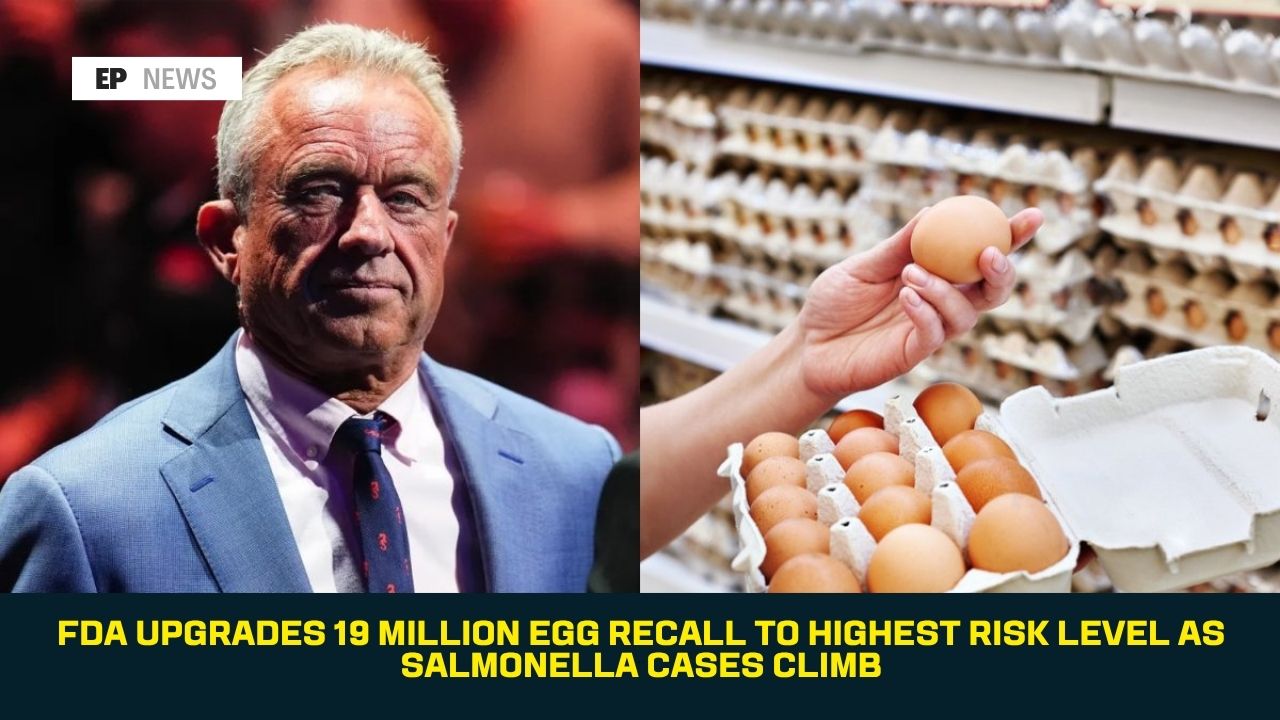
FDA Upgrades 19 Million Egg Recall to Highest Risk Level as Salmonella Cases Climb
The Food and Drug Administration has upgraded a recall of nearly 19.1 million eggs to its most serious risk classification, Class I, meaning the agency now considers exposure to the product capable of causing serious health consequences or death. The reclassification comes as the underlying Salmonella outbreak has grown to at least 98 confirmed illnesses across 17 states.
What the Reclassification Means
Midwest Poultry Services originally recalled 1,589,577 dozen eggs on July 22 due to possible contamination with Salmonella Enteritidis, according to CBS12. The recall covers white shell eggs and brown cage-free shell eggs produced at two Texas farms between June 6 and July 3, carrying “sell by” or “best by” dates ranging from July 20 through August 17, 2026 — meaning some affected cartons could still be sitting in consumers’ refrigerators as of today’s date.
The FDA’s decision to classify the recall as Class I, its highest-severity designation, reflects the agency’s determination that reasonable probability exists that using the recalled products could cause serious adverse health consequences or death, according to CBS12’s reporting on the upgrade.
The Scale of Illness So Far
The CDC and FDA said in an update reported by ABC News that 98 people had been infected, including 26 who required hospitalization, across 17 states. No deaths have been reported. Time’s coverage confirmed the same figures, noting the reclassification came three weeks after the initial recall was first announced.
Where the Eggs Were Sold
The recalled eggs reached a range of retailers and food-service accounts across the South and Southwest. According to ABC News, the eggs were available at Kroger locations in Texas and Louisiana, Brookshire Grocery stores across Texas, Oklahoma, Arkansas, Louisiana, New Mexico, and Mississippi, and various other smaller retail outlets. The eggs were also shipped to food-service customers in Texas, Oklahoma, and Louisiana.
Investigators found direct evidence tying the recalled eggs to the outbreak strain. According to Time, samples collected at the implicated farms tested positive for Salmonella, and genetic sequencing confirmed some of those samples matched the specific strain responsible for the broader outbreak.
A Separate but Simultaneous Outbreak
This egg-related recall isn’t happening in isolation. Health officials are simultaneously investigating a separate, unrelated Salmonella outbreak tied to jalapeño peppers, which has continued to grow. According to Time, the number of people infected in that jalapeño-linked outbreak rose to 345 as of Friday, August 14, with 36 hospitalizations across 27 states — an increase from the 26-state, 345-case figures reported in earlier updates. Several of those who fell ill reported recently eating at either Chipotle or QDOBA, both of which have since stopped selling jalapeños grown in Sinaloa, Mexico, the specific product tied to the outbreak.
The CDC addressed the restaurant-specific risk directly in a Friday statement, according to Time: “Given their actions to remove product from their stores, CDC and FDA do not consider there to be a current ongoing risk from these establishments to consumers in this outbreak.”
Part of an Unusually Active Summer for Food Safety
These two Salmonella outbreaks are unfolding alongside a third, entirely separate public health concern: a record-breaking outbreak of cyclosporiasis, a parasitic illness. According to CIDRAP, the CDC has now confirmed 13,895 Cyclospora cases nationally, with an additional 10,455 infections under investigation — a combined total exceeding 24,000 confirmed or suspected cases, which CIDRAP notes is likely still an undercount. Of the confirmed cases, at least two deaths and more than 740 hospitalizations have been recorded.
For comparison, CIDRAP reported that the CDC tracked just 1,180 Cyclospora cases during the same May-through-August window last year — meaning this year’s case count is already more than 11 times higher, driven substantially by a major outbreak linked to tainted lettuce running alongside other concurrent outbreaks.
The overlap of three separate, high-profile foodborne illness investigations running simultaneously has contributed to what TODAY’s consumer reporting has described as growing “recall fatigue” among American shoppers, who are navigating overlapping warnings involving eggs, jalapeños, and lettuce all within the same several-week stretch.
FAQ
How many eggs were recalled? Approximately 19.1 million eggs — 1,589,577 dozen — produced by Midwest Poultry Services at two Texas farms between June 6 and July 3, 2026.
What does a Class I recall classification mean? It’s the FDA’s most serious risk category, indicating a reasonable probability that using the recalled product could cause serious adverse health consequences or death.
How many people have gotten sick from the egg outbreak? At least 98 people across 17 states, with 26 hospitalizations. No deaths have been reported.
Where were the recalled eggs sold? Kroger locations in Texas and Louisiana, Brookshire Grocery stores across six states (Texas, Oklahoma, Arkansas, Louisiana, New Mexico, and Mississippi), other smaller retailers, and food-service accounts in Texas, Oklahoma, and Louisiana.
Is this connected to the jalapeño Salmonella outbreak? No, they are separate outbreaks caused by different sources, though both are being investigated simultaneously by the CDC and FDA, alongside an unrelated, record-breaking Cyclospora outbreak.
Conclusion
The FDA’s decision to escalate this egg recall to its highest risk classification underscores the seriousness of a summer that’s brought an unusually heavy convergence of foodborne illness investigations — eggs, jalapeños, and a record cyclosporiasis outbreak all developing at once. With some recalled egg cartons carrying best-by dates extending through today, consumers in the affected states, particularly those who shop at Kroger, Brookshire Grocery, or use the specific listed food-service accounts, should check their refrigerators against the recall details and discard or return any matching product.
Sources: ABC News, Time, CBS12, CIDRAP, U.S. Food and Drug Administration, CDC (reporting dated August 14-17, 2026).