
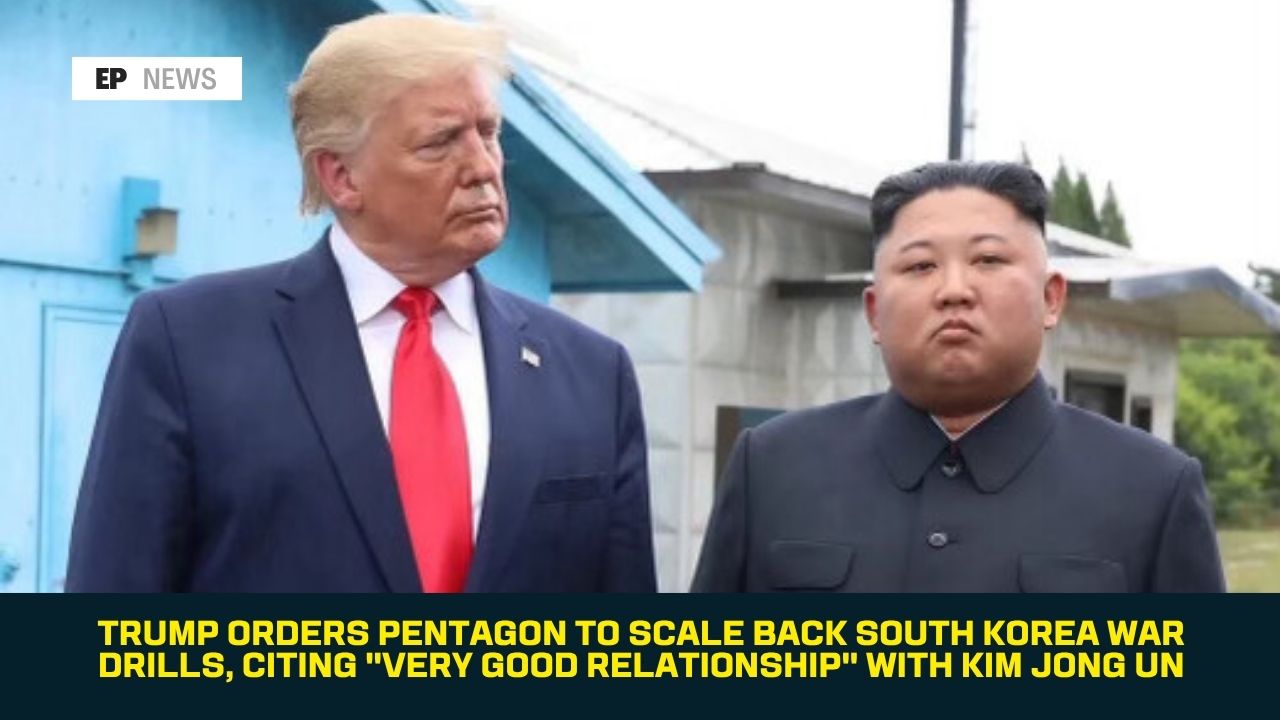
Trump Orders Pentagon to Scale Back South Korea War Drills, Citing “Very Good Relationship” With Kim Jong Un
President Trump announced Sunday, August 16, that he has directed Defense Secretary Pete Hegseth to “substantially reduce” the annual Ulchi Freedom Shield military exercises with South Korea, citing his relationship with North Korean leader Kim Jong Un and criticizing the drills as costly and needlessly hostile toward Pyongyang — coming just hours before the 11-day exercise was scheduled to begin.
What Trump Said
Trump made the announcement in a Sunday evening Truth Social post, writing that he was “not happy with the fact that the United States has, long ago, agreed to participate in Joint Military Exercises with South Korea,” according to NBC News. He argued the drills carry an outsized cost to American taxpayers and send the wrong message. “These exercises are not only costly, with much of these costs paid for by the United States of America (as usual!), but send a signal that is totally inappropriate and hostile, to a Country that, as long as Donald J. Trump has been President, has been unthreatening and respectful,” Trump wrote, according to The Hill.
Trump said it was “too late to cancel” the exercises outright, so he had “instructed Secretary of War, Pete Hegseth, to substantially reduce the Joint Military Exercises,” according to Al Jazeera. Trump did not specify exactly what a scaled-down version of the drills would look like, and it wasn’t immediately clear whether the Pentagon would make any concrete changes in response, according to Newsweek.
The Iran Connection
Trump tied his announcement to a separate diplomatic thread involving Iran. He wrote that he had recently asked South Korean President Lee Jae Myung whether Seoul would like to join U.S. efforts toward “the Denuclearization of the Islamic Republic of Iran,” and that Lee had responded, “No thanks!” according to NBC News. Trump introduced that detail with the phrase “while somewhat unrelated (?)” — a formulation that left the connection between South Korea’s answer on Iran and Trump’s decision to scale back the Korea drills somewhat ambiguous, according to Axios’s reporting on the post.
What the Exercises Actually Involve
Ulchi Freedom Shield is one of the two major annual joint exercises between the U.S. and South Korea, scheduled to run 11 days, from August 17 through August 27, according to Al Jazeera. This year’s edition was set to involve roughly 18,000 South Korean troops, a level similar to previous years, alongside American service members from the approximately 28,500-strong U.S. troop presence in South Korea, according to Fox News.
The 2026 exercises were designed to address North Korea’s evolving capabilities specifically. According to Stars and Stripes, Australian Army Lt. Gen. Scott Winter, deputy commander of U.N. Command, said the allies had accounted for Pyongyang’s increased use of technology, its ballistic missile development, and lessons North Korean troops have learned while supporting Russia’s war effort in Ukraine. This year’s drills were built to test the allies’ ability to respond to North Korean drones, GPS disruption, and cyberattacks, according to a tactics analysis reported by Tactics Institute.
South Korea’s Response
South Korea’s Ministry of National Defense responded to Trump’s announcement by indicating the drills would continue as planned. Asked about Trump’s post, the ministry said the military exercises would “proceed as previously notified and scheduled,” according to Al Jazeera — a response that, as of Sunday night, left unclear how or whether the Pentagon would actually implement Trump’s directive to reduce the exercises’ scope before or during the 11-day window.
The Timing: A North Korean Escalation and an Upcoming Summit
Trump’s announcement lands amid several converging developments. North Korea resumed ballistic missile testing on August 6, launching a short-range missile from the Wonsan area, less than two weeks before the drills’ scheduled start, according to the Tactics Institute analysis. Fox News reported that Pyongyang conducted two ballistic missile launches within six days earlier this month. North Korea’s Foreign Ministry had separately denounced the upcoming drills the week before as more provocative than the previous year’s exercises, warning that growing U.S.-Japan-South Korea military cooperation was “turning into a nuclear alliance” and that Pyongyang would respond to “a new level of threat with a new level of deterrent,” according to Reuters reporting via U.S. News.
The announcement also comes ahead of a scheduled August 25 summit between Trump and South Korean President Lee Jae Myung in Washington, according to NBC News’s background reporting — a meeting where Trump has separately raised concerns in Seoul that he may seek higher payments for the American troop presence in South Korea, or even reduce that presence, as Washington shifts more of its strategic focus toward China.
FAQ
What did Trump order regarding the South Korea drills? He directed Defense Secretary Pete Hegseth to “substantially reduce” the scope of the Ulchi Freedom Shield exercises, though he said it was too late to cancel them outright.
Why did Trump cite Iran in his announcement? He noted that South Korea had declined his request to join U.S. efforts toward Iran’s denuclearization, though he characterized the connection between that and the Korea drills as “somewhat unrelated.”
How has South Korea responded? Its Ministry of National Defense said the exercises would proceed “as previously notified and scheduled,” suggesting no immediate change had been implemented as of Sunday night.
When were the drills scheduled to take place? August 17 through August 27, 2026, an 11-day exercise involving roughly 18,000 South Korean troops.
How has North Korea reacted to the drills generally? Pyongyang has consistently condemned them as rehearsals for an “aggressive war” and warned it would respond to what it called a growing threat with stronger deterrence measures, including recently resumed ballistic missile testing.
Conclusion
Trump’s directive marks a notable break from the traditional bipartisan U.S. defense posture toward the annual Korea exercises, arriving just hours before this year’s drills were set to begin and creating genuine uncertainty about what a “substantially reduced” version will actually look like in practice. With South Korea signaling the exercises will proceed as originally scheduled and Trump’s own August 25 summit with President Lee fast approaching, how this specific tension between the White House and the Pentagon’s traditional exercise planning gets resolved is likely to become clearer within days, even as the broader question of the U.S. troop presence and alliance costs in South Korea remains a live issue heading into that summit.
Sources: NBC News, Axios, The Hill, Al Jazeera, Fox News, Newsweek, Stars and Stripes, Tactics Institute (reporting dated August 16-17, 2026).