
August 12 Brings a Total Solar Eclipse, the Perseids, and a Partial Lunar Eclipse — Here’s What Americans Will Actually See
A rare astronomical trifecta is set to unfold in mid-August 2026: a total solar eclipse crossing the Arctic and parts of Europe on August 12, followed hours later by the peak of the Perseid meteor shower, with a partial lunar eclipse visible from the Americas as well. For U.S. skywatchers hoping to relive the drama of the 2024 total eclipse, there’s an important catch — this one won’t deliver totality anywhere in the country.
Where the Eclipse Will Actually Be “Total”
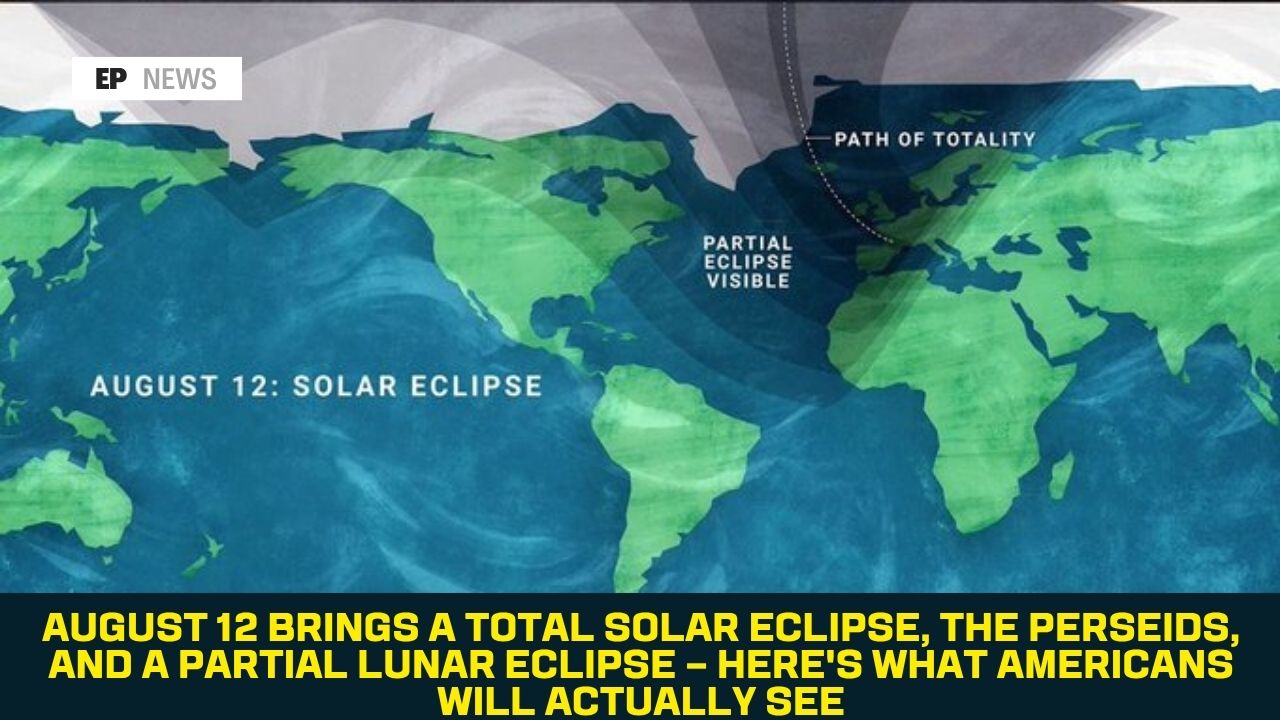
According to NASA, the path of totality for the August 12 eclipse will cross the Arctic Ocean, Greenland, Iceland, the Atlantic Ocean, northern Spain, and a small corner of northeastern Portugal. Observers within that narrow band will experience true totality — the moon fully blocking the sun, turning day briefly into night, dropping temperatures, and revealing the sun’s outer atmosphere, or corona, along with planets like Jupiter, Venus, and Mercury becoming visible in the darkened sky.
The timing adds a scientific wrinkle: the eclipse falls about 2.2 days after the moon reaches perigee, its closest point to Earth in its orbit, on August 10. That makes the moon appear slightly larger than average, according to Wikipedia’s eclipse data drawn from NASA’s Besselian elements calculations, which can affect the width and duration of the path of totality.
What the U.S. Will See Instead
The United States won’t experience totality at all this time. Instead, most of the country will see a partial eclipse — and in many regions, only a modest one. NASA describes the U.S. view as the moon taking a small “bite” out of the sun’s disk rather than fully covering it.
Coverage will vary significantly by location. According to Earth.com, Alaska offers the best view in the country, with the moon covering about 37% of the sun over Fairbanks and 28% over Anchorage during the morning hours. On the East Coast, the eclipse becomes more of a midday curiosity: Bangor, Maine gets the deepest partial coverage at roughly 24% around 1:53 p.m., while Boston reaches about 16%, New York City around 9%, and Washington, D.C. just 4%.
BBC Sky at Night Magazine reports that across populated regions of North America, the sun will never be covered by more than about 56%, with the deepest coverage confined to the remote Qikiqtaaluk region of Nunavut in far northern Canada, near Greenland. NASA notes the visible partial eclipse will generally be limited to the northern tier of the country, spanning from Alaska across the northeastern U.S. and Upper Midwest, with much of the southern and central U.S. seeing no eclipse effect at all.
Why You’ll Need Eclipse Glasses the Entire Time
Unlike the 2024 total eclipse, when millions of Americans in the path of totality had a brief window to view the sun safely with the naked eye, this event offers no such moment anywhere in the U.S. Because the eclipse will only ever be partial across the country, NASA and eclipse safety experts emphasize that certified eclipse glasses — meeting the ISO 12312-2 international safety standard — must be worn for the entire duration of viewing. There is no point during a partial eclipse when it’s safe to look directly at the sun without proper protection.
A Perseid Bonus the Same Night
The eclipse’s timing lines up with one of the most reliable astronomical events of the year. The Perseid meteor shower is expected to peak overnight on August 12 into August 13, and this year’s viewing conditions are especially favorable. NASA noted that the new moon falling around the same time means there will be little to no interfering moonlight to wash out fainter meteors, a combination that doesn’t happen every year.
The Perseids are produced by debris left behind by Comet 109P/Swift-Tuttle as it burns up in Earth’s atmosphere, and they’re typically best viewed from the Northern Hemisphere in the hours before dawn, though some meteors can become visible as early as 10 p.m. Fox 5 New York recommends finding a dark location away from city light pollution and allowing 20 to 30 minutes for your eyes to adjust for the best viewing experience.
Don’t Forget the Lunar Eclipse
Rounding out the week’s celestial activity, a partial lunar eclipse will also be visible from the Americas overnight, adding a third distinct sky event within days of each other — a total solar eclipse for parts of Europe and the Arctic, a partial solar eclipse for the northern U.S., the Perseids’ peak, and a partial lunar eclipse, all clustered around the same mid-August stretch.
When’s the Next Total Eclipse for the U.S.?
For Americans hoping for another experience like April 8, 2024 — when the path of totality swept across 15 states from Texas to Maine — the wait continues. According to NASA, the next total solar eclipse visible from any part of the United States won’t occur until March 30, 2033, and even then, totality will be limited to Alaska. The next total eclipse visible from the contiguous United States isn’t expected until August 23, 2044.
FAQ
Will anyone in the U.S. see a total solar eclipse on August 12, 2026? No. The path of totality only crosses the Arctic Ocean, Greenland, Iceland, the Atlantic Ocean, northern Spain, and a small part of Portugal. The U.S. will only experience a partial eclipse.
Where in the U.S. will the eclipse be most visible? Alaska offers the best partial view, with the moon covering up to about 37% of the sun in Fairbanks. The Northeast and Upper Midwest will see smaller partial coverage, generally under 25%, while much of the southern and central U.S. won’t see any eclipse effect.
Do I need eclipse glasses to view it? Yes, for the entire event. Because the eclipse is only partial across the U.S., it is never safe to view it without certified eclipse glasses meeting the ISO 12312-2 safety standard.
What else is happening in the sky that week? The Perseid meteor shower peaks overnight August 12 into August 13, coinciding with a new moon that should provide excellent dark-sky viewing conditions. A partial lunar eclipse will also be visible from the Americas around the same time.
When is the next total solar eclipse visible from the U.S.? March 30, 2033, though totality will be limited to Alaska. The next total eclipse visible from the contiguous United States isn’t expected until August 23, 2044.
Conclusion
While the August 12 total solar eclipse belongs to Europe and the Arctic this time, American skywatchers still have plenty to look forward to that week — a partial solar eclipse across the northern tier of the country, one of the year’s best Perseid meteor shower displays thanks to dark, moonless skies, and a partial lunar eclipse to close things out. Grab a pair of certified eclipse glasses if you’re anywhere from Alaska to the Northeast, and consider staying up late that same night for the Perseids — this particular stretch of sky-watching won’t repeat itself the same way again for years.
Sources: NASA, Good Morning America/ABC News, BBC Sky at Night Magazine, Earth.com, Fox 5 New York, National Solar Observatory (reporting current as of July-August 2026).