
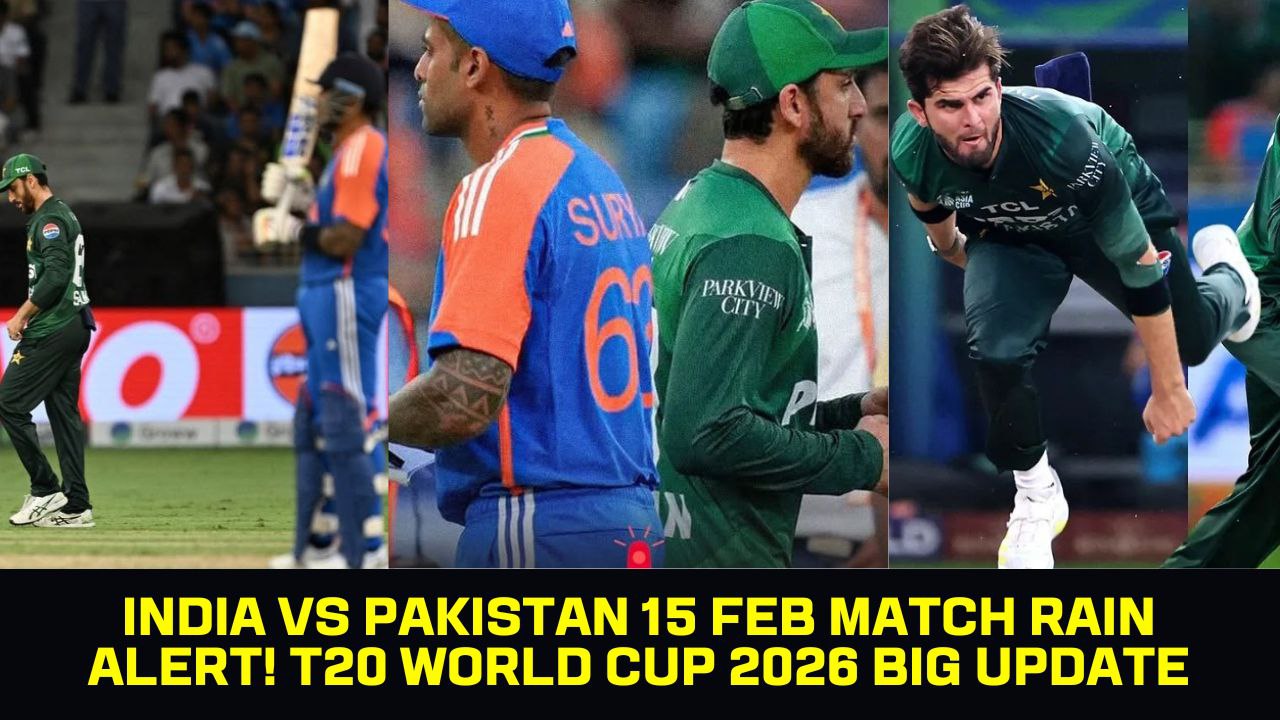
February 15 has now become one of those dates on the cricket calendar that fans across the world eagerly wait for. In the T20 World Cup 2026, India and Pakistan are scheduled to clash at the iconic R. Premadasa Stadium in Colombo — but before either team faces each other, their biggest opponent might be the weather.
Weather concerns before the big match
Usually, discussions around an India vs Pakistan match revolve around team combinations, player form, and tactics. This time, however, the focus has shifted to the sky above Colombo. Weather agencies suggest a strong possibility of heavy rain on February 15.
Reports indicate a low-pressure system forming over the southeast Bay of Bengal, which could directly affect Sri Lanka’s western region. Continuous cloud cover, thunderstorms, and intermittent rain are expected throughout the day, with temperatures ranging between 24°C and 30°C. The real concern isn’t just rain — it’s repeated interruptions that could reduce overs.
What if the match gets cancelled?
The most common question among fans is: Is there a reserve day?
The answer is no.
There is no reserve day for T20 World Cup 2026 group-stage matches. That means:
- If not a single ball is bowled → both teams get 1 point each
- If play starts but 5 overs per side are not completed → still 1 point each
- If at least 5 overs per side are played → a result will be declared
So rain won’t just spoil the spectacle — it could also reshape the points table.
Group A scenario explained
Currently, Group A is extremely tight.
India and Pakistan both have 4 points each.
However, India sits at the top due to a superior net run rate.
If the match is washed out, the standings remain close and qualification may depend on the remaining matches. In tournaments like this, semifinals are often decided by net run rate — which is why fans desperately want a full game.
The 5-over rule and the DLS factor
According to ICC rules, at least 5 overs per side are required to produce an official T20 result.
If rain interrupts play after the minimum overs are bowled, the Duckworth-Lewis-Stern (DLS) method will be used to revise the target.
And this is where the game becomes fascinating.
In shortened matches:
- Power hitters become more dangerous
- Spinners become less effective
- Fast bowlers gain importance
- The toss becomes twice as crucial
Many historic matches have shown how a 20-over game turning into an 8-10 over contest completely changes strategies.
Pitch and playing conditions
Colombo’s pitch is generally batting-friendly, but moisture changes everything.
If rain affects the surface:
- The new ball will swing
- The outfield slows down
- Spin grip reduces
- Total scores drop
A 200-run game can suddenly become a 140-run battle.
Mental pressure on players
India vs Pakistan matches are always played under intense pressure.
Now imagine players stepping onto the field knowing the match could shrink anytime. Every ball becomes crucial.
Batters attack from the start.
Bowlers cannot afford mistakes.
Captains constantly adjust field placements.
Ironically, rain might actually make the contest faster and more thrilling.
All eyes on the sky
In cricket, the biggest opponent isn’t always the other team — sometimes it’s the weather.
Fans can only hope that Colombo’s skies stay clear on February 15 so the match can be completed. Because an unfinished India vs Pakistan clash would feel like the ultimate anticlimax.
The countdown has begun…
Now the big question is — who will win: a team, or the rain?