
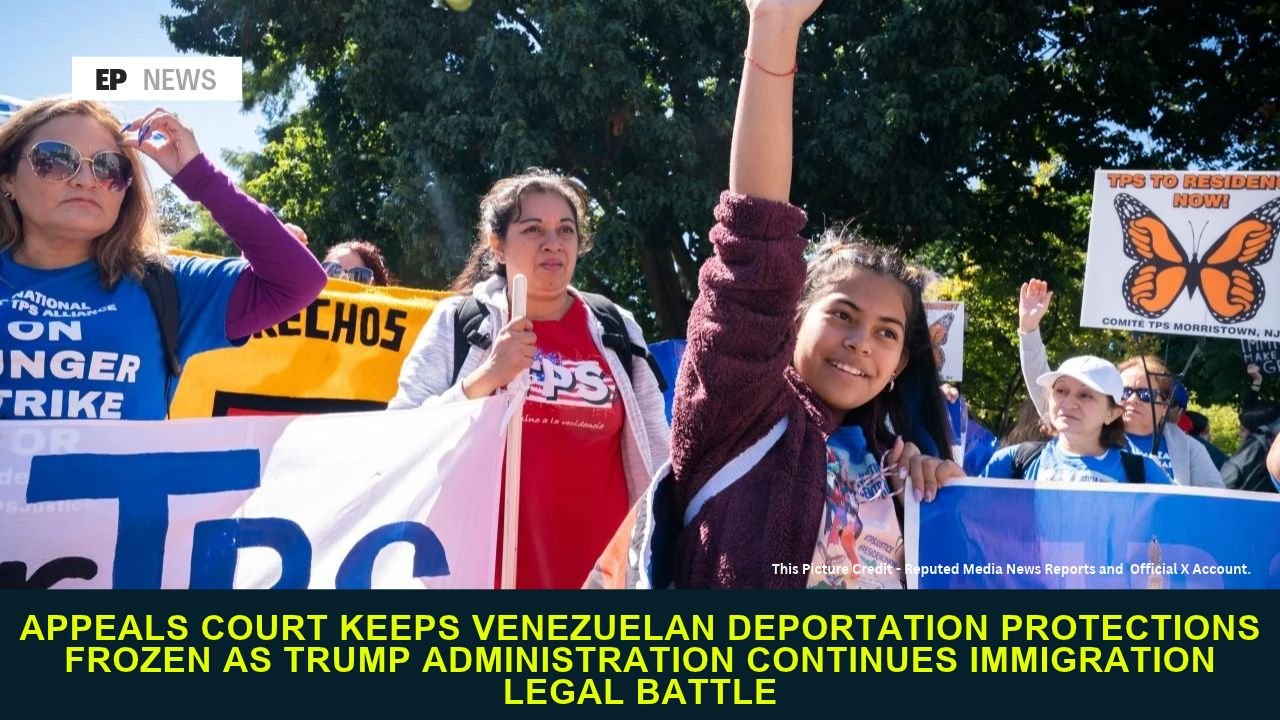
Appeals Court Keeps Venezuelan Migrant Deportation Protections Frozen
November 19, 2026 | U.S News
A major immigration legal battle in the United States has taken another turn after a federal appeals court agreed to keep deportation protections frozen for hundreds of thousands of Venezuelan migrants.
The November 19 development represents an important moment in President Donald Trump’s administration’s efforts to end Temporary Protected Status (TPS) for Venezuelans who previously received permission to remain and work legally in the United States.
The legal dispute has attracted national attention because it affects approximately 600,000 Venezuelans who received protection under the program.
The latest court order allows the administration to continue enforcing its decision while the Ninth U.S. Circuit Court of Appeals considers the underlying legal dispute.
The decision came shortly after the Justice Department approached the U.S. Supreme Court seeking emergency intervention in the case.
However, the appeals court’s subsequent action changed the immediate legal situation and reduced the urgency of the administration’s Supreme Court request.
For affected families, the outcome means that uncertainty surrounding their immigration status, employment authorization and potential removal from the United States continues.
The case also raises broader questions about presidential authority, immigration protections and the legal responsibilities of federal agencies.
According to the Associated Press, federal attorneys have reported that approximately 1,800 Venezuelans were in immigration detention, with around 330 facing deportation proceedings at the time of the reporting.
What Is Temporary Protected Status?
Temporary Protected Status is a U.S. immigration program established by Congress in 1990.
It allows eligible individuals from certain countries to remain temporarily in the United States when conditions in their home countries make a safe return difficult.
These conditions can include:
- Armed conflict.
- Natural disasters.
- Political instability.
- Other extraordinary and temporary circumstances.
People who receive TPS generally receive protection from deportation for the designated period.
They may also qualify for employment authorization, allowing them to work legally in the United States.
However, TPS does not automatically provide permanent residency or U.S. citizenship.
It is a temporary immigration protection that depends on government decisions and applicable legal requirements.
The program is particularly important for people whose home countries are experiencing serious humanitarian or political difficulties.
Venezuela received TPS designations in 2021 and 2023, allowing hundreds of thousands of Venezuelan nationals to qualify for protection.
Over time, the program became an important source of legal stability for Venezuelan families living across the United States.
Why the Trump Administration Wants to End Venezuelan TPS
The Trump administration has pursued a broader effort to terminate temporary immigration protections for several nationalities.
Its position is that the government has the authority to reassess country designations and determine whether particular groups continue to qualify for TPS.
In the Venezuelan case, the administration moved to terminate protections that had been established during former President Joe Biden’s administration.
The government has defended the decision through legal proceedings, arguing that continuing the protections would interfere with immigration enforcement.
The issue eventually reached federal court after affected migrants and advocacy organizations challenged the termination.
A California-based federal judge ruled that the administration’s decision to end the protections was unlawful.
The ruling created a legal obstacle for the government’s immigration policy.
The Trump administration subsequently sought intervention from higher courts to prevent the restoration of the protections while the legal challenge continued.
The dispute is now part of a wider national debate about the limits of executive authority over immigration programs.
Why the Appeals Court’s Latest Decision Matters
The latest development came from the Ninth U.S. Circuit Court of Appeals.
The court agreed to maintain the temporary freeze on restoring Venezuelan TPS protections until seven days after it issues its full decision in the case.
This means the administration can continue enforcing the termination while the appeals process remains active.
The timing is significant because the Justice Department had already approached the Supreme Court seeking emergency relief.
The administration argued that allowing TPS protections to return could create immediate operational and legal complications.
Federal attorneys warned that restoring the program could require the release of approximately 1,800 Venezuelans from detention.
They also argued that hundreds of removal orders could be delayed and employment authorizations would need to be restored.
The appeals court’s order provided an additional temporary legal safeguard for the administration while it considers the case.
According to Associated Press reporting, the Justice Department subsequently withdrew its emergency Supreme Court request following the appeals court’s action.
This does not mean the Supreme Court has issued a final ruling supporting the administration’s immigration policy.
The underlying legal dispute remains unresolved.
What Could Happen to the 600,000 Venezuelan Migrants?
The situation is particularly important for Venezuelan nationals who previously depended on TPS to remain legally in the United States.
The termination of protections can affect several aspects of their daily lives.
Employment authorization
One of the most immediate concerns involves employment.
TPS recipients who also had employment authorization could lose their ability to work legally when their protections end.
This can create significant difficulties for people who have established careers and depend on regular income to support their families.
Employers may also face uncertainty when checking employment authorization documents.
Risk of detention and deportation
Another major concern is the possibility of immigration detention and removal proceedings.
Without the relevant legal protections, affected individuals may face enforcement actions depending on their individual circumstances and other available legal grounds for remaining in the country.
However, losing TPS does not automatically mean every affected person will be immediately deported.
Individual immigration cases can involve additional factors, including pending applications, other legal protections and court proceedings.
Family separation
Some Venezuelan families include U.S.-citizen children.
Changes in the immigration status of parents can create difficult decisions for households.
Families may face uncertainty about whether they can remain together in the United States or need to make alternative arrangements.
Financial uncertainty
People who lose employment authorization or face immigration proceedings may experience financial pressure.
Housing expenses, healthcare costs, education and other household obligations can become harder to manage.
The uncertainty can also affect businesses that employ workers who previously held TPS.
Why the Supreme Court Has Become Involved
The Supreme Court has already played a role in the broader legal dispute.
The administration previously asked the nation’s highest court to allow the termination of Venezuelan protections while litigation continued.
The justices issued temporary orders allowing the administration’s decision to remain in effect during earlier stages of the proceedings.
In October 2026, the Supreme Court sent the case back to the Ninth Circuit for additional consideration in light of another decision involving TPS.
That procedural development created another round of litigation.
The administration subsequently argued that the temporary legal arrangements were approaching expiration and requested additional intervention.
However, the appeals court acted before the Supreme Court needed to resolve the latest emergency request.
It is important to distinguish between temporary court orders and a final decision on the underlying constitutional and administrative questions.
The latest developments concern the immediate status of the protections while the case continues.
They do not represent a comprehensive final ruling on every legal argument raised by the migrants or the administration.
What the Decision Means for U.S. Immigration Policy
The Venezuelan TPS dispute is part of a wider debate about immigration enforcement in the United States.
The Trump administration has pursued changes affecting temporary protections for nationals of multiple countries.
Supporters of the administration’s approach argue that immigration programs should be reviewed regularly and that temporary protections should not become permanent arrangements without appropriate legal authorization.
They also emphasize the government’s responsibility to enforce immigration laws.
Opponents argue that people who received protection under established federal programs should not lose their legal status through decisions that violate statutory requirements or administrative procedures.
They also highlight the humanitarian consequences for families who have lived and worked in the United States for years.
The courts must consider these competing arguments within the framework of federal immigration law.
The outcome could influence future disputes involving TPS designations and the authority of presidential administrations to terminate them.
How Employers and Businesses Could Be Affected
The legal uncertainty also matters to American businesses.
Some employers have hired Venezuelan workers who qualified for TPS-related employment authorization.
Changes to immigration protections can create questions about employment eligibility and workforce planning.
Companies must follow federal employment verification requirements.
They cannot simply assume that every person who previously held TPS remains authorized to work after a program termination.
Employers should rely on current federal guidance and applicable legal requirements when evaluating employment documents.
Businesses may also experience staffing difficulties if workers lose authorization or are required to leave their positions.
The impact will vary depending on the industries and locations involved.
What Happens Next in the Legal Case?
The Ninth Circuit’s next major step is to issue its full decision.
The temporary freeze is scheduled to remain in effect until seven days after that decision.
Afterward, the legal situation could change depending on the court’s ruling and any further appeals.
Possible developments include:
- The appeals court could issue a decision supporting the administration’s position.
- The court could rule in favor of the organizations challenging the termination.
- Either side could seek additional judicial review.
- The dispute could return to the Supreme Court.
The exact outcome cannot be predicted.
For affected Venezuelan migrants, following official immigration guidance and obtaining qualified legal assistance is particularly important.
People should avoid making major immigration decisions based solely on social media posts or unofficial online information.
Frequently Asked Questions
1. What happened to Venezuelan TPS on November 19, 2026?
A federal appeals court agreed to keep the termination of Venezuelan TPS protections in effect temporarily while it considers the underlying legal dispute.
2. How many Venezuelans are affected?
Approximately 600,000 Venezuelans received TPS protections under the relevant designations.
3. What is TPS in the United States?
Temporary Protected Status is a federal immigration program that allows eligible nationals of designated countries to remain temporarily in the United States when conditions in their home countries prevent safe return.
4. Can Venezuelan migrants still be deported?
The latest appeals court order allows the administration to continue enforcing the termination of TPS. Individual immigration circumstances and other legal protections may affect each person’s case.
5. Did the Supreme Court permanently approve the deportation policy?
No. The latest development concerns a temporary court order from the Ninth Circuit. The underlying legal dispute has not received a final resolution.
6. Can affected Venezuelans continue working legally?
Employment authorization depends on the individual’s current immigration status and applicable legal documents. People affected by the termination should seek qualified immigration legal advice.
7. When will the next major court decision arrive?
The Ninth Circuit’s temporary order is scheduled to remain in place until seven days after the court issues its full decision. No final outcome should be assumed before that happens.
Conclusion: Venezuelan Migrants Face Continued Uncertainty as Immigration Battle Moves Forward
The latest appeals court decision represents another significant development in the Trump administration’s efforts to end Temporary Protected Status for Venezuelan migrants.
By maintaining the temporary freeze, the court has allowed the administration to continue its immigration enforcement position while the broader legal dispute remains under consideration.
For approximately 600,000 Venezuelans who previously received TPS protections, the situation creates continuing uncertainty about employment, family stability and the possibility of removal from the United States.
The case also raises important questions about the authority of presidential administrations to change immigration policies established under earlier governments.
Although the latest decision provides a temporary legal advantage to the administration, it should not be confused with a final Supreme Court judgment.
The next major development will depend on the Ninth Circuit’s full ruling and any subsequent legal challenges.
For American policymakers, employers and affected families, the case will remain an important immigration issue to watch as the country approaches the end of 2026.
Source – Associated Press, Reuters and U.S. Supreme Court filings.