
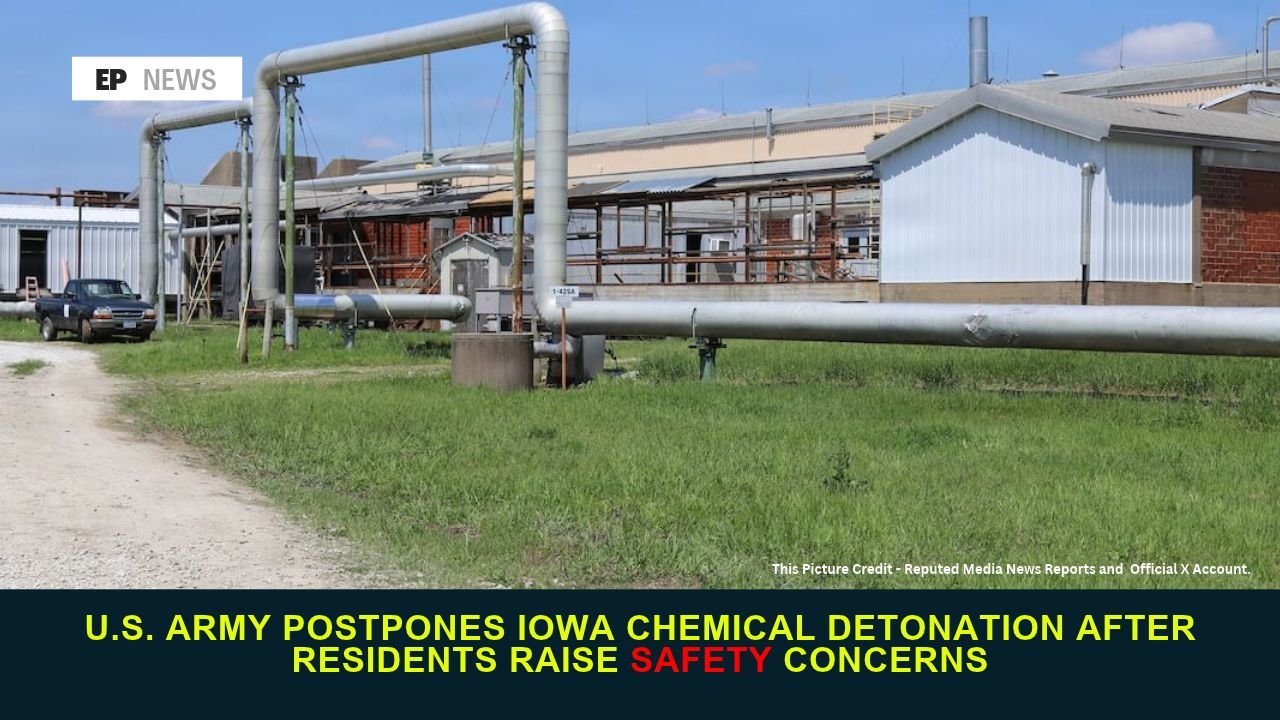
U.S. Army Delays Planned Chemical Detonation in Iowa Following Public Opposition
November 19, 2026 | U.S News
The U.S. Army has postponed a planned detonation involving several tons of unstable lead azide at an ammunition facility in Iowa after residents, environmental groups and state officials raised concerns about potential safety and environmental consequences.
The operation had originally been scheduled for Friday, November 20, at the Iowa Army Ammunition Plant in Middletown.
However, the Army announced that the detonation would be postponed until Monday, following growing public opposition and legal challenges.
The decision has attracted attention because the material involved is unstable and can present serious handling risks.
Residents are concerned that an explosion could release lead-containing particles into the surrounding environment.
The Army has maintained that the chemicals require urgent treatment because leaving them untreated or attempting to move them could create additional dangers.
The disagreement highlights the difficult balance between managing hazardous military materials and protecting nearby communities.
What Is Lead Azide and Why Is It Dangerous?
Lead azide is a chemical compound used in certain explosive applications.
It is sensitive to physical disturbance and can become dangerous if handled improperly.
The material involved in the Iowa operation had reportedly deteriorated, increasing concerns about its stability.
The Army has argued that the degraded chemicals could accidentally explode if they are moved or left untreated.
This creates a difficult situation for officials.
Any operation involving unstable explosive material must be planned carefully to reduce the possibility of accidental detonation.
However, controlled destruction can also create environmental and safety concerns for people living nearby.
The operation therefore requires specialized technical planning and coordination with relevant authorities.
Why Residents Opposed the Planned Operation
Local residents raised concerns about the possibility of lead contamination during the planned detonation.
Lead is a toxic metal that can cause serious health problems when people are exposed to it.
Children are particularly vulnerable to lead exposure because it can affect neurological development.
Environmental groups also questioned whether the Army had adequately considered alternative methods of dealing with the material.
Their concerns included the possibility that explosive activity could send lead-containing particles into the air and onto nearby surfaces.
The issue is particularly sensitive for residents who live close to the ammunition facility.
The Army’s proposed operation also led some schools and businesses to adjust their plans.
Some Middletown residents were advised to leave temporarily because the expected vibrations could potentially break windows.
Why the Army Says the Detonation Is Necessary
The Army has argued that the degraded chemical material presents a danger if it remains untreated.
According to AP reporting, officials said that moving the material could create additional risks.
The Army also indicated that experts had developed a detonation plan and that the Environmental Protection Agency had approved an emergency permit.
Officials have considered other possible approaches, including chemical treatment.
However, the Army has raised concerns that alternative methods could make the handling process more dangerous.
This is the central disagreement.
Military officials must reduce the risk posed by unstable explosive material.
Residents and environmental organizations want assurance that the selected method will not create unnecessary exposure to hazardous substances.
What Changes After the Postponement?
The immediate change is the postponement of the operation from Friday to Monday.
This provides additional time for officials and the surrounding community to consider safety concerns.
However, postponement does not mean the Army has permanently canceled the operation.
The Army still considers the material a potential hazard.
Residents therefore remain concerned about what will happen next.
Environmental groups have also pursued legal action, arguing that safer alternatives and better public notification should have been considered.
The legal dispute could influence the timing and conditions of any future operation.
What Residents Should Understand About Lead Exposure
Lead exposure can occur through contaminated dust, soil and other materials.
The health effects depend on the level and duration of exposure.
Children are especially vulnerable because lead can affect brain development and learning.
Adults can also experience health problems following significant exposure.
The Army’s planned safety measures and public guidance are therefore important.
According to AP reporting, residents were advised to stay indoors, close windows and doors, bring animals inside and clean outdoor surfaces after the planned operation.
People living in the affected area should follow official instructions from local authorities and public health agencies rather than relying on speculation or social media claims.
Why the Case Raises Broader Questions About Military Facilities
The Iowa situation demonstrates that military installations can create environmental and public safety challenges for nearby communities.
Ammunition plants and other defense facilities may store hazardous materials for long periods.
Those materials require monitoring, maintenance and appropriate disposal procedures.
The Army must balance national security responsibilities with the safety of people living near its facilities.
Public communication is also important.
Residents need clear information about what is planned, why it is necessary and what protective measures are being implemented.
When communities believe they have not received adequate information, public trust can deteriorate.
Frequently Asked Questions
1. Where was the planned detonation scheduled?
At the Iowa Army Ammunition Plant in Middletown, Iowa.
2. Why was the operation postponed?
The Army postponed it after public safety and environmental concerns were raised by residents, state officials and environmental groups.
3. What chemical material was involved?
The operation involved unstable lead azide.
4. When was the operation rescheduled?
The Army postponed the Friday operation until Monday, November 23, 2026.
5. Does the postponement mean the operation is canceled?
No. The announcement was a postponement, not a permanent cancellation.
Conclusion
The Army’s decision to delay the Iowa chemical detonation reflects the seriousness of the safety concerns surrounding unstable explosive materials.
Military officials argue that the chemicals must be handled to prevent an accidental explosion, while residents and environmental organizations want stronger protections against potential lead contamination.
The coming days will be important as officials determine the next steps.
For the surrounding community, transparent communication, appropriate safety measures and clear public health guidance will remain essential.
Source – AP News