
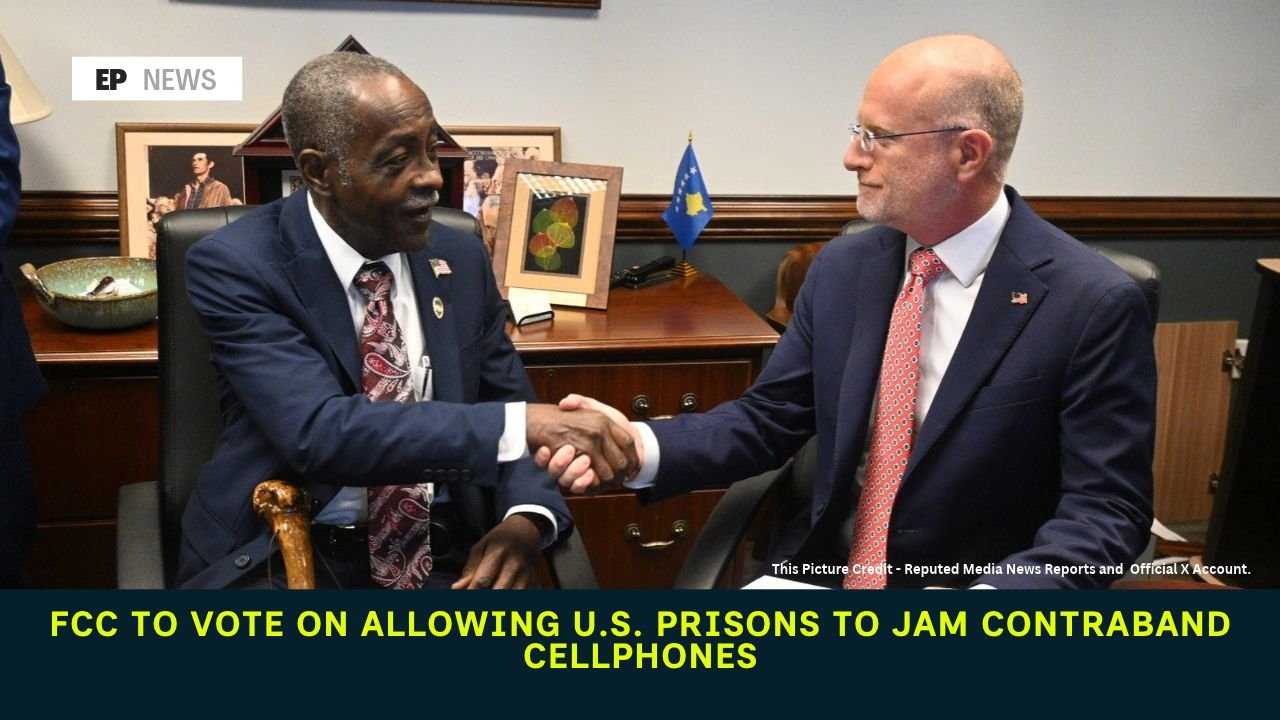
FCC to Vote on Prison Cellphone Jamming Rules
Reporting Date: November 19, 2026
Category: U.S. News | Technology | Public Safety
The Federal Communications Commission is preparing to vote on a major proposal that could allow state and local prisons across the United States to block cellphone signals from devices illegally smuggled into correctional facilities.
The proposal, scheduled for consideration at the FCC’s open meeting on Thursday, November 19, would authorize approved radio-frequency jamming systems in limited prison settings. The technology is intended to prevent incarcerated individuals from using unauthorized mobile phones to coordinate criminal activities, arrange drug deliveries, threaten victims or organize violence from behind bars.
The issue has attracted support from prison officials, law enforcement agencies and state attorneys general. They argue that contraband cellphones have become a serious security problem because inmates can communicate with people outside prison walls without using monitored correctional communication systems.
However, the proposal has also raised concerns about the potential impact on legitimate mobile communications. Prisoners’ rights advocates argue that expensive official phone services can make unauthorized devices more attractive to inmates seeking contact with their families. Telecommunications companies have also warned that poorly designed jamming systems could interfere with mobile networks, emergency calls and communications outside prison facilities.
FCC Chairman Brendan Carr has indicated that the agency is ready to move forward with a more targeted approach.
The commission’s November 19 meeting is scheduled to begin at 10:30 a.m. Eastern Time. As of the time of this report, the vote had not yet taken place, and the final outcome remained unknown.
What Is the FCC Planning to Approve?
The FCC is considering a Report and Order under the proceeding titled Combatting Contraband Wireless Device Use in Correctional Facilities, identified as GN Docket No. 13-111.
The proposed action would authorize non-federal operation of radio-frequency jamming solutions in the limited context of correctional facilities, subject to applicable federal law.
This matters because state and local correctional facilities have historically faced significant legal restrictions on operating cellphone jammers.
Federal law generally prohibits the intentional interference with authorized radio communications. As a result, state prison authorities have not been able to freely deploy traditional signal-jamming systems, even when they believe the technology could improve security.
The FCC’s proposal seeks to establish a regulatory framework that could allow eligible facilities to use approved equipment under specific conditions.
The commission is also considering a further notice seeking additional public comment on a proposed framework involving unlicensed spectrum, satellite communications and potential safeguards.
Importantly, the proposal would allow eligible facilities to seek authorization. It would not automatically require every state prison or local jail to install signal-jamming equipment.
Why Are Contraband Cellphones a Serious Problem in American Prisons?
Correctional officials say unauthorized mobile phones have become a major challenge for prison security.
Unlike official prison communication systems, contraband cellphones can allow inmates to contact people outside the facility without the same monitoring and restrictions.
Authorities say these devices have been used for activities including:
- Coordinating drug trafficking operations.
- Communicating with criminal organizations outside prison.
- Organizing gang activity and prison disturbances.
- Threatening witnesses, victims and correctional employees.
- Arranging violent attacks outside prison walls.
- Continuing criminal operations while serving prison sentences.
According to FCC Chairman Brendan Carr, approximately 25,000 contraband cellphones are confiscated annually in state and local correctional facilities.
That figure illustrates the scale of the problem identified by correctional authorities. However, confiscation numbers do not mean that every seized phone was used to organize serious criminal activity.
Officials say the devices can enter prisons through several methods.
Some phones are allegedly smuggled in by visitors or corrupt employees. Others have been concealed inside packages, food containers and objects delivered to correctional facilities.
Authorities have also reported cases involving drones dropping prohibited items into prison compounds.
Once a cellphone reaches an inmate, it may be difficult for correctional officers to identify and disable it immediately.
Prison officials therefore argue that preventing the device from connecting to mobile networks could provide an additional security measure.
How Would Cellphone Jamming Technology Work?
Cellphone jamming technology works by transmitting radio-frequency signals designed to prevent nearby devices from communicating with mobile networks.
A conventional cellphone connects to a nearby wireless network using radio signals. A jamming system creates interference that can prevent the phone from establishing or maintaining that connection.
In a prison environment, the goal would be to prevent unauthorized devices inside designated areas from making calls, sending messages or accessing mobile data.
The technology is different from simply confiscating a cellphone.
Confiscation requires correctional officers to locate the device, identify its user and physically remove it. Signal jamming could prevent a device from communicating even if officers have not yet discovered where it is hidden.
However, the technology must be carefully engineered.
If a jammer operates beyond its intended coverage area, it could interfere with legitimate phones belonging to correctional employees, visitors, nearby residents or emergency responders.
That is why the FCC’s proposed framework focuses on limiting jamming to authorized correctional environments.
The commission’s earlier regulatory work has also emphasized the need for technical protections to prevent harmful interference with legitimate wireless services.
Why South Carolina Is Central to the Debate
South Carolina has been one of the most active states pushing for permission to use cellphone jamming technology in correctional facilities.
The state has conducted tests and worked with federal officials to demonstrate how targeted jamming systems could operate inside prisons.
In 2008, the FCC authorized a one-time test of a jamming system at a maximum-security prison in South Carolina.
The briefcase-sized equipment used during the test emitted radio-frequency interference that blocked cellphone connections within a designated indoor area. Officials reported that mobile service outside the testing location remained available.
Another test took place in 2019 at a different state correctional facility.
South Carolina’s interest in the issue is also connected to a deadly prison riot in 2018 at Lee Correctional Institution.
Seven inmates died during the violence, which authorities said involved gang activity and the use of contraband cellphones.
Correctional officials have cited such incidents as examples of how unauthorized communications can create security risks inside prisons.
On November 18, South Carolina Attorney General Alan Wilson joined FCC Chairman Brendan Carr, state correctional officials and law enforcement representatives in publicly urging the commission to approve the proposed rules.
The announcement demonstrated the continued support of state officials who believe that signal jamming could help prevent crimes coordinated from inside correctional facilities.
What Happened to Correctional Officer Robert Johnson?
The debate has also been influenced by the experience of former South Carolina corrections officer Robert Johnson.
In 2010, Johnson was shot multiple times at his home in an attack that officials said had been arranged by an inmate using a smuggled cellphone.
Johnson survived the shooting and later became an advocate for stronger measures to prevent contraband phones from being used inside prisons.
His experience has been cited by South Carolina officials as an example of the potential danger posed by unauthorized communications.
Correctional authorities argue that inmates should not be able to use hidden mobile devices to arrange attacks against prison employees and other people outside correctional facilities.
The case has helped make cellphone jamming a public-safety issue rather than simply a matter of prison discipline.
Nevertheless, the effectiveness of any new system will depend on its technical design, the ability to contain interference and the way correctional facilities implement the rules.
Why Prisoners’ Rights Advocates Oppose the Proposal
Not everyone supports the FCC’s plan.
Prisoners’ rights organizations have raised concerns about the consequences of using signal jamming inside correctional facilities.
One argument is that the availability and cost of official prison phone services can influence why inmates seek unauthorized devices.
Some correctional facilities charge inmates significant amounts for phone calls and other communication services.
Advocates argue that making legitimate communication expensive or difficult can increase the incentive to obtain contraband cellphones.
They believe correctional authorities should also examine the policies governing prison communication, including pricing, access to family members and the availability of affordable alternatives.
Another concern involves the potential impact on incarcerated individuals who rely on regular communication with children, spouses, parents and other family members.
Even when a cellphone is unauthorized, advocates argue that broad signal restrictions could affect people who are not involved in criminal activity.
They also question whether jamming addresses the underlying problem of how phones enter correctional facilities in the first place.
From this perspective, better screening, stronger employee oversight and improved security at prison entry points should remain important parts of any solution.
Could Cellphone Jamming Affect Emergency Calls?
One of the most important technical questions involves emergency communications.
Cellphone networks are used not only for personal conversations but also for emergency calls and public-safety coordination.
If a jamming system affects signals beyond the prison’s authorized area, it could potentially prevent nearby people from contacting emergency services.
This is one reason telecommunications companies and public-safety organizations have expressed concern about poorly designed systems.
The FCC’s earlier regulatory documents specifically recognized the possibility that radio-frequency jamming could affect authorized users outside correctional facilities or permitted areas inside them.
The agency has therefore considered safeguards involving technical testing, equipment authorization and restrictions on where jamming systems can operate.
Its September 2025 fact sheet also discussed concerns involving emergency and 911 calls, wireless carrier networks and public-safety communications.
The November 19 proposal is intended to establish a controlled framework rather than permit unrestricted signal interference.
However, the precise effectiveness of those safeguards will depend on the final rules and the performance of individual systems.
What Restrictions Could Apply to Prison Jamming Systems?
The FCC’s proposal and earlier regulatory documents describe a framework designed to keep jamming technology within correctional facilities.
The proposed approach includes several important considerations.
Authorized correctional locations: Jamming would be limited to correctional facilities and designated areas where unauthorized wireless devices are prohibited.
Technical equipment standards: Systems would need to meet applicable FCC requirements and demonstrate that they can operate within approved technical limits.
Testing before deployment: Experimental and site-specific testing may be required to assess whether a system can contain interference within the authorized area.
Coordination with wireless providers: The regulatory framework considers the role of mobile carriers in the licensing and deployment process.
Public-safety protections: Emergency services, 911 authorities and public-safety communication systems are important considerations in the FCC’s proposed safeguards.
The final requirements will depend on the order adopted by the commission.
The November 19 meeting also includes consideration of a further notice seeking comment on additional technical and regulatory questions.
This means the commission’s action could establish an initial authorization framework while leaving some implementation questions open for further public input.
Why Telecommunications Companies Have Raised Concerns
Wireless carriers have historically opposed broad cellphone-jamming authority because radio-frequency interference can affect legitimate customers.
Mobile networks operate across areas that include homes, roads, businesses, public buildings and correctional facilities.
A jamming system that is not properly contained could affect people who are not connected to prison activities.
For example, a resident living near a correctional facility might experience disrupted mobile service if a system operates outside its intended boundaries.
The same concern applies to employees, visitors and emergency responders.
Wireless industry opposition has therefore focused on the need for precise engineering, clear licensing rules and protection for legitimate communications.
FCC Chairman Brendan Carr said on November 18 that opposition from the telecommunications industry had receded substantially.
He emphasized that the commission was considering jamming only in the specific context of correctional facilities.
That statement suggests that the agency believes it can establish a more targeted approach than the unrestricted use of signal-blocking equipment.
However, the final rules and their practical impact will need to be assessed after the commission’s action and subsequent implementation.
What Is the FCC Expected to Decide on November 19?
The commission’s open meeting is scheduled to begin at 10:30 a.m. Eastern Time on Thursday, November 19, 2026.
The agenda includes a Report and Order concerning contraband wireless devices in correctional facilities.
The commission is also scheduled to consider a further notice seeking comments on additional issues involving jamming technology and safeguards.
The immediate question is whether commissioners will approve a framework allowing non-federal correctional facilities to operate approved jamming systems.
If the proposal is adopted, it could create a new option for state and local prison authorities.
However, approval would not mean that every prison could immediately switch on a jammer. Facilities would still need to comply with the applicable authorization, technical and safety requirements.
If commissioners make changes to the proposal or request additional work, the implementation process could take longer.
As of the reporting time on November 19, the vote had not yet taken place. Readers should not interpret the scheduled meeting as confirmation that the rules have already been approved.
What Could This Mean for U.S. Prison Security?
If the FCC approves the framework, prison authorities could gain an additional tool for controlling unauthorized communications.
Supporters believe the technology could reduce the ability of inmates to organize criminal activity through hidden mobile phones.
It could also make it harder for individuals to use unauthorized devices to threaten victims, coordinate outside operations or arrange attacks.
However, signal jamming alone would not eliminate contraband.
Phones could still be smuggled into facilities, and inmates might attempt to use other communication methods.
Correctional authorities would continue to need searches, intelligence gathering, staff oversight, visitor screening and security improvements.
The proposal is therefore best understood as one potential part of a broader prison-security strategy.
Its success will depend on whether approved systems can block unauthorized devices without affecting legitimate communications or creating new safety problems.
Conclusion: FCC Decision Could Change Prison Security Technology
The FCC’s November 19 vote could mark an important development in the long-running effort to stop inmates from using illegally smuggled cellphones inside American prisons.
Supporters argue that unauthorized phones have enabled drug operations, gang communications, threats and violence beyond prison walls.
Opponents warn that jamming systems could interfere with legitimate mobile service, affect emergency communications and make it harder for incarcerated people to remain in contact with their families.
The proposed rules attempt to balance these competing concerns by limiting the technology to approved correctional environments and requiring safeguards.
The outcome of the commission’s vote will determine whether state and local correctional authorities gain access to this additional security option.
As of November 19, the FCC meeting was still scheduled to take place later in the day. The final decision and implementation details had not yet been confirmed.
Frequently Asked Questions (FAQs)
1. What is the FCC voting on November 19, 2026?
The FCC is scheduled to consider rules that would authorize approved radio-frequency jamming systems in state and local correctional facilities to block signals from contraband cellphones.
2. Why do U.S. prisons want to jam cellphone signals?
Correctional officials say inmates use smuggled phones to coordinate drug operations, gang activity, threats, prison disturbances and other criminal activities.
3. Will every prison be required to install jamming equipment?
No. The proposal would allow eligible correctional facilities to seek authorization. It would not automatically require every prison or jail to install the technology.
4. Can cellphone jamming affect people outside prisons?
Yes, poorly designed systems could interfere with legitimate mobile communications outside a correctional facility. This is why the FCC is considering technical restrictions and safeguards.
5. How many contraband cellphones are confiscated in U.S. prisons?
FCC Chairman Brendan Carr has cited approximately 25,000 confiscated phones annually in state and local correctional facilities.
6. Why do some groups oppose cellphone jamming?
Prisoners’ rights advocates are concerned about family communication, expensive official phone services and the possibility of interference with legitimate mobile networks.
7. What happened in South Carolina that increased support for jamming?
South Carolina officials have cited a deadly 2018 riot at Lee Correctional Institution and other incidents involving contraband phones as reasons for supporting stronger restrictions.
8. Will cellphone jamming block 911 calls?
The risk of interference with emergency communications is an important technical concern. The FCC’s proposed framework includes safeguards intended to limit interference, but the final rules and their implementation will determine how these protections work.
9. When will the FCC vote take place?
The open meeting is scheduled for November 19, 2026, at 10:30 a.m. Eastern Time.
10. Has the FCC already approved prison cellphone jamming?
Not as of the reporting time for this article on November 19, 2026. The commission’s vote was still scheduled for later that day.
Note: This article reflects information available before the FCC’s scheduled November 19, 2026, open meeting. Update the article after the meeting to report whether the commission approved, modified or delayed the proposal. Do not describe the proposed rules as already implemented.