
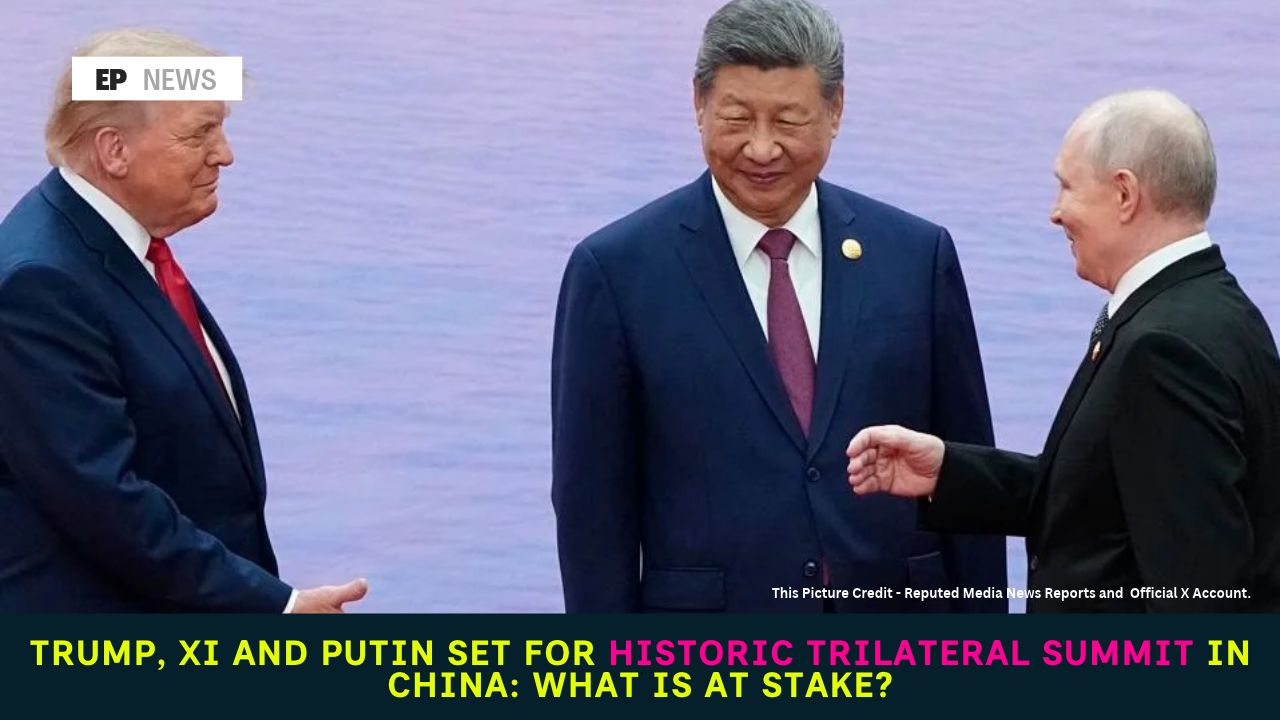
Trump, Xi and Putin Set for Historic Trilateral Summit in China: What Is at Stake?
November 19, 2026 | U.S News
The leaders of the United States, China and Russia are preparing for an unprecedented diplomatic meeting in Shenzhen, China, on November 19, 2026. President Donald Trump, Chinese President Xi Jinping and Russian President Vladimir Putin are scheduled to participate in a trilateral summit during the Asia-Pacific Economic Cooperation (APEC) gathering.
The meeting brings together the leaders of three major nuclear powers at a time when international tensions remain high. The wars involving Iran and Ukraine, disagreements over global trade, competition in advanced technology and the future of nuclear arms control are all important issues surrounding the gathering.
The summit is particularly significant because Washington, Beijing and Moscow have different priorities. Trump has expressed interest in reducing nuclear weapons, while Putin wants to advance Russia’s interests in Ukraine. China, meanwhile, has traditionally resisted joining nuclear-arms negotiations on the same terms as the United States and Russia.
Although the meeting could create an opportunity for direct communication between the three governments, analysts have cautioned against expecting immediate agreements.
As of the morning of November 19, the trilateral meeting was scheduled to take place later in the day. No final agreement or joint statement had been confirmed.
When and Where Will Trump, Xi and Putin Meet?
The meeting is scheduled for Thursday, November 19, in Shenzhen, a major technology and business center in southern China.
China’s Foreign Ministry officially announced on November 16 that Xi Jinping would host a China-Russia-U.S. summit with Trump and Putin.
The gathering is taking place on the sidelines of the APEC leaders’ meeting.
The three leaders have already arrived in Shenzhen for the broader diplomatic events. Their public appearance together at the APEC welcome activities on November 18 attracted international attention.
Trump and Putin were seen greeting each other and shaking hands, while Xi also welcomed the visiting U.S. president.
The trilateral gathering is being described as an unusual diplomatic event because it brings together the heads of government of the world’s three largest nuclear powers in one formal meeting.
Trump is also expected to hold separate discussions with Putin and Xi, giving the leaders opportunities to address bilateral disagreements alongside the wider three-country meeting.
However, the exact outcome of the discussions remains uncertain.
Why Is This Summit Considered Historically Important?
The United States, China and Russia have major influence over international security, economic policy, military competition and diplomatic negotiations.
Their decisions can affect countries far beyond their own borders.
The three governments have also experienced significant disagreements over recent years.
The United States and China have competed over technology, trade restrictions, tariffs and access to critical minerals. Washington and Moscow remain divided over Russia’s war in Ukraine, sanctions and European security. China and Russia have strengthened their strategic relationship, creating additional concerns among some U.S. and European policymakers.
Bringing all three leaders together creates an opportunity to discuss these issues directly.
The gathering has also attracted comparisons with the 1945 Yalta Conference, where the leaders of the United States, Britain and the Soviet Union discussed the postwar international order.
However, the historical comparison should not be taken too literally. The Shenzhen meeting has a different diplomatic setting, and no evidence indicates that the three leaders have agreed to divide the world into political spheres of influence.
The summit’s importance lies primarily in the opportunity for direct negotiations between governments that have considerable influence over global affairs.
Nuclear Arms Control Could Be a Major Topic
One of Trump’s stated priorities for the meeting is reducing nuclear weapons.
The United States and Russia possess the world’s two largest nuclear arsenals, while China has been expanding its own nuclear capabilities.
Trump has expressed interest in a broader agreement that could involve all three countries.
The challenge is that China and the United States have different views about how such negotiations should begin.
Beijing has argued that the United States and Russia possess significantly larger nuclear stockpiles and should take the lead in reducing their arsenals before China joins comparable restrictions.
Washington, meanwhile, has argued that any future framework should account for China’s growing nuclear capabilities.
Another complication is the expiration of the New START treaty, the last major nuclear arms-control agreement between Washington and Moscow.
The treaty expired in February 2026, leaving the two countries without that existing framework for limiting their deployed strategic nuclear weapons.
The absence of the agreement has increased concerns about the future of nuclear arms control.
A trilateral discussion could help establish communication, but reaching a legally binding agreement would require difficult negotiations over verification, limits, military capabilities and national security priorities.
A single summit is unlikely to resolve all these issues.
Iran War Adds Another Layer of Complexity
The conflict involving Iran is another important issue surrounding the leaders’ discussions.
The United States has been directly involved in the conflict, while China and Russia have their own diplomatic, economic and strategic interests in the Middle East.
Trump is expected to raise the Iran situation during discussions with the other leaders.
For Washington, the conflict involves regional security, military operations and the stability of important energy routes.
China has major economic interests in the region, particularly because of its energy imports and trade relationships.
Russia also has strategic interests in maintaining influence across the Middle East.
However, their approaches toward the conflict are not necessarily aligned with Washington’s position.
The leaders may use the opportunity to discuss regional stability and the possibility of reducing further escalation.
It is important to distinguish between discussions and actual agreements. No confirmed ceasefire arrangement or final settlement should be assumed simply because the three leaders are meeting.
Ukraine War Remains a Difficult Issue
Russia’s ongoing war in Ukraine remains one of the most difficult subjects in relations between Washington and Moscow.
Putin is expected to seek discussions that advance Russia’s position in the conflict.
Trump has repeatedly expressed interest in ending the war, but negotiations have faced major obstacles involving territory, security guarantees and the political future of Ukraine.
Ukraine and several European governments are concerned that discussions among major powers could affect their security without giving Kyiv an adequate role.
The possibility of the United States, Russia and China discussing Ukraine has therefore attracted attention beyond the three countries.
China has previously presented itself as a potential diplomatic participant while maintaining a close strategic relationship with Russia.
European leaders have emphasized that Ukraine must be involved in decisions about its own future.
As of November 19, there was no confirmed agreement from the Shenzhen summit that would settle the war or establish a new peace framework.
The meeting may provide an opportunity for Trump and Putin to discuss their differences, but any meaningful settlement would require broader negotiations and the involvement of the parties directly affected.
U.S.-China Trade and Technology Disputes
Trade and technology are also important parts of the wider diplomatic relationship between Washington and Beijing.
The United States has imposed restrictions on certain advanced technologies and semiconductor exports because of national security concerns.
China, meanwhile, has strengthened controls over some critical mineral exports and has continued to develop its domestic technology industry.
Agricultural purchases and rare-earth supplies are also part of the economic discussions between the two countries.
The existing U.S.-China trade truce is due to expire in January 2027, making the November meeting particularly important for both governments.
U.S. officials have argued that China has not fully met certain purchasing and export-related commitments.
Beijing has also objected to American trade restrictions and technology controls.
The two countries have strong economic reasons to avoid a major escalation. Their trade relationship affects manufacturers, technology companies, agricultural producers and consumers across the world.
However, the leaders have not announced a final trade agreement for the Shenzhen summit.
Any new understanding would likely require further discussions among trade officials and economic advisers.
Why China Is Cautious About Nuclear Negotiations
China’s participation in a trilateral nuclear meeting does not necessarily mean that Beijing is ready to accept the same arms-control limits as Washington and Moscow.
China’s position has traditionally been that the United States and Russia should first reduce their much larger nuclear arsenals.
Beijing argues that the three countries do not begin negotiations from equal positions.
The United States and Russia have decades of experience with bilateral nuclear-arms agreements, while China has not participated in the same type of legally binding framework.
This difference creates a major challenge for Trump’s proposal.
Washington wants China to be included in future discussions because its nuclear capabilities are growing. Beijing does not want to accept restrictions that it considers unfair.
A successful negotiation would therefore need to address differences in arsenal size, security concerns, verification systems and the strategic priorities of all three governments.
The Shenzhen meeting could help clarify these positions, but it does not guarantee progress toward a new treaty.
What Are the Concerns of Ukraine and European Allies?
The summit has also raised concerns among Ukraine and European governments.
Their main concern is that major powers could discuss issues affecting European security without sufficient participation from European countries or Ukraine itself.
For Ukraine, the most sensitive issue is the future of its territory and national security.
Kyiv has consistently argued that any agreement concerning the war must respect Ukraine’s sovereignty and include Ukrainian participation.
European governments are also concerned about the broader security consequences of any possible understanding between Washington and Moscow.
The relationship between Trump and Putin has attracted particular attention because the two leaders have previously met in Alaska in August 2025.
The new meeting in China provides another opportunity for direct communication.
However, diplomatic contact does not automatically mean that Washington and Moscow have resolved their disagreements.
European leaders will be watching closely for any statements about Ukraine, sanctions and future security arrangements.
Could the Summit Change Global Politics?
The Shenzhen meeting could influence international diplomacy, but its long-term importance will depend on what happens after the leaders leave the negotiating table.
There are several possible areas where the discussions could matter:
- Nuclear security: The leaders could establish a basis for further discussions on strategic weapons and arms control.
- Middle East stability: They could exchange positions on Iran and the wider regional conflict.
- Ukraine negotiations: Trump and Putin could clarify their positions on possible diplomatic steps.
- Trade relations: Washington and Beijing could seek to prevent further escalation before the current trade truce expires.
- Strategic communication: The meeting could create additional channels for direct contact between the three governments.
Even if the summit produces no major agreement, direct discussions may help reduce misunderstandings and clarify the priorities of the three countries.
On the other hand, significant differences over nuclear weapons, Ukraine, Iran and trade could limit what the leaders can achieve.
The meeting should therefore be viewed as an important diplomatic opportunity rather than a guaranteed turning point in global politics.
What Happens After the November 19 Meeting?
The next important development will be the official statements released by the governments after the summit.
Observers will look for information about whether the leaders agreed to continue nuclear-arms discussions, established new diplomatic channels or made progress on trade and regional security.
A joint statement, if issued, could provide insight into areas of agreement and disagreement.
If no joint statement is released, each government may communicate its own interpretation of the discussions.
The United States, China and Russia will also need to decide whether their foreign ministries and security officials should continue negotiations on specific subjects.
For any agreement to become meaningful, it will need follow-up meetings, technical discussions and clearly defined commitments.
Until those details are confirmed, it would be premature to describe the summit as a diplomatic breakthrough.
Conclusion
The November 19 meeting between Donald Trump, Xi Jinping and Vladimir Putin in Shenzhen represents an unusual moment in international diplomacy.
The three leaders are gathering at a time when nuclear security, the Iran conflict, Russia’s war in Ukraine and U.S.-China trade disputes are creating major international challenges.
Trump wants to advance discussions on nuclear arms control, while Xi and Putin have their own strategic priorities.
The meeting could create opportunities for direct communication, but the differences between the three governments are substantial.
For now, the world will be watching to see whether the historic gathering produces concrete diplomatic progress or remains primarily an opportunity for high-level discussions.
The real significance of the summit will depend not only on what the leaders say in Shenzhen, but also on the actions and negotiations that follow.
Frequently Asked Questions (FAQs)
1. When are Trump, Xi and Putin meeting?
The three leaders are scheduled to meet on November 19, 2026, in Shenzhen, China, during the Asia-Pacific Economic Cooperation gathering.
2. Why are Trump, Xi and Putin meeting?
The summit provides an opportunity to discuss nuclear arms control, international security, the Iran conflict, Ukraine and major-power relations.
3. Is this the first trilateral summit involving the three leaders?
Yes. The November 19 gathering is being described as the first formal trilateral summit involving the leaders of the United States, China and Russia.
4. Will the leaders discuss nuclear weapons?
Nuclear arms control is one of Trump’s stated priorities. However, the three countries have different positions on how a future agreement should be structured.
5. Will the Ukraine war be discussed?
Ukraine is an important issue surrounding the summit, although the precise scope of the trilateral discussions has not been confirmed.
6. Will the summit end the Iran conflict?
There is no confirmed agreement that the meeting will end the conflict. The leaders may discuss the situation, but a diplomatic settlement would require further negotiations.
7. Where is the summit taking place?
The meeting is scheduled in Shenzhen, a major technology and economic center in southern China.
8. Has a major agreement been announced?
As of the morning of November 19, no final agreement from the scheduled trilateral meeting had been confirmed.
Sources and References
- Associated Press – Reporting on the Trump-Xi-Putin meeting and nuclear arms control.
- Reuters – Reporting on Trump’s Asia tour and the leaders’ diplomatic priorities.
- China’s Ministry of Foreign Affairs – Official announcement of the November 19 trilateral summit.
- Yonhap News Agency – Reporting on the summit schedule and possible diplomatic outcomes.
- CBS News – Background on the White House and Kremlin confirmation of the meeting.