Fed Holds Rates Steady as Three Officials Revolt — Markets Swing Wildly, Then Rebound
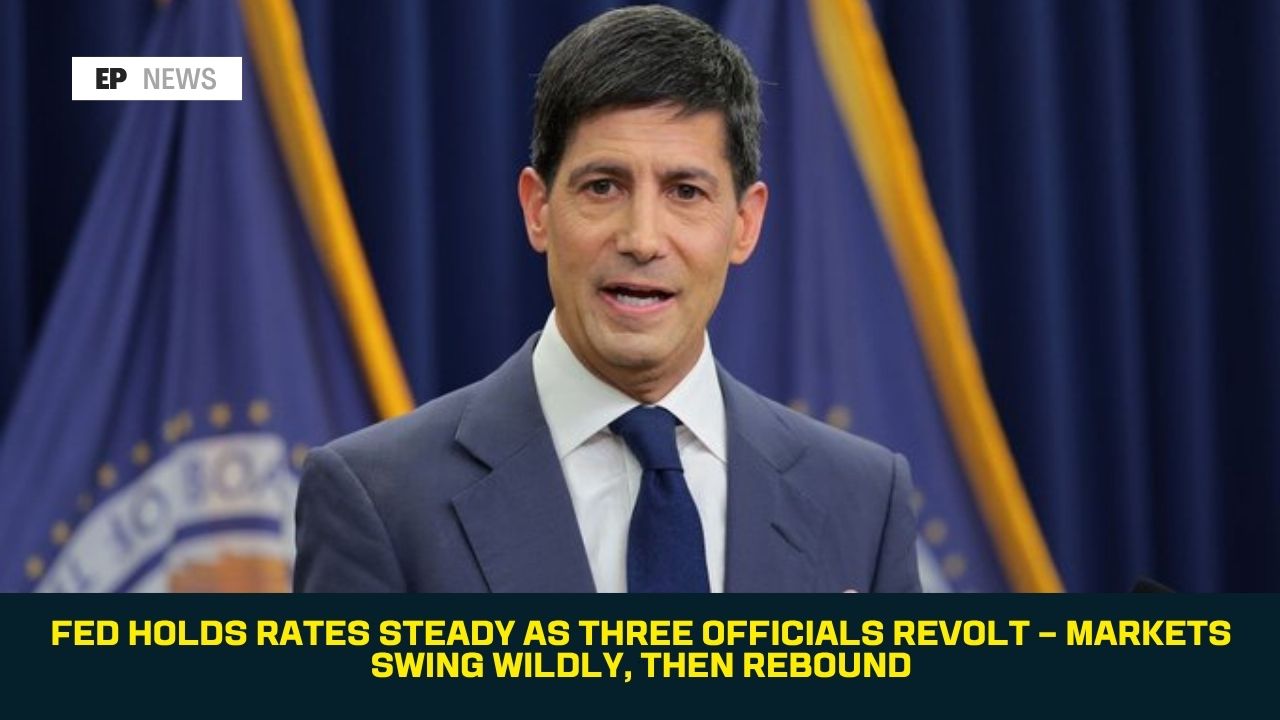
The Federal Reserve left interest rates unchanged on July 29, 2026, but the decision was anything but routine. Three regional Fed presidents broke ranks to demand a rate hike, marking the most internal opposition a sitting Fed chair has faced in the early going of his tenure since 1970. Wall Street responded with a sharp sell-off — then, less than 24 hours later, staged one of its strongest rebounds of the year.
What the Fed Actually Decided
The Federal Open Market Committee voted 9-3 to hold the benchmark federal funds rate in its current range of 3.5% to 3.75%. It was the second rate decision under Chairman Kevin Warsh, who took over the central bank earlier this year.
Three regional Fed presidents — Beth Hammack of Cleveland, Neel Kashkari of Minneapolis, and Lorie Logan of Dallas — dissented, each preferring to raise the federal funds rate by a quarter percentage point instead. According to the Fed’s post-meeting statement, all three cited inflation that has remained above the central bank’s 2% target for more than five years.
It marked a sharp reversal from June, when the committee’s decision to hold rates was unanimous.
A Rare Show of Dissent
Three officials dissenting with a single, unified preference — all wanting to raise rates — hadn’t happened at the Fed since September 2016, according to Fed watchers cited by CNBC. Separately, U.S. News reported that the early dissents against Warsh represent the most pushback a new Fed chair has encountered since 1970, based on data on Fed leadership going back decades. For comparison, Warsh’s predecessor Jerome Powell didn’t face his first dissent until his 11th meeting as chair, in June 2019.
Warsh, who has deliberately pulled back on offering forward guidance about the Fed’s next moves, described the internal debate as a “good family fight” — a phrase he has now used repeatedly in public remarks. “That’s the purpose. That’s the design feature,” he told reporters after the meeting, framing open disagreement among policymakers as healthy rather than alarming.
Asked whether the Fed’s decision amounted to a “pause,” Warsh pushed back on the characterization, saying the committee had instead conducted what he called a rigorous review of the economic situation, with more work ahead before the next meeting.
Why the Hawks Wanted a Hike
Officials favoring tighter policy pointed to inflation that has stayed persistently above target and hasn’t shown clear signs of easing. Recent price pressure has been linked in part to tariffs, and analysts told CNBC that the hawkish dissents were also likely intensified by the recent flare-up in Middle East hostilities, which has kept oil prices elevated and added to inflation concerns.
Going into the meeting, markets had largely expected a hold, though CME Group’s FedWatch tool showed traders had priced in roughly a 1-in-3 chance of a surprise hike — a sign of just how divided expectations were heading into decision day.
Markets Whipsaw, Then Snap Back
Stocks fell hard in the immediate aftermath. The Dow Jones Industrial Average tumbled 1,153.18 points, or 2.19%, to close at 51,594.14 — its worst single-day decline since April 2025. The S&P 500 dropped 1.52% to 7,316.15, and the Nasdaq Composite fell 1.74% to 24,442.94, ending the session more than 10% below its all-time high. The bond market moved in tandem: the 10-year Treasury yield jumped 7 basis points to above 4.67%, a signal that investors worried the Fed could be falling behind in its inflation fight.
Semiconductor stocks bore the brunt of the selling. The PHLX Semiconductor Index fell 5.3%, its fifth straight losing session, and Micron Technology shares tumbled nearly 10%. Energy stocks were the exception, climbing as oil prices rose on the Iran-related tension.
The mood reversed almost as quickly as it soured. The very next session, the Nasdaq Composite jumped 2.8% to snap a six-day losing streak, the Dow surged 613.92 points (1.2%) to 52,208.06, and the S&P 500 climbed 1.7% to 7,437.63. Microsoft was the standout, with shares surging 16% after the company reported stronger-than-expected growth from its Azure cloud business — adding roughly $450 billion to its market value in a single day, one of the largest one-day value gains for any single stock on record.
What’s Driving the Rebound
Analysts attributed the bounce-back largely to renewed confidence in the AI trade after a rough patch for chip and tech stocks. Investors were also digesting a wave of megacap earnings, with Amazon and Apple both due to report results the same week; Amazon shares jumped following its report, while Apple’s stock retreated. Elsewhere in the market, Intercontinental Exchange — the parent of the New York Stock Exchange — agreed to acquire bond-trading platform MarketAxess for roughly $5.7 billion, a deal aimed at deepening ICE’s presence in electronic fixed-income trading, in a sign that dealmaking hasn’t slowed despite the volatility.
What This Means Going Forward
The Fed’s next scheduled meeting is September 15-16, and Warsh is expected to speak beforehand at the Jackson Hole Economic Policy Symposium in August — a venue where Fed chairs have historically signaled shifts in policy thinking. Until then, investors are left parsing a central bank that is, by its own chairman’s description, still in the middle of “resolving” a set of hard questions rather than having settled them.
JPMorgan Wealth Management’s Phil Camporeale said the firm agreed with the Fed’s decision to hold, noting that despite some encouraging inflation data earlier in July, there simply wasn’t enough evidence yet to justify tightening policy — and that a lack of bargaining power among U.S. workers, combined with an assumption that the Iran conflict won’t escalate further, should keep the Fed on hold through the end of 2026.
FAQ
What is the Fed’s current interest rate? The federal funds rate remains in a target range of 3.5% to 3.75% following the July 2026 decision.
Who dissented in the Fed’s July 2026 vote? Cleveland Fed President Beth Hammack, Minneapolis Fed President Neel Kashkari, and Dallas Fed President Lorie Logan all dissented, each preferring a quarter-point rate hike.
When is the next Fed meeting? The FOMC’s next scheduled meeting is September 15-16, 2026, with Chairman Kevin Warsh expected to speak at the Jackson Hole symposium in August beforehand.
Why did stocks fall and then recover so quickly? Stocks initially sold off on concern that persistent inflation and a divided Fed could complicate the path forward for rates. The rebound was driven largely by renewed enthusiasm for AI-related tech stocks, led by Microsoft’s strong cloud earnings, along with a broader wave of positive megacap earnings reports.
Is a rate hike likely at the next meeting? The Fed has not signaled its next move; Chairman Warsh has intentionally scaled back forward guidance. Market pricing and dissent within the committee suggest the debate between holding and hiking remains unresolved.
Conclusion
The Fed’s decision to hold rates steady wasn’t the story on July 29 — the size and unity of the dissent was. Three regional presidents pushing for a hike in lockstep hasn’t happened in nearly a decade, and it’s landed early in Kevin Warsh’s tenure as chairman, at a moment when inflation, tariffs, and Middle East tensions are all pulling policy in different directions. Markets have already shown how sensitive they are to every signal — or lack of one — coming out of the Eccles Building. With the next meeting more than six weeks away and Jackson Hole in between, all eyes will be on whether Warsh’s “family fight” produces more unity or more division by September.
Sources: CNBC, Bloomberg, CNN Business, Fox Business, Forbes, U.S. News & World Report, Axios (reporting dated July 29-30, 2026).