
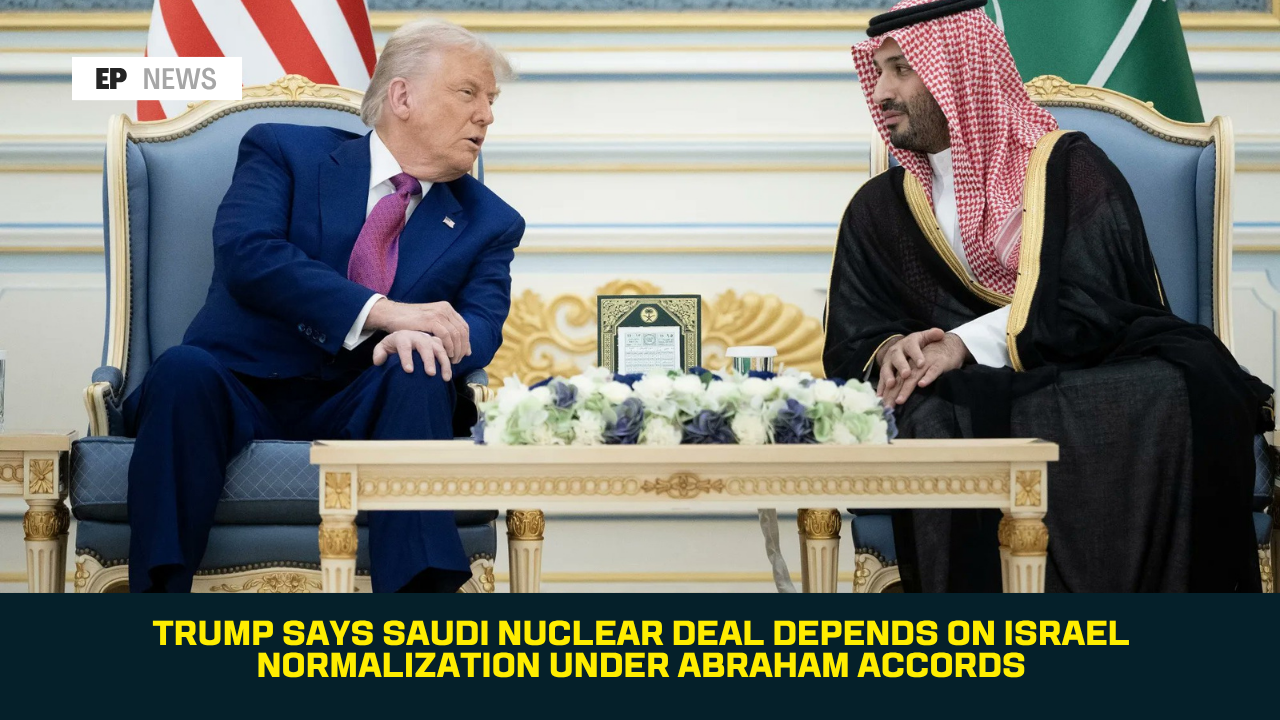
Trump Says Saudi Nuclear Deal Depends on Israel Normalization Under Abraham Accords
President Donald Trump said the United States will not proceed with a proposed civil nuclear cooperation agreement with Saudi Arabia unless the kingdom agrees to normalize diplomatic relations with Israel through the Abraham Accords. The comments, made at the White House on July 24, add a new condition to one of the administration’s most closely watched foreign policy initiatives.
The proposed agreement has drawn significant international attention because it would expand cooperation on civilian nuclear energy while also affecting the broader diplomatic landscape in the Middle East. Trump’s latest statement links the future of the agreement directly to regional normalization efforts.
What Trump Said
According to President Trump, Saudi Arabia’s participation in the Abraham Accords is now a prerequisite for completing the proposed nuclear agreement.
The president indicated that:
- The United States supports civilian nuclear cooperation.
- A final agreement will require broader diplomatic progress.
- Normalized Saudi-Israeli relations remain an important U.S. objective.
- Discussions with regional partners are continuing.
What Are the Abraham Accords?
The Abraham Accords are a series of normalization agreements between Israel and several Arab nations.
The agreements are intended to strengthen:
- Diplomatic relations.
- Regional security cooperation.
- Trade and investment.
- Scientific and technological partnerships.
- Economic development.
Saudi Arabia has not formally joined the accords, making its potential participation one of the region’s most significant unresolved diplomatic questions.
Why the Nuclear Agreement Matters
The proposed U.S.-Saudi agreement focuses on civilian nuclear energy, which can be used to generate electricity and diversify energy supplies.
Supporters say such cooperation could:
- Expand clean-energy capacity.
- Strengthen U.S.-Saudi strategic relations.
- Create opportunities for American companies.
- Promote long-term energy cooperation.
However, lawmakers and non-proliferation experts have debated what safeguards should accompany any agreement.
Regional and Global Significance
The announcement comes during a period of continued instability across the Middle East.
Diplomatic observers say the outcome could influence:
- U.S.–Saudi relations.
- Saudi–Israeli diplomacy.
- Regional security.
- Energy cooperation.
- International investment.
Because Saudi Arabia is a major global energy producer, policy developments involving the kingdom often receive close attention from governments and financial markets.
Congressional Scrutiny
Members of Congress from both parties have expressed interest in reviewing the proposed agreement, particularly its non-proliferation provisions and long-term strategic implications.
Any final arrangement could face congressional review before implementation.
What Happens Next?
Negotiations are expected to continue among U.S., Saudi, and regional officials.
Key issues include:
- Civilian nuclear cooperation.
- Diplomatic normalization.
- Security guarantees.
- Oversight and safeguards.
- Congressional review.
No final agreement has been announced.
Frequently Asked Questions
What condition did President Trump announce?
He said the United States would not move forward with the proposed Saudi civil nuclear agreement unless Saudi Arabia joins the Abraham Accords and normalizes relations with Israel.
Is the agreement finalized?
No. Discussions are continuing, and no final agreement has been signed.
Why is this important?
The proposal could influence U.S. foreign policy, Middle East diplomacy, civilian nuclear cooperation, and regional security.
Conclusion
President Trump’s latest statement adds a significant diplomatic condition to the proposed U.S.–Saudi civilian nuclear agreement. By linking the deal to Saudi Arabia’s potential participation in the Abraham Accords, the administration has tied energy cooperation to a broader regional peace initiative. As negotiations continue, governments, investors, and lawmakers will closely watch whether diplomatic progress can produce an agreement that addresses both strategic and non-proliferation concerns.